ZRDAO Whitepaper
An Art Self-Governance Community for the Silicon Age
ZRDAO is a Silicon Art decentralized autonomous organization initiated by the artist CryptoZR. Through a sixteen-year on-chain issuance, a treasury continuously replenished by the artist's works, and fully transparent on-chain governance, it is dedicated to building a global crypto-art self-governance community with the full range of functions: co-creation, collection, curation, investment, trading and incubation — redefining how art is created and collected in the Silicon Age.
Version: 1.0 | Release: July 2026 | Network: Ethereum Mainnet Genesis Issuance: 27 July 2026 (block height 25,624,800)
Press → or Space to begin
Executive Summary
What ZRDAO is: ZRDAO is a Silicon Art (crypto / artificial-intelligence / data art) decentralized autonomous organization (DAO) initiated by the artist CryptoZR's team, with contracts deployed on Ethereum Mainnet and all source code openly verified.
Core mechanism: The governance token, CryptoZR DAO Token (ZRT), has a total supply of 2.1 billion, issued publicly and entirely on-chain over 201 periods (about 16.5 years); each period is distributed pro rata to the ETH contributed by participants, with no private placement and no whitelist. The artist injects 10% of already-issued works into the treasury at launch, and thereafter continues to inject new works according to the formula 10% + 0.2% × number of completed periods.
Governance structure: For the first two years after the DAO's launch, the treasury is managed by the founding team's multi-signature wallet through a 48-hour timelock; once the system has proven stable and ZRT in circulation exceeds 20% of total issuance, control will be handed over to the on-chain governance contract, entering full self-governance. The threshold to submit a proposal is 1% of total issuance, and the quorum is 4% of total issuance.
Executive Summary (cont.)
Why it matters: This is the first self-governing organization to bind an artist's entire creative career to an open community through an on-chain formula. The artist holds institutional-grade credentials — the world's first solo crypto-art exhibition, an Asian NFT price record, and acquisitions by the Ulsan Art Museum and Uli Sigg — while the technical team brings more than five years of accumulated experience in issuing and trading non-fungible assets.
Key date: 27 July 2026 (mainnet block 25,624,800), when genesis issuance begins.
Reading Guide
Readers may take different paths:
- If you only have ten minutes: read the Executive Summary and the Chapter 10 Roadmap;
- Collectors and participants: focus on Chapter 3 (the artist and the works), Chapter 4 (tokenomics) and Appendix E (participation guide);
- Governance and mechanism researchers: focus on Chapter 5 (governance), Chapter 6 (treasury) and Chapter 9 (technical architecture);
- Art professionals and researchers: focus on Chapter 1 (art-historical coordinates), Chapter 8 (community and culture) and Appendix D (catalogue raisonné);
- Developers and auditors: after Chapter 9 and Appendix A, please read the verified source code directly on Etherscan — the code is the only binding version of this whitepaper.
Table of Contents
- Preface · A Silicon Art Manifesto
- Chapter 1 · A Parallel New Continent of Art
- 1.1 Sixteen Years: Crypto Art from the Genesis Block to Institutional Collection
- 1.2 The Three Pillars of Silicon Art
- 1.3 Parallel, Not Replacement: The Growth Logic of a New Market
- 1.4 A New Collector Community: A Market Still Growing
- 1.5 The Art-Historical Coordinates of Silicon Art
Table of Contents (cont.)
- Chapter 2 · ZRDAO: A Full-Function Art Self-Governance Community
- 2.1 Positioning: An Art Autonomy Beyond Mere Collection
- 2.2 Two Hundred Months: The Design Philosophy of Long-Cycle Issuance
- 2.3 Organizational Vision: Nine Directions of Construction
- 2.4 ZRDAO's Place in the DAO Lineage
- 2.5 Stakeholders: What Each Role Gives and Receives
- 2.6 Why a DAO
- 2.7 What ZRDAO Does Not Do
Table of Contents (cont.)
- Chapter 3 · The Artist CryptoZR and the Body of Work
- 3.1 From Product Designer to Crypto-Art Pioneer
- 3.2 Milestones
- 3.3 The Body of Work: Four Creative Threads
- 3.4 The Entrepreneur Dimension: Someone Who Helped Build This World
- 3.5 Exhibitions and Dissemination
- 3.6 Three Exhibition Sites: Crypto Art's Three-Step Entry into Institutional Narrative
- 3.7 Art Criticism: The Shifting Narrative Across Nine Years
- 3.8 Why It Is Worth Creating a DAO
Table of Contents (cont.)
- Chapter 4 · ZRT Tokenomics
- 4.1 Total Supply and Allocation
- 4.2 Pro-Rata Distribution by Period: A Sixteen-Year Experiment in Fair Pricing
- 4.3 Team Allocation: Two-Year Linear Vesting
- 4.4 The Five Rights of ZRT
- 4.5 The Threefold Design of a Sixteen-Year Supply Curve
- 4.6 A Comparison: Five Token-Issuance Models
- 4.7 A Numerical Example: Three Participants in One Period
- 4.8 Why There Is No Private Round
- 4.9 The Value Logic of ZRT
Table of Contents (cont.)
- Chapter 5 · Governance: From Multisig Stewardship to Full Autonomy
- 5.1 Two-Phase Governance: Stability First, Devolution Second
- 5.2 The Proposal Lifecycle
- 5.3 Governance-Attack Defenses by Design
- 5.4 A Brief History of DAO Governance Attacks and ZRDAO's Countermeasures
- 5.5 The Complete Journey of One Proposal
- 5.6 Delegation: Letting Expertise and Passion Each Find Their Place
- 5.7 Progressive Decentralization: Why Not All at Once
- 5.8 What Governance Cannot Do
Table of Contents (cont.)
- Chapter 6 · The Treasury: An On-Chain, Transparent Pool of Art Assets
- 6.1 Founding Injection: One-Tenth of a Body of Work
- 6.2 The Continuous-Injection Formula: A Long-Term Covenant Between Artist and Community
- 6.3 What the Treasury Can Do: A Modular On-Chain Vault
- 6.4 DAO Collecting: Why This Is a Structural Upgrade to Art Collection
- 6.5 The Complete Lifecycle of a Collection
- 6.6 The Treasury's Risk Boundaries
- 6.7 Valuation and Disclosure: The Annual Report of the On-Chain Era
Table of Contents (cont.)
- Chapter 7 · Issuance and Trading Infrastructure: The Bidder Suite
- 7.1 Five Years of Technical Accumulation: From Protocol Experiments to a Platform Matrix
- 7.2 The Issuance System: Making Mechanism a Language of Curation
- 7.3 Mechanisms in Detail: Why Every Auction Is a Mode of Expression
- 7.4 The Trading System
- 7.5 Why Build Our Own Infrastructure
- 7.6 Self-Built but Not Self-Enclosed: The Relationship with Open Standards
Table of Contents (cont.)
- Chapter 8 · Community and Culture
- 8.1 Participatory Creation: ZRDAO's Artistic DNA
- 8.2 ZRDAO.org and ZIP: A Digital Agora and a Self-Governance Charter
- 8.3 Annual Membership Events: From the Chain to the High Seas
- 8.4 CHIJIN Art Museum: Metaverse Curation
- 8.5 The Academic Construction of Silicon Art
Table of Contents (cont.)
- Chapter 9 · Technical Architecture and Security
- 9.1 A Four-Contract Architecture: A System Designed for Sixteen Years
- 9.2 Contract Mechanisms in Detail
- 9.3 The Security-Design Checklist
- 9.4 Verifiable Entirely On-Chain: Mainnet Deployment Information
- 9.5 Why Deploy on Ethereum Mainnet
- 9.6 Open Security: Audits, Bounties and Downgrade Contingencies
- 9.7 Standing on the Shoulders of an Ecosystem: ZRDAO's Technical Dependencies
- 9.8 The Permanence of the Archive: What Can Still Be Seen a Hundred Years From Now
Table of Contents (cont.)
- Chapter 10 · Roadmap
- 10.1 Completed (before July 2026)
- 10.2 Launch Phase (second half of 2026)
- 10.3 Construction Phase (2027–2028)
- 10.4 Autonomy Phase (from around 2028)
- 10.5 The Long Horizon (to 2043)
- 10.6 How We Measure Success
- Epilogue: A Letter to the People Sixteen Years From Now
- Frequently Asked Questions (FAQ)
- Appendix A · Contract Addresses and Parameter Master Table
- Appendix B · Glossary
- Appendix C · Index of Exhibitions and Press Coverage
Table of Contents (cont.)
- Appendix D · Catalogue Raisonné: An On-Chain Chronology of Creation (2017–2026)
- Appendix G · Data Room: Deriving the Key Numbers
- Appendix E · Participation Guide: Five Steps from Zero
- Appendix F · Risk Disclosure
- Appendix H · From Whitepaper to OpenSlide: A Structural Mapping
- Appendix I · Official Information Channels
Preface · A Silicon Art Manifesto
Carbon-based life took tens of thousands of years to learn to smear pigment onto cave walls; it took thousands more to build galleries, museums, auction houses and biennials. And over the past sixteen years, an entirely new art form has grown quietly in the silicon-based world. It does not depend on canvas and gallery wall, nor does it circulate through logistics companies and insurers; its birth, its authentication, its trading and its collection all take place upon a public ledger made of code.
We call this art Silicon Art: crypto art that takes cryptographic technology as its medium and mode of existence; AI art that takes neural networks as co-authors; data art that takes the flows of network data as its raw material. They share three underlying features:
On-chain native. A work is not an entity that has been "digitized"; it is something native, growing on the blockchain from the moment of its birth. The smart contract is both the carrier of the work and, often, the work itself. Every transfer, every change of state, is permanently recorded by the public ledger — visible to all, alterable by none.
Preface · A Silicon Art Manifesto (cont.)
Collective participation. Silicon-based art is open by nature. The meaning of a single work can be co-written by the bidding of hundreds of participants; the direction of a creative act can be decided by the votes of an entire community. The audience is no longer merely a viewer, but a constituent part of the work's narrative.
Programmable value. Ownership of a work can be precisely divided, rights can be executed automatically, and collection can be guaranteed by code rather than by contract. For the first time, artistic value has taken on a programmable form. It can be composed, it can be shared, and it can be transferred frictionlessly to any corner of the globe.
Preface · A Silicon Art Manifesto (cont.)
ZRDAO does not intend to reform the existing art world. Galleries will still hold openings, auction gavels will still fall, and museum lights will still go dark after closing. What we set out to do is to build, alongside it, a parallel new continent — using cryptographic technology and community consensus: a place where a young creator not yet represented by any gallery can face global collectors directly; where an enthusiast with a budget of only a few hundred dollars can genuinely take part in the decisions of a world-class collecting body; where the complete lifecycle of a work — from creation, issuance and exhibition to secondary circulation — can be completed transparently on-chain.
The artist CryptoZR will take as her cornerstone the entire body of work she has created on public chains over the past nine years, and, together with the new works she will continue to create over the coming 200 months, inject them into this autonomous organization's treasury. This is not a single issuance, but a long-term experiment on the scale of sixteen years: when an artist binds her creative career deeply to an open community, and when the power to collect is distributed fairly by code to every participant, what face will the art of the Silicon Age wear?
Preface · A Silicon Art Manifesto (cont.)
This whitepaper is a complete account of that experiment. Welcome to the new continent.
Chapter 1 · A Parallel New Continent of Art
Sixteen Years: Crypto Art from the Genesis Block to Institutional Collection
On 3 January 2009, a headline from The Times was engraved into Bitcoin's genesis block. Satoshi Nakamoto may not have realized that this act of writing information permanently into a distributed ledger was also the first demonstration of Silicon Art: using on-chain space to carry human conceptual expression.
Over the sixteen years that followed, crypto art accelerated along a clear trajectory.
Germination (2012–2014): making the ledger carry things beyond the ledger. Bitcoin proved that a decentralized ledger could record money; the experimenters behind Colored Coins and the Counterparty protocol posed the next question: could this ledger record ownership of things other than money? They "colored" specific satoshis and built an asset layer atop Bitcoin. Clumsy in technique, but ahead of its time in concept. All the later imagination of putting art on-chain grew out of those few lines of protocol code.
Sixteen Years: Crypto Art from the Genesis Block to Institutional Collection (cont.)
Cultural awakening (2016): Rare Pepe and the first on-chain collectors. When Rare Pepe trading cards circulated on Counterparty, something more important than technology happened: a group of people began to pay real money for the scarcity of on-chain images, and spontaneous community norms formed around issuance rules, rarity and authentication. Collecting culture appeared before the art market — an ordering that determined crypto art's bottom-up genes.
Twin explosion (2017): the birth of a standard and an Eastern harbinger. On Ethereum, CryptoPunks answered what an on-chain native collectible looks like with ten thousand pixel avatars, and CryptoKitties proved the reality of demand with a network congestion; the ERC-721 standard was established in their wake. In the same year, on the other side of the world, Liu Jiaying (CryptoZR), who had just begun her master's studies at the Central Academy of Fine Arts, released her first on-chain work, Out of Nothing — a conceptual experiment that made tokens appear out of thin air in half a million wallets, earlier even than the formal establishment of the NFT standard. Crypto art in the East and the West each caught fire in the same year.
Sixteen Years: Crypto Art from the Genesis Block to Institutional Collection (cont.)
Bear-market building (2018–2020): the maturing of native forms. After the speculative tide receded, platforms such as SuperRare, Async Art and Art Blocks were built to no applause; generative art made code a brush, and programmable art gave works state and behavior. In the same period, CryptoZR completed the naming and promotion of "crypto art" (加密艺术) in the Chinese-speaking world, and, through dense creation around 2020 — 1000EYE, Red and Blue, Sound Money, Small Goal and others — built a complete personal vocabulary. Every later explosion was interest paid on the foundation laid in these three years.
Sixteen Years: Crypto Art from the Genesis Block to Institutional Collection (cont.)
Going mainstream (2021): sixty-nine million dollars and a solo exhibition. Beeple's Everydays: The First 5000 Days sold at Christie's for USD 69.3 million, and for the first time the world's media discussed "what an NFT is" on their front pages. In May of that year, CryptoZR held the world's first solo crypto-art exhibition at the Guardian Art Center in Beijing; on 26 September, 1000EYE sold out in two hours and set an Asian art-NFT price record. The clamor of speculation and the seriousness of exhibition occurred in the same year — the former brought traffic, the latter left history.
Reshuffling and sedimentation (2022–2024): the bubble recedes, institutions arrive. The market corrected deeply and short-term money left, but a countervailing motion happened at the same time: the Venice Metaverse Biennale opened, the Ulsan Art Museum took Red and Blue into its collection, the Saatchi Gallery opened its halls to crypto art, and a crypto work went into space aboard a satellite. The winter of prices was precisely the spring of legitimacy: as buying and selling grew quiet, collecting and writing began.
Sixteen Years: Crypto Art from the Genesis Block to Institutional Collection (cont.)
Institutionalization (2025 to the present): writing one's own history. Institutional collection became the norm, and serious collectors entered systematically. When Uli Sigg — the most important collector of Chinese contemporary art in the world — acquired The Consensus, one signal was clear enough: crypto art no longer needs to prove its legitimacy to the traditional world; it has already begun to write its own history. ZRDAO launches at precisely this juncture: not a product of the hype cycle, but the next natural chapter in sixteen years of evolution.
The Three Pillars of Silicon Art
Sixteen years of evolution have sedimented into three pillars that distinguish Silicon Art from every prior art form.
Pillar One: On-chain Native
The "original" of a Silicon Artwork exists on the blockchain itself. The original of Out of Nothing is an ERC20 contract; the original of Red and Blue is a matrix of one hundred NFTs whose meaning can be conferred through bidding; the original of The Consensus is a data structure of 410 media entries arranged by timestamp. The contract address is the work's identity card, and the on-chain record is its complete archive: when it was created, who has held it, at what prices it changed hands — all public and immutable. For the first time, art history has a form of work that carries its complete provenance natively.
The Three Pillars of Silicon Art (cont.)
The significance of this for art-historical scholarship can hardly be overstated. A great many of art history's disputes arise from incomplete archives: questions of authenticity, of dating, of chain of transmission. But the "archive" of an on-chain work is born at the same moment as the work, grows in step with it, and is never scattered. When future researchers study the crypto art of the 2020s, they will face the first batch of works in human art history with a 100% archival-completeness rate. Every piece in the ZRDAO treasury carries with it such a biography — one that cannot lie.
Pillar Two: Collective Participation
Silicon-based art dissolves the one-way relationship between creator and audience. In CryptoZR's Red and Blue, every bid by a collector is a vote for "the red side" or "the blue side," and the work's trajectory of meaning is co-written by bidding behavior; in 100 Days, a reverse Dutch auction based on community credit makes the participants' trust itself into the material of the work. When creation can be designed as an open protocol, participation becomes part of creation — an artistic grammar physically impossible for an oil painting on canvas.
The Three Pillars of Silicon Art (cont.)
Worth noting is the "measurability" of participation: every bid in Red and Blue, every claim in United We Stand, every wager in 100 Days is structured data with a timestamp, an address and an amount. For the first time, artistic participation can be studied quantitatively: which mechanisms leverage the broadest participation, and how participants' behavior shifts with market sentiment. The experimental conditions a sociologist dreams of are here, naturally, a by-product of the work.
Pillar Three: Programmable Value
Smart contracts give artistic value programmability: a work can distribute rights automatically by protocol rule, a collecting body can guarantee by code the share of each contributor, every disposition of treasury assets is executed automatically by the outcome of a vote, and the entirety of a collecting organization's decisions can be written into an on-chain, verifiable record of votes. For the first time, trust need not depend on people, but on code that anyone can audit.
The Three Pillars of Silicon Art (cont.)
Programmability also rewrites the downstream of the art economy: a contract can stipulate to whom the royalty of each resale belongs, can agree how a collecting body's proceeds are automatically distributed, can let a work's ownership change automatically upon some on-chain condition. Arrangements that in traditional art law require lawyers, contracts and courts are here a few lines of publicly verified code. A drop of orders of magnitude in transaction cost means that the tiny rights not once worth arranging are now worth treating precisely.
Parallel, Not Replacement: The Growth Logic of a New Market
Silicon-based art is not a "disruptor" of the traditional art market, just as photography did not kill painting, nor cinema kill theatre.
The traditional art world holds things the silicon-based world cannot replicate: a system of connoisseurship accumulated over five hundred years, the public-education function of the museum, the bodily experience of standing before an original. And the Silicon Art world likewise holds things the traditional system cannot provide: a globally frictionless channel of participation, authentication and settlement measured in seconds, programmable collective collaboration, and a native collector community still growing exponentially.
Parallel, Not Replacement: The Growth Logic of a New Market (cont.)
What the two worlds are forming is a relationship of parallel symbiosis. Traditional institutions have begun to collect on-chain works (the Ulsan Art Museum; the Sigg collection within the M+ context), and on-chain communities have begun to enter traditional venues (Art Basel, the Saatchi Gallery, the Guardian Art Center). The position ZRDAO chooses lies precisely at the intersection of these two worlds: operating with the purest on-chain mechanisms, and creating with the most serious artistic standards — letting a self-governing community native to the crypto world grow into an art institution of the Silicon Age.
The scale logic of this new market is equally clear. Holders of crypto assets already number in the hundreds of millions, and among them a rapidly growing new collector community — one that takes pride in on-chain identity — is settling. They have the will and the purchasing power to collect, yet are often shut out by the traditional art world's barriers to entry, geographic distance and knowledge walls. To build native infrastructure for the issuance, collection and governance of art for this community is to open a market that did not exist before.
A New Collector Community: A Market Still Growing
Where does the population of the parallel new continent come from? The answer lies in several curves now intersecting.
The base of crypto-asset holders. Holders of crypto assets worldwide already number in the hundreds of millions, and their age structure is markedly younger than that of the traditional art-collector community. This group is used to expressing positions through wallet signatures and building identity with on-chain assets. For them, collecting an on-chain work requires crossing no cognitive threshold at all — whereas walking into a traditional auction house requires learning a set of unfamiliar rules.
The intergenerational transfer of wealth. Over the next twenty years the largest intergenerational transfer of wealth in history will continue to unfold, and in the asset portfolios of a new generation of high-net-worth individuals the share of crypto assets is structurally rising. When these people begin to build their own collections, they will naturally look for objects within the medium familiar to them.
A New Collector Community: A Market Still Growing (cont.)
The cadence of institutional entry. Museums are beginning to establish collecting series for NFTs, established auction houses hold standing digital-art sales, and on-chain works appear on the lists of serious collectors. Institutional endorsement is hardening crypto art from a "market phenomenon" into an "art-historical fact." Every institutional acquisition pours another layer of concrete into the value foundation of the whole category.
The unserved middle layer. Between the top whales and the pure speculators lies a vast middle group: with an annual collecting budget of a few thousand to tens of thousands of dollars, with genuine aesthetic aspirations, longing to participate rather than merely to hold. The traditional art world has prepared no seat for them, and most NFT projects treat them merely as liquidity. ZRDAO's long-cycle issuance, low barrier to participation and genuine voting rights are designed precisely for this group. They are not the market's marginal people, but the future masters of Silicon Art.
A New Collector Community: A Market Still Growing (cont.)
The intersection of these four curves is the reason ZRDAO chooses to launch in 2026: the infrastructure is mature, the institutional narrative is established, the collector community has formed — and a self-governing community of "art-institution grade" built for them is still a blank.
The Art-Historical Coordinates of Silicon Art
The establishment of any new art category must answer the question, "Where do you come from?" Silicon-based art is not a rootless tree; every one of its features can find a foreshadowing in the art history since the twentieth century, and every one has attained, on-chain, an unprecedented thoroughness.
The legacy of Conceptual Art: the concept is the work. The principle Duchamp established when he sent a urinal into the museum — that the core of art is the concept rather than the craft — is crypto art's most direct source of legitimacy. When Out of Nothing exists in the form of an ERC20 contract, it inherits precisely this lineage: contract code is to CryptoZR what the readymade was to Duchamp. The difference is that the on-chain concept no longer needs the museum's contextual endorsement — the public ledger is itself an exhibition hall that never closes.
The Art-Historical Coordinates of Silicon Art (cont.)
Fluxus and instruction art: the work as executable rule. Nam June Paik and the Fluxus artists created with "event scores": the work is a set of instructions, and anyone who executes them constitutes art. Smart contracts push this idea to its limit: the work is not only an instruction, but an automatically executed, undeniable instruction. The bidding rules of Red and Blue and the forced-purchase mechanism of TopBidder are both event scores written as code.
Relational aesthetics on-chain: the work exists between people. The "relational aesthetics" described by Nicolas Bourriaud — that art exists in the interpersonal relationships it creates — attains a quantifiable form in participatory crypto works. The participants' wagers on community credit in 100 Days, and the collective memory of the more than two thousand holders in United We Stand, are the relationships themselves, permanently recorded.
The Art-Historical Coordinates of Silicon Art (cont.)
The unfinished ambition of net art: from the ephemeral to the permanent. The net.art pioneers of the 1990s created in the browser, but their works died en masse as servers shut down and plug-ins were retired. The blockchain fills exactly this most painful gap: the decentralized ledger gives digital art its first credible "permanence." Silicon-based art is net art reborn after acquiring a permanent carrier.
The distinctive contribution of the Eastern context. Within this global lineage, crypto art in the Chinese-speaking world has its own problem-consciousness: CryptoZR's works continually treat money and credit, the collective and consensus — propositions especially acute in the East Asian experience of modernity. The individual-credit issuance in Private Currency and the chronological examination of Western media discourse in The Consensus are not translations of a Silicon Valley narrative, but original expressions grown from local experience. ZRDAO's academic construction (see Chapter 8) will systematically trace this lineage, so that Silicon Art may attain, in art history, coordinates that withstand the test of time.
Chapter 2 · ZRDAO: A Full-Function Art Self-Governance Community
Positioning: An Art Autonomy Beyond Mere Collection
ZRDAO is a decentralized autonomous organization initiated by the artist CryptoZR's team and positioned as Silicon Art. Unlike single-function collector DAOs or investment DAOs, ZRDAO has been, from the outset of its design, a full-function art community whose functional matrix covers the complete chain of the art ecosystem:
Positioning: An Art Autonomy Beyond Mere Collection (cont.)
| Function | Content | Vehicle |
|---|---|---|
| Co-creation | Collective creation in which the community participates in — and even decides — a work's direction of meaning | Participatory work protocols (see Chapter 8) |
| Collection | A pool of art assets held and continuously expanded by the treasury | On-chain treasury + governance voting |
| Curation | Presentation of works in an online museum and at global physical events | CHIJIN Art Museum + membership events |
| Investment | Allocation of treasury assets and blue-chip art collection | Governance proposals + modular treasury |
| Trading | Issuance, auction and secondary circulation of works | The Bidder.Club platform suite |
| Incubation | A channel of entry for emerging creators and new collectors | Long-cycle issuance + community grants |
Positioning: An Art Autonomy Beyond Mere Collection (cont.)
These six functions are not a parallel product list but a cycle: co-creation produces works, works enter the collection, the collection supports curation, curation expands the community, the community drives trading and investment, and the proceeds of trading and investment feed back into co-creation and incubation. The treasury is the heart of this cycle, and governance is its nervous system.
Positioning: An Art Autonomy Beyond Mere Collection
Two Hundred Months: The Design Philosophy of Long-Cycle Issuance
The issuance cycle of ZRDAO's governance token, ZRT, runs for a full 200 months (about 16.5 years). In a crypto world that chases quick results this is an anomaly — yet it is the most important design decision of the entire project.
Why 200 months?
First, to keep a ticket for those still growing. The most valuable members of an art community are often the young creators and new collectors who have not yet made their names. A one-off issuance means that only those who hold capital at this moment can enter; but a long-cycle issuance of 200 periods lets a student who first encounters crypto art in 2030, or an enthusiast who accumulates a first collecting budget in 2035, still join the community fairly from the primary market.
Two Hundred Months: The Design Philosophy of Long-Cycle Issuance (cont.)
Second, to filter speculation with time. An issuance mechanism of 30 days per period, distributed pro rata, is by nature unsuited to money chasing short-term volatility. The person willing to accompany an art project through sixteen years, and the person willing to hold an artwork for sixteen years, are the same kind of person.
Third, to be isomorphic with the artist's creative career. Two hundred months is roughly the length of an artist's golden creative period. ZRT's issuance curve interlocks with CryptoZR's creative curve over the coming sixteen years. Behind every period of issuance, new works are continuously injected into the treasury by formula (see Chapter 6). To take part in the ZRT issuance is not to buy a static basket of assets, but to subscribe to the artist's creation over the coming sixteen years.
Organizational Vision: Nine Directions of Construction
ZRDAO's long-term construction unfolds around the following directions, which will be progressively taken over by the community as governance matures.
Founding injection of works: At launch, 10% of all NFT works the artist has issued on public chains since 2017 are injected into the treasury, including Red and Blue, 1000EYE, Sound Money and The Consensus (4th edition). The significance of these founding pieces exceeds their market value; they are originals from nine years of crypto-art history, and from the day of its birth the treasury is a museum with a collection at its foundation.
Treasury governance: The community votes to decide every use of treasury assets: community bounties rewarding contributors, NFT auctions through rigorous process, donations toward public causes, on-chain asset management enabled through governance, and long-horizon blue-chip art NFT collection. The object of governance is not an abstract pool of funds, but a portfolio of cultural assets that must be actively managed.
Organizational Vision: Nine Directions of Construction (cont.)
Collective participatory creation: Continuing the methodology established by Red and Blue and 100 Days, turning the community from "audience of the work" into "variable of the work." Codenamed B404 (September 2026) will debut after genesis issuance is complete, becoming ZRDAO's first act of collective creation; codenamed Utopia (expected 2036) takes ten years as its cycle, and its final form will be determined by the community's collective trajectory over its first decade. Never before in art history has a collecting organization been at once a co-author of works; ZRDAO will set this precedent.
Annual membership events: Art must, in the end, have a live presence. ZRDAO will hold annual events in rotation across major international art cities — New York, London, Paris, Berlin, Los Angeles, Hong Kong, Shanghai, Tokyo, Seoul, Basel, Singapore and others: exhibition openings, collector salons, creative workshops and governance discussions; plus a bespoke high-seas cruise party, creating live works upon waters that have sailed beyond every jurisdiction. The chemistry between on-chain identity and offline face-to-face is a source of cohesion no purely online community can replace.
Organizational Vision: Nine Directions of Construction (cont.)
Issuance and trading system: Built atop the Bidder platform matrix forged from the team's five years of development experience (see Chapter 7), carrying the listing of the artist's already-issued works and the sale of new works. Owning the infrastructure means: issuance mechanisms can innovate freely, trading rules are governed by the community, ecosystem proceeds can return to the treasury — the master control of the art ecosystem is in the community's own hands.
Metaverse curation: Building the CHIJIN Art Museum, using web and AR/VR technology to realize permanent exhibitions and special exhibitions of treasury pieces, as well as real-time exchange among visitors. The artist's Point Zero Museum, CHIJIN and Bit Tower have already accumulated a complete spatial vocabulary for on-chain curation; the CHIJIN Art Museum will institutionalize these experiments — building a museum open 24 hours, with no barrier to anyone worldwide, its collection synchronized in real time with the ledger.
Organizational Vision: Nine Directions of Construction (cont.)
Global online community: Establishing ZRDAO.org as the community agora, standardizing the ZIP (ZRDAO Improvement Proposals) format, and gradually sedimenting a self-governance charter drafted by the community. The community is at the same time an exchange of ideas: sustained discussion around frontier technology, art and community collaboration in the crypto / AI / data fields makes ZRDAO a live site for disseminating this era's newest currents of thought.
Academic construction of Silicon Art: Tracing the lineage of crypto / AI / data art within art history (see § 1.5), establishing a taxonomy of work forms and standards of criticism, and — through publication, symposia and awards — giving Silicon Art an academic foundation that withstands the test of time. Markets fluctuate; scholarship is the long-term value anchor of an art category.
Organizational Vision: Nine Directions of Construction (cont.)
A fully on-chain art fund: As governance matures, the treasury will evolve into an art fund governed directly by the DAO: incubation decisions for new projects and new collectors arise from votes, the trading system's profits enter unified management, the DeFi yield system runs continuously, and the functional interfaces for the sale and auction of works are all put on-chain. A traditional art fund maintains trust through quarterly reports; this fund maintains trust through block code and on-chain data.
ZRDAO's Place in the DAO Lineage
Placing ZRDAO within the lineage of DAOs makes its distinctiveness clearer:
| Collector DAO | Investment DAO | ZRDAO | |
|---|---|---|---|
| Source of assets | Members pool funds to acquire | Members pool funds to invest | Continuous injection of the artist's works |
| Relationship with creator | Purchase relationship | Investment relationship | Symbiotic relationship |
| Functional scope | Collection | Investment | Co-creation / collection / curation / investment / trading / incubation |
| Infrastructure | Dependent on external platforms | Dependent on external platforms | Its own issuance and trading system |
| Expected duration | Fluctuates with holdings and hype | Fund cycle | Isomorphic with the artist's creative career |
ZRDAO's Place in the DAO Lineage (cont.)
Most art DAOs are a union of capital: a group of people pool money to buy, from external markets, works created by others. ZRDAO, by contrast, is a restructuring of the relations of production: the artist cedes half the output of her creative career, by an on-chain formula, to an open community, and the community responds with long-cycle crowdfunding, governance participation and cultural co-construction. The former changes who is buying; the latter changes the very structure of artistic production and distribution.
This also explains why ZRDAO must be full-function: collection alone cannot receive a continuous inflow of works; investment alone cannot build the cultural value of works; only when issuance, trading, curation, scholarship and community interlock into an ecosystem loop can the complete lifecycle of an artist's body of work run self-consistently on-chain.
Stakeholders: What Each Role Gives and Receives
| Role | Gives | Receives |
|---|---|---|
| Artist | 10% of already-issued works + continuous injection of up to 50% of new works; a sixteen-year commitment to create | A community symbiotic with her creative career; long-term institutional collection of her works; agreed consideration from the issuing entity under the Work License Agreement |
| ZRT holders | The ETH contributed in the crowdsale; the time spent on governance | Governance rights, membership benefits, entry to new-work sales; a collective stake in the treasury's growth |
| Curators / researchers | Curatorial proposals, academic writing | ZIP curatorial rights, treasury funding, the silicon-based-art academic community |
| Developers | Modules, tools and platform building | Treasury bounties, a long-term user base for the infrastructure |
| Team | Years of operational and development effort | 100 million ZRT vesting linearly over two years |
Stakeholders: What Each Role Gives and Receives (cont.)
| Role | Gives | Receives |
|---|---|---|
| Traditional art institutions | Exhibition collaboration, academic dialogue | A credible gateway into the silicon-based-art field and a mature collector community |
This map has only one design principle: no party receives without giving, and no party's gain depends on another's loss. The artist injects works in exchange for a community, the community invests funds in exchange for rights, the team invests labor in exchange for vesting — and every party's return is anchored to the same variable: whether this ecosystem is still growing sixteen years from now.
Why a DAO
For the same vision, why not use a more established organizational form? A point-by-point comparison makes it clear:
A foundation can hold art assets, but decision-making power rests with a board of directors. Community members are beneficiaries rather than decision-makers, and a foundation's place of registration determines its jurisdictional fate. A company can operate a platform efficiently, but there is a structural tension between shareholder interest and community interest: a company that maximizes shareholder returns conflicts with the logic of injecting works into a treasury. An artist's studio preserves creative freedom, but every commitment rests on an individual, and cannot offer the community institutional guarantees that transcend a single person's agency and will.
Why a DAO (cont.)
A DAO is the only form that satisfies four conditions at once: decision-making power proportional to depth of participation (token voting), commitments executed by code rather than by charter (the issuance formula, the team vesting curve, the timelock), membership open globally without barrier (a single wallet address suffices), and an organizational life that depends on no individual (after the handover of governance, the mechanism runs on as usual even if the founding team retires). For an organization meant to span sixteen years, to connect a global community and to hold half an artist's creative career in custody, these four are not bonus points but necessary conditions of survival.
Of course, a DAO is not a magic word in a legal vacuum; it is a technical organizational form, and participants must still obey the laws of their respective jurisdictions (see Appendix F). ZRDAO chooses a DAO not to evade anything, but because only this form can write the long-term agreement between artist and community into trustless code.
What ZRDAO Does Not Do
Clear boundaries are as important as a clear vision. ZRDAO is not a raising of an investment fund — ZRT promises no return, and the treasury's objective function is the art ecosystem, not a net-asset-value curve; it does not financialize art through wrapper tokens — it issues no derivative token pegged to a work's price, and it does not encourage slicing works into speculative chips; it does not chase narrative hype — the roadmap will not pivot because some new chain or new concept becomes fashionable, and the 16.5-year schedule is an institutional device against FOMO; it does not replace the artist's creative sovereignty — community participation in works is a creative grammar designed by the artist, not a vote over creation; and it does not promise the illusion of "full decentralization" — decentralization is a gradual process with clear conditions and a clear path, not merely a marketing phrase.
Chapter 3 · The Artist CryptoZR and the Body of Work
Chapter 3 · The Artist CryptoZR and the Body of Work
The Consensus
CryptoZR: From Product Designer to Crypto-Art Pioneer
CryptoZR (Liu Jiaying) holds the dual identity of artist and entrepreneur. She worked at Tencent's headquarters as a product designer in the International Business Department; in 2016 she was admitted to the Central Academy of Fine Arts for a master's degree; and in 2017 she began making conceptual art using the underlying technology of blockchain, her works spanning, in technical form, ERC20, NFT, the metaverse, DeFi, auction protocols, smart contracts and public-chain deployment.
In 2019, she introduced "Crypto Art" into the Chinese-language context and translated it as 加密艺术, and has continually promoted the concept. The name used today when the Chinese-speaking world discusses this field is precisely the one she gave it.
Her artistic practice has one clear through-line: using the serious methods of conceptual art to treat the core propositions of the crypto world — money and value, consensus and trust, speculation and faith, decentralization and power. And her entrepreneurial experience (see § 3.4) lends this through-line a rare internal vantage point: she is not an artist observing the crypto world from outside, but someone who helped build that world with her own hands.
CryptoZR: From Product Designer to Crypto-Art Pioneer (cont.)
This dual identity shaped a distinctive creative methodology that can be summarized in three steps: build the system first, then speak of meaning — nearly all her works open with a genuinely running mechanism (a contract, an auction, a platform), and the concept emerges naturally from the mechanism's operation rather than relying on the retroactive confirmation of interpretive text; let market behavior be the brush — bidding, transfer, holding, blocking, these economic behaviors usually regarded as outside art are transformed in her works into the strokes that constitute meaning; and accept the uncontrollable — from 1000EYE handing randomness over to the Nasdaq index, to Red and Blue letting collectors decide the work's direction of meaning, she repeatedly cedes the final form of a work to the system and the crowd. This methodology is of one origin with the spirit of the DAO: design the rules well, then trust everything the rules produce. ZRDAO is therefore not a commercial project outside the artist's creation, but this methodology's implementation at its largest scale: a total work with a term of sixteen years and the entire community as its participants.
Milestones
- May 2021, held the world's first solo crypto-art exhibition, CryptoZR: COOKIE COOKIE, at the Guardian Art Center in Beijing
- September 2021, the work 1000EYE issued 1,000 NFTs in total, sold out within two hours for total sales exceeding USD 3 million, becoming the highest-priced art NFT in Asia
- 2022, invited by the First Venice Metaverse Biennale, held the solo exhibition COOKIE COOKIE 2.0 at the Arsenale in Venice, Italy, as the biennale's inaugural exhibition unit
- 2023, the work Red and Blue was collected by the Ulsan Art Museum in South Korea
- May 2023, held the solo exhibition CRYPTOZR: ARRIVAL in Gallery 3 of the Saatchi Gallery in London, UK
- 2024, invited to the Xu Bing Art Satellite Creation Residency Program, the work Solo Mining was uploaded to China's first art satellite SCA-1, becoming the first crypto artwork to enter space
Milestones (cont.)
- 2025, invited to the aranya Theatre Festival, the work Add, Subtract, Multiply, Divide achieved the first crossover of theatre and crypto art in art history
- August 2025, the work The Consensus was collected by the renowned Swiss art collector Uli Sigg; the same month it was invited to be shown at Bitcoin Asia in Hong Kong
- 5–14 November 2026, will hold the solo exhibition CONSENSUS at the Hong Kong Arts Centre (HKAC)
Milestones
The Body of Work: Four Creative Threads
CryptoZR's creation since 2017 constitutes a complete body of work spanning Bitcoin, Ethereum, protocols and the metaverse. The representative works are described below by creative thread.
Thread One · Ethereum ERC20: Money as Conceptual Material
Out of Nothing (2017) CryptoZR's earliest blockchain-art experiment, created in December 2017. The artist modified the ERC20 token contract so that, when the more than 500,000 active addresses then on Ethereum opened their wallets, 88,888 PRO Tokens appeared out of thin air. The work asks in the most direct way: when money can be written into everyone's account out of nothing, what is the essence of value? This work, earlier even than the ERC-721 standard, was later regarded as one of the origin points of crypto-conceptual art.
The Body of Work: Four Creative Threads (cont.)
Greed is Good (2019, EOS) and Private Currency (2020) Continue the inquiry into the very being of money: the former, naming a token after greed, points directly at the human nature of speculation; the latter, anchoring on the artist's personal credit to issue a "private currency," explores a community of value beyond the state's monetary monopoly.
Add, Subtract, Multiply, Divide (ASMD, 2025) At the aranya Theatre Festival, four arithmetic operations were randomly introduced into ERC20 transfer operations; the audience's live interaction changed token balances in real time, the theatrical plot and the on-chain state mirroring each other, completing the first serious crossover of theatre and crypto art.
Thread Two · NFT: A Laboratory of Ownership and Meaning
The Body of Work: Four Creative Threads (cont.)
Red and Blue (2019–2020) Conceived during the period of Sino-US trade conflict. One hundred NFTs, their images only a contest of two colors, red and blue; the collectors' bidding behavior itself constitutes voting, and the work's direction of meaning is co-written by market behavior. Collected by the Ulsan Art Museum in South Korea in 2023 — a public museum's formal acceptance of the proposition that "bidding is creation."
1000EYE (2019) Centered on Satoshi Nakamoto's "eye," it arranges the eyes of 1,000 anonymous figures along an Ulam prime spiral, issuing a corresponding 1,000 NFTs. Issuance used the closing index of the first Nasdaq trading day after the sale as a random seed to shuffle the image numbering, so that the artist could not foresee which image any given NFT would correspond to, guaranteeing fairness of distribution by mathematics. The work homogenizes the eyes of different people by deleting the NFT metadata. It went on sale on 26 September 2021, sold out within two hours, for total sales exceeding USD 3 million.
The Body of Work: Four Creative Threads (cont.)
The Sound Money Series (2020), Smiley FED (2020), United We Stand (2020), Not Found Tokens (2020) and 0day (2020) Dense creation in the year of pandemic and quantitative easing — from the ideal of sound money to the irony of central-bank policy — forming a set of on-chain commentaries on the age of fiat currency.
Thread Three · Bitcoin: Contemporary Concepts on the Oldest Ledger
Solo Mining (2023) The ZRCOIN mainnet launched in May 2023, and in 2024 the work was uploaded to the SCA-1 satellite as part of the Xu Bing Art Satellite project — humanity's first crypto artwork in space: a lone node running a mining program participates in mining at an extremely low hash rate from orbit, unable to communicate with any external node, yet still producing blocks continuously. This posture of "knowing that no one responds, yet persisting" is a metaphor for every independent innovator.
The Body of Work: Four Creative Threads (cont.)
The Consensus (2024) Collecting 410 commentaries on Bitcoin by mainstream media and public figures between 2010 and 2024, arranged by time in the layout of The Times; each entry marks its author, position, date and the BTC price at the time. The artist discovered: had one bought USD 100 of Bitcoin at each report's publication, the holding would today be worth more than USD 100 million — the most elegant rebuttal of "expert consensus." Collected by Uli Sigg in 2025.
Silicon Time (2026) The latest moving-image creation, observing the human world with the Bitcoin block height as its unit of time.
Thread Four · Protocol and Metaverse: Making the Mechanism the Work
TopBidder / YAP721 (2021) A self-pricing NFT protocol based on the theory of Radical Markets: anyone may at any time force a purchase of a work by bidding 10% above its current price, so ownership remains forever in a state of open competition. The protocol is itself the work, and the work is at the same time a usable market for issuing and trading NFTs.
The Body of Work: Four Creative Threads (cont.)
100 Days (2022) A 100-day standalone-contract experiment, a reverse Dutch auction with community credit as its subject; the participants' trust is priced, traded and tested.
Small Goal (2020, DeFi) Writing "make a hundred million" into a composable DeFi position, letting financial Lego carry the dark humor of worldly desire.
CHIJIN (2020), Topbidder Artbyss (2021), Point Zero Museum (2021) and Bit Tower (2021) Four metaverse spatial works, from a virtual vault to an on-chain museum, forming the prehistory of the CHIJIN Art Museum.
The Entrepreneur Dimension: Someone Who Helped Build This World
- 2017, entered the blockchain industry, founding a public-chain advertising project in Singapore that raised USD 6 million from more than twenty institutions including FBG and Link VC; the decentralized application PRACandybox long held the top spot for daily active users on the EOS chain.
- 2020, as a core member, co-launched YFII with China's early DeFi community, becoming a representative project of DeFi Summer, listing on Binance, OKX, Coinbase and other major global exchanges, with a peak market cap of USD 360 million.
- 2021, founded TopBidder, an art-NFT trading platform based on the theory of Radical Markets, raising USD 2 million led by NGC Capital, with total platform volume exceeding USD 5 million.
- 2023, developed BidderArt, an issuance and trading platform for art inscriptions based on the BTC Ordinals protocol, with more than 100 artists issuing works on the platform.
The Entrepreneur Dimension: Someone Who Helped Build This World (cont.)
The significance of this résumé for ZRDAO is: the founding team possesses all three proven capabilities at once — artistic creation, protocol design and community operation — which is precisely the key variable in whether an art DAO can walk through sixteen years.
Exhibitions and Dissemination
Besides three solo exhibitions (Guardian, Beijing 2021 / Arsenale, Venice 2022 / Saatchi, London 2023), the works have participated in group exhibitions at institutions including the CAFA Art Museum, UCCA Lab, the Ming Contemporary Art Museum, the How Art Museum, the 751 Design Festival, the Beijing Exhibition Center, the Sea World Culture and Arts Center (UNESCO pavilion), the Chengdu Art Museum, the Hyundai Motorstudio (Hyundai Blue Prize winners' exhibition), the Phoenix Center (Forbes China Outstanding Female Artists Invitational), the Shandong Art Museum (3rd Jinan International Biennale), the TEAM EXPO pavilion at the Osaka World Expo, Tang Contemporary Art, and the Hong Kong Convention and Exhibition Centre (Bitcoin Asia). Press coverage and academic discussion span Chinese and international media including Forbes, iFeng Art, Artribune, The Cryptonomist and Artron (full index in Appendix C).
Exhibitions and Dissemination (cont.)
Worth singling out are the Hyundai Blue Prize Art + Tech winners' exhibition Dramatic Ecology (2023–2024) — an award with "art + technology" as its evaluative axis, where winning meant a work's methodological recognition within the curatorial-academic system — and the Forbes China "Outstanding Female Artists Invitational" (2024), where, within a dual narrative of gender and technology, CryptoZR's practice was placed in a representative sequence of Chinese contemporary art. From the crypto community to the museum, from a technology award to a mainstream-media annual list, over nine years this body of work has established itself simultaneously within four mutually independent systems of evaluation. This cross-system structure of recognition cannot be faked by the heat of any single market.
Exhibitions and Dissemination
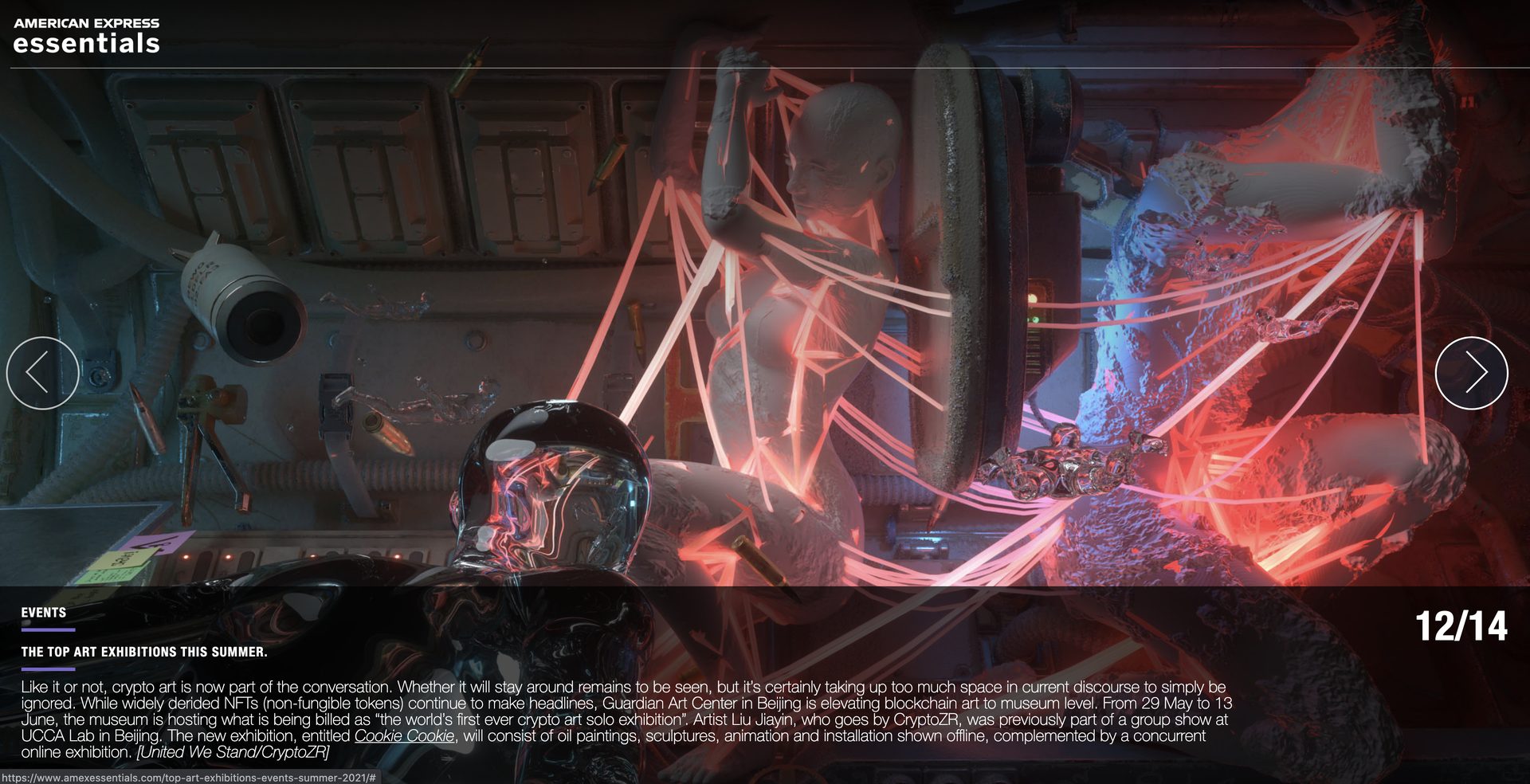
American Express Top Art Exhibitions 2021 Summer
Three Exhibition Sites: Crypto Art's Three-Step Entry into Institutional Narrative
Beijing · Guardian Art Center (2021) — the moment of naming. From 29 May to 13 June 2021, CryptoZR: COOKIE COOKIE (Small Goal), curated by the internationally renowned independent curator Li Zhenhua with spatial design by Wang Zhenfei, opened at the Guardian Art Center. This was the world's first thematic solo crypto-art exhibition. Before it, crypto art existed only in the grid thumbnails of trading platforms; after it, it had walls, lighting, a curatorial foreword and a site taken seriously. The exhibition simultaneously opened an online virtual hall, and the dual-venue structure of physical and on-chain became the artist's standard exhibition grammar thereafter. Li Zhenhua wrote in the foreword that Liu Jiaying, "through her practice in the field of blockchain, ultimately, by virtue of artistic expression, forms an interesting whole."
Three Exhibition Sites: Crypto Art's Three-Step Entry into Institutional Narrative (cont.)
Venice · the Arsenale (2022) — going global. From April to November 2022, COOKIE COOKIE 2.0, as the inaugural exhibition unit of the First Venice Metaverse Biennale, was shown for seven months in the Lamierini Hall 2 of the Arsenale. Representative works such as 1000EYE, Red and Blue and Small Goal were presented in Venice, the birthplace of the biennale system, in sync with the Point Zero Museum in the metaverse, thirteen works mirroring each other in physical and virtual form. The dense coverage of international media such as Forbes, Artribune and The Cryptonomist brought crypto art from Asia into the narrative of Europe's mainstream art media for the first time.
London · the Saatchi Gallery (2023) — entering the hall. From 26 to 28 May 2023, CRYPTOZR: ARRIVAL was held in Gallery 3 of the Saatchi Gallery, free and open to the public, with a global announcement on e-flux. The exhibition's title "ARRIVAL" is itself a manifesto: from an on-chain wallet to one of London's most influential contemporary-art spaces, crypto art completed an arrival in the institutional sense.
Three Exhibition Sites: Crypto Art's Three-Step Entry into Institutional Narrative (cont.)
Three sites, three steps: naming (Beijing) → going abroad (Venice) → entering the hall (London). The November 2026 solo exhibition CONSENSUS at the Hong Kong Arts Centre will be the fourth step. This time, standing in the hall will be not only the artist, but a self-governing community just brought into being.
Art Criticism: The Shifting Narrative Across Nine Years
The critical literature around this body of work (see Appendix C) itself constitutes a miniature history of reception.
2019–2020: naming and defense. The core issue of early Chinese criticism was "does this even count as art." Two long interviews on 8btc and the retrospective writings on the first blockchain-art exhibition were all defending the legitimacy of a new category. In this period the artist played creator and evangelist at once: introducing the translated term "crypto art," writing methodological texts, organizing exhibition practice.
2021–2022: institutionalization and internationalization. The Guardian solo exhibition brought mainstream art media in, and the curator Li Zhenhua's judgment — "through her practice in the field of blockchain, ultimately, by virtue of artistic expression, forms an interesting whole" — set the critical keynote: the unity of technical practice and artistic expression. The Venice solo exhibition triggered dense international writing, and coverage by Forbes and various Italian journals made "crypto art from Asia" a new entry in Europe's art media.
Art Criticism: The Shifting Narrative Across Nine Years (cont.)
2023 to the present: entering academic depth. The international dialogue on Right Click Save and the art-and-technology conversations of Hyundai Master Talks turned the discussion from "what it is" to "what it means" — the performativity of bidding, the authorship of protocols, the archival value of the ledger. This literature is the first batch of holdings in ZRDAO's academic construction: the history of a category's discussion is as precious as the works themselves.
Why It Is Worth Creating a DAO
Viewed through the logic of collecting, CryptoZR's body of work has four features hard to replicate:
- Historical priority: Out of Nothing (2017) precedes the establishment of the NFT standard, and several works are the "first of their kind" in their respective forms (DeFi art, protocol art, crypto art in space, theatrical crossover); in art history, "first" is a non-renewable resource.
- Genealogical completeness: from ERC20 to inscriptions, from the metaverse to AI, the body of work completely covers every formal evolution of crypto art over nine years; to collect it is to collect the chronicle of the category.
- Density of institutional endorsement: the world's first solo crypto-art exhibition, a Venice Biennale unit, a Saatchi solo exhibition in London, public-museum collection, the Sigg collection — endorsement from the serious art system outside the crypto circle.
- Continuous injection of new works: unlike a static collection, this body of work will keep growing and evolving for more than sixteen years.
Why It Is Worth Creating a DAO (cont.)
The overlay of these four features constitutes the collection-scholarship basis for the treasury's founding assets.
Chapter 4 · ZRT Tokenomics
Total Supply and Allocation
ZRT is ZRDAO's governance token, with a total issuance of 2.1 billion, all issued on Ethereum Mainnet by preset rules, with no pre-mine, no private placement and no institutional round:
| Allocation | Amount | Share | Release |
|---|---|---|---|
| Genesis sale | 200 million ZRT | 9.52% | Period 0 (first 30 days), crowdsale |
| Regular-period sale | 1.8 billion ZRT | 85.71% | Periods 1–200, 9 million each, 30 days each |
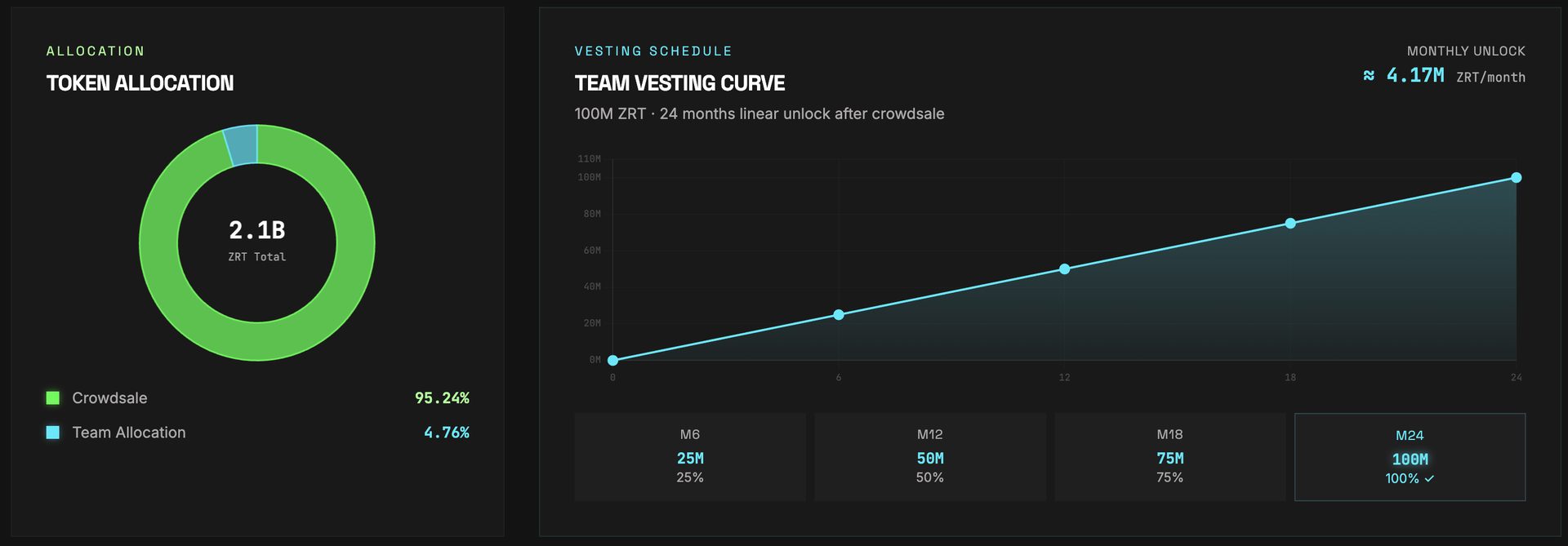
| Team allocation | 100 million ZRT | 4.76% | Linear vesting over 2 years (730 days) from deployment, claimed by the team multisig |
| Total | 2.1 billion ZRT | 100% | Total issuance duration about 16.5 years |
Total Supply and Allocation (cont.)
The key parameters of issuance are fixed in the mainnet smart contracts and can be verified on-chain by anyone:
- Issuance start: 27 July 2026, Ethereum Mainnet block height 25,624,800
- Genesis period: 27 Jul 2026 – 26 Aug 2026, selling 200,000,000 ZRT
- Regular periods: beginning immediately after the genesis period, 200 periods in total, 216,000 blocks each (about 30 days), selling 9,000,000 ZRT each
- Issuance platform: Bidder.Club | Pricing asset: ETH
Total Supply and Allocation (cont.)
Genesis period vs. regular period:
| Genesis period (Period 0) | Regular period (Periods 1–200) | |
|---|---|---|
| Amount issued | 200,000,000 ZRT | 9,000,000 ZRT per period |
| Duration | 216,000 blocks (about 30 days) | Same |
| Pricing mechanism | Pro-rata to contribution | Same |
| Historical significance | The community's initialization | A window open continuously for sixteen years |
Pro-Rata Distribution by Period: A Sixteen-Year Experiment in Fair Pricing
Each period of issuance uses a pro-rata mechanism, with only three rules:
- Within the period, any address may contribute any amount no less than 0.001 ETH;
- After the period ends, participants receive the whole period's tokens in the proportion
individual contribution ÷ total contribution of the period; - Price of the period = total ETH contributed in the period ÷ tokens issued in the period — the price is discovered jointly by the genuine contributions of all participants, with no market maker and no pricing power.
The elegance of this mechanism lies in this: no one can overpay, and no one can jump the queue. A whale's large contribution directly raises the period's average price and dilutes its own share; small participants settle at the same price. If no one participates in a given period, that period's tokens are burned by the artist and permanently removed from circulation.
Pro-Rata Distribution by Period: A Sixteen-Year Experiment in Fair Pricing
Team Allocation: Two-Year Linear Vesting
The reserved 100 million ZRT team allocation (4.76% of total) is for development and operations, using a mechanism of linear release over 730 days from contract deployment, claimed by the founding-team multisig (a 4/5 Gnosis Safe) according to the vested amount, and cannot be unlocked early. This proportion and vesting cadence sit in an extremely conservative range for the industry — the team and the community align their interests along the same sixteen-year timeline.
Team Allocation: Two-Year Linear Vesting
alt text
The Five Rights of ZRT
- Right to new-work injection: new works the artist issues are injected into the treasury at the ratio
10% (genesis) + 0.2% × number of completed sale periods, capped at 50%. For example, after Period 100 the ratio is 10% + 0.2%×100 = 30%. If the artist issues a project of 100 NFTs at that point, 30 of them go into the ZRDAO treasury; after Period 200 it is locked long-term at 50%. - Scope of works: covering every on-chain, traceable crypto asset issued in CryptoZR's name, including sellable NFTs, ERC20 tokens, BTC inscriptions and the like; excluding easel paintings, sculpture, installation and other physical works.
- Membership-event pass: holding a certain amount of ZRT is the pass to the global annual membership events.
- New-work entry pass: priority to participate in the artist's future new-work sales.
- Governance voting power: on-chain decision-making power over how all treasury assets are disposed (see Chapter 5).
The Threefold Design of a Sixteen-Year Supply Curve
ZRT's supply curve embeds a threefold behavioral design:
Front-loaded: the gravity of the genesis period. The genesis period issues 200 million, close to 10% of total issuance, giving the earliest supporters a natural advantage in supply — not through a discount, but through more abundant supply under the same formula. Thereafter the steady release of 9 million per period makes the supply shock gentle and predictable from Period 1 onward.
Constant and even: no token-release shock. Equal release over 200 periods means there is no "unlock cliff" — that time bomb of a massive token release concentrated on a single date that has toppled countless projects. Anyone at any moment can precisely compute the ceiling of circulating supply on any future date; uncertainty is entirely removed from the supply side.
A deflation valve: self-pruning in periods no one attends. If no one participates in a period, that period's 9 million do not roll over, do not accumulate and do not transfer to the team — they can only be burned by the artist. In cold markets, supply automatically contracts, which protects holders.
The Threefold Design of a Sixteen-Year Supply Curve (cont.)
The threefold design synthesizes into one result: ZRT's supply side has no room for human discretion whatsoever — no one can decide to issue a single extra token, the artist herself included.
A Comparison: Five Token-Issuance Models
| Model | Who prices | Barrier to entry | Time dimension | Typical risk |
|---|---|---|---|---|
| One-off public sale / IDO | Project sets the price | Speed of the rush and gas war | Seconds to hours | Distorted pricing, bot front-running |
| Private round + unlock | Institutional negotiation | Qualification and connections | Multiple rounds, retail last | Price troughs, unlock dumps |
| Mining / airdrop distribution | No direct pricing | Capital or work | Months | Sybil attacks, disorderly sell pressure |
| Single-session Dutch auction | Curve pricing | Timing judgment | Hours to days | Complex single-session game |
| ZRDAO pro-rata by period | Priced jointly by all participants' contributions | 0.001 ETH, no rush | 201 periods / 16.5 years | Requires the patience of long-termism |
A Comparison: Five Token-Issuance Models (cont.)
Pro-rata distribution by period sacrifices the marketing narrative of "sold out in an instant" in exchange for three more expensive things: the thorough democratization of pricing power (no party holds a pricing privilege), the extreme lengthening of the time dimension (turning a one-off event into a sixteen-year institution), and the de-armament of the participation experience (no bots needed, no gas wars, no staying up to guard the sale). For an art organization whose lifeline is the quality of its community, these three are exactly the foundation.
A Numerical Example: Three Participants in One Period
Take a regular period (issuance 9,000,000 ZRT), and suppose the period has three kinds of participants:
| Participant | Contribution | Share of period total | ZRT received | Actual unit price |
|---|---|---|---|---|
| Small collector Alice | 0.1 ETH | 0.1% | 9,000 ZRT | Same as everyone |
| Mid-size collector Bob | 10 ETH | 10% | 900,000 ZRT | Same as everyone |
| Whale Carol | 89.9 ETH | 89.9% | 8,091,000 ZRT | Same as everyone |
| Period total | 100 ETH | 100% | 9,000,000 ZRT | 100 ÷ 9,000,000 ETH/ZRT |
A Numerical Example: Three Participants in One Period (cont.)
Three observations: First, Alice and Carol settle at exactly the same unit price — no bulk discount, no retail premium. Second, if Carol wants a larger share, she can only keep contributing ETH, which directly raises the period's unit price for everyone (including herself) — the whale's "dump advantage" is inverted, at the primary-market level, into a "price-raising cost." Third, periods are independent of one another: miss this period, and the next window opens again under the same rules.
Why There Is No Private Round
Most projects' token structures hide several "price troughs": seed round, private round, advisor allocation. Early entrants lead public participants by a price gap of several to tens of times. Yet ZRT's issuance table contains none of these terms.
Of the 2.1 billion tokens, 2 billion (95.24%) are issued through the 201-period public crowdsale, each period open to the whole world at once and priced by the same formula; the remaining 100 million team allocation is released by two-year linear vesting, and if the team wants more ZRT it, too, can only go through the same public-crowdsale door.
This is not only a statement of values but a governance-security design: a token distribution without concentrated low-cost chips means there is no "zero-cost vote-dumping" whale class in future governance votes. A fair issuance structure is the foundation of fair governance.
The Value Logic of ZRT
It must be stated: ZRT promises no financial return (see Appendix F). Its value logic is built on three layers of genuine rights:
The governance layer: decision-making power over the disposition of a treasury that continually absorbs high-quality art assets. As time advances, the scale and lineage of governed assets increase monotonically by design; the weight of governance rights grows naturally in step.
The rights layer: the pass to membership events, the qualification to participate in new-work sales. The value of these rights is anchored to the continued operation of the artist's creative career and the community's event network — a typical use value rather than a financial promise.
The cultural layer: the hardest to price and the most genuine layer — being a named participant (at least in the sense of an on-chain address) in a long-term experiment that may be remembered by art history.
The Value Logic of ZRT (cont.)
All three layers share a common feature: none depends on the next buyer, and all are anchored to the organization's own genuine operation. This is precisely the holding structure ZRDAO hopes to attract: the more people who come to participate, the closer this organization is to its design intent.
Chapter 5 · Governance: From Multisig Stewardship to Full Autonomy
Two-Phase Governance: Stability First, Devolution Second
ZRDAO adopts a carefully considered two-phase governance design, rather than "full decentralization" in a single leap:
Two-Phase Governance: Stability First, Devolution Second
Two-Phase Governance: Stability First, Devolution Second (cont.)
Phase 1 (about two years after launch): the treasury, holding the artist's works and ERC20 assets, is managed by the founding team via a 4/5 multisig. An important constraint: the multisig cannot use the treasury directly — any operation must first be submitted to the timelock contract and can only execute after a 48-hour publicized delay, so the community has full advance knowledge.
Phase 2 (after handover): once issuance and the trading system are proven stable and ZRT issuance reaches 20% of total, treasury authority is handed to the Governor contract, formally entering the phase of decentralized governance. Thereafter every disposition of treasury assets, and even every modification of the governance parameters themselves, can be done only by a vote of ZRT holders. After the handover the multisig retains only the emergency role of canceling anomalous pending operations.
The Proposal Lifecycle
Once in the autonomy phase, the complete path of a treasury operation from idea to execution is as follows:
The Proposal Lifecycle
The Proposal Lifecycle (cont.)
| Governance parameter | Value | Note |
|---|---|---|
| Proposal threshold | 21,000,000 ZRT | 1% of total issuance, anti-spam |
| Voting delay | 1 day | Publicity period for the community to digest the proposal |
| Voting period | 5 days | A full voting window for holders in all time zones |
| Quorum | 84,000,000 ZRT | 4% of total issuance, a fixed absolute value |
| Passing condition | for > against | And total votes reach the quorum |
| Execution delay | 2 days | Timelock publicity, the community's final review window |
The Proposal Lifecycle (cont.)
The division of roles across the proposal lifecycle:
| Action | Who may execute | Condition |
|---|---|---|
| Submit a proposal | Any address | Voting power ≥ 21 million ZRT (incl. delegated) |
| Vote | Any holder | Has voting power in the snapshot at proposal creation |
| Queue a passed proposal | Anyone | Proposal state is "Succeeded" |
| Execute a matured proposal | Anyone | Timelock delay has elapsed |
| Cancel a proposal | The proposer | Before voting begins |
| Emergency-cancel a queued operation | Team multisig | Only during the timelock publicity period |
Governance-Attack Defenses by Design
The famous attack cases in DAO governance history (flash-loan voting, last-minute raids, low-quorum hijacking) are each addressed at ZRDAO's contract level:
- Snapshot voting: voting weight is taken from the historical snapshot at the moment of proposal creation (the ERC20Votes checkpoint mechanism). Tokens bought during the voting period carry no power in that vote, so flash-loan attacks fail mathematically.
- Fixed quorum: the quorum is fixed at 84 million ZRT (4% of total issuance), never shrinking with circulation or burns, eliminating the hijacking window in low-issuance periods.
- Late-Quorum Extension: if a proposal first reaches quorum within the last 2 days before the vote closes, the deadline automatically extends by at least 2 days, ensuring the community has time to react to a raid-style vote.
- Dual time buffer: 1-day voting delay + 2-day execution timelock, so any malicious proposal is exposed in the sunlight for at least 8 days from submission to effect, with the multisig's emergency-cancel as the last insurance.
Governance-Attack Defenses by Design (cont.)
- Governance self-modification limit: parameters such as voting delay, voting period and proposal threshold can be modified only through a governance proposal itself (onlyGovernance); neither the team nor the multisig has authority to adjust the rules.
This combination draws on the governance frameworks of mature DAOs such as ENS and Uniswap (OpenZeppelin), and strengthens the quorum computation and handover path for the art-treasury scenario.
A Brief History of DAO Governance Attacks and ZRDAO's Countermeasures
ZRDAO's governance parameters were not designed in a vacuum; each corresponds to a lesson this industry paid for with real money.
The DAO (2016): a code bug and hasty governance. Ethereum's first large DAO lost 3.6 million ETH to a reentrancy bug, directly causing Ethereum's hard fork. Two lessons: contract security above all; and an emergency brake is needed. ZRDAO's response: all fund paths use reentrancy protection and the CEI pattern, on the OpenZeppelin standard library verified by thousands of projects; the multisig keeps emergency-cancel on the timelock — an emergency design that can only brake, not accelerate.
Beanstalk (2022): flash-loan vote hijacking. The attacker used a flash loan to borrow a massive amount of governance tokens within one transaction, passed a malicious proposal, moved USD 182 million, and repaid the loan — all in 13 seconds. The lesson: instantaneous voting power = rentable voting power. ZRDAO's response: voting weight is taken from the historical snapshot at the moment of proposal creation, and tokens obtained during the voting period carry no power in that vote. A flash loan cannot reach the snapshot point on the timeline, and the attack does not hold mathematically.
A Brief History of DAO Governance Attacks and ZRDAO's Countermeasures (cont.)
The Tornado Cash governance hijack (2023): the disguise of a malicious proposal. The attacker submitted a proposal seemingly identical to a previously passed one, but with hidden self-destruct and re-deployment logic, and briefly seized governance control. The lesson: a proposal's contents need enough exposure time and professional review. ZRDAO's response: a triple window of 1-day voting delay + 5-day voting period + 2-day timelock, exposing any proposal for at least 8 days from submission to effect; during the timelock phase the multisig can still cancel anomalous operations, backstopping community review.
Low-quorum hijacking: an ambush in the quiet. If the quorum floats with circulating supply, then in periods of low turnout a small amount of tokens can pass a malicious proposal "legally." ZRDAO's response: the quorum is fixed at the absolute value of 84 million ZRT (4% of total), never changing with circulation, burns or turnout, so the threshold never quietly drops in a cold market.
A Brief History of DAO Governance Attacks and ZRDAO's Countermeasures (cont.)
Last-minute raid: an ambush in the final hour. The attacker concentrates votes hours before the deadline, leaving the community no time to react. ZRDAO's response: the late-quorum extension mechanism — if quorum is first reached within the last 2 days, the deadline automatically extends by at least 2 days.
In one sentence, the philosophy of this defense line: assume no goodwill from participants; only ensure that malice is not worthwhile by mechanism.
The Complete Journey of One Proposal
Suppose, on some day of the autonomy phase, the community member 0xCAFEBABE proposes that the treasury acquire a representative early generative-art piece. The complete journey of this idea from germination to execution is as follows:
Day 0 · brewing. 0xCAFEBABE posts on ZRDAO.org setting out the reasons: the work's art-historical standing, its complementarity with the collection's lineage, the market timing and a budget ceiling. The community discusses for three days; someone suggests lowering the budget and adding a purchase-price-ceiling condition. 0xCAFEBABE incorporates the feedback and forms a standardized ZIP proposal document.
Day 3 · proposal on-chain. 0xCAFEBABE's address holds more than 21 million ZRT of voting power in total, and calls the Governor's propose to submit the proposal: the target contract is the treasury, and the calldata is "execute the on-chain acquisition of this work within the set budget." The proposal enters a 1-day voting delay, the final reading time for all holders, and the voting-weight snapshot is locked at this moment.
The Complete Journey of One Proposal (cont.)
Days 4–9 · voting. The 5-day voting window opens. Holders vote in three stances — for / against / abstain — and every vote is instantly on-chain and checkable. On Day 8, cumulative votes reach the quorum of 84 million ZRT; if this happens in the last two days before the deadline, the deadline automatically extends, ensuring there is no final-hour raid.
Day 9 · result confirmed. For 62 million > against 28 million, and total votes exceed the quorum: the proposal passes. Anyone (not limited to 0xCAFEBABE) can call queue to send the proposal into the timelock.
Days 9–11 · timelock publicity. A 48-hour countdown. This is the final security window: if the proposal is found to be maliciously constructed, the multisig can exercise emergency-cancel (a power that can only stop the execution of a malicious proposal, and cannot initiate any operation).
The Complete Journey of One Proposal (cont.)
Day 11 · execution. The delay elapses, and anyone calls execute. The treasury contract completes the acquisition transaction per the proposal, and the work enters the treasury address. The transaction hash, the event log and the change in treasury assets — together with every vote before them — become a permanent archive of ZRDAO's decision history.
Not a single step of the whole journey requires "contacting an administrator": the process itself is the administrator.
Delegation: Letting Expertise and Passion Each Find Their Place
Not every holder has time to study every proposal case by case — this is the reality of all token governance. ZRDAO's built-in delegation mechanism offers an institutional outlet for this: any holder can delegate their voting power to a community member they trust, and can change or reclaim it at any time; every vote by a delegate is public on-chain.
It can be expected that, as the community matures, a cohort of "delegates" who make their governance philosophies public will grow naturally — as has already happened in mature project-governance ecosystems: some strong in art expertise, some skilled in DeFi risk control, some representing the stance of small holders. ZRDAO.org will provide delegates with pages showing their statements of philosophy and voting histories, along with proposal-submission and voting interfaces, making delegation a well-informed choice.
Progressive Decentralization: Why Not All at Once
In the early days of genesis, ZRT is highly concentrated among the participants of the first few periods, the voting population is insufficient, and the cost for an attacker to assemble 4% quorum is actually at its lowest; at the same time, the issuance system, trading platform and treasury modules are all in a running-in phase and need fast-response engineering decisions, while the shortest decision cycle of on-chain governance is 8 days. To hand the steering wheel to an immature community in the startup phase would be irresponsible.
ZRDAO's solution is to make decentralization a process with a clear endpoint: the multisig's power is constrained by the timelock from day one (execution only after publicity, never a silent operation); the handover condition (a stable system + issuance reaching 20%) is objectively verifiable; the handover operation itself is publicized via the timelock, under the community's full supervision; and after the handover the multisig retains only the single defensive power of "canceling" the execution of a malicious proposal. In industry history, the most successful governance systems all walked this gradual path: first let the organization live, then let it be free.
What Governance Cannot Do
An honest account of governance must also spell out the boundaries of power. Even if 100% of ZRT votes unanimously agree, the following still cannot be changed through governance:
What Governance Cannot Do (cont.)
- Cannot issue more ZRT: total supply, the periodization and the per-period amount are fixed at compile time, and the contract contains no minting entry;
- Cannot modify the injection formula: the curve 10% + 0.2%×periods is not a governance parameter but a contract constant;
- Cannot confiscate anyone's tokens: under the ERC20 standard, a holder's balance is controlled solely by their own private key;
- Cannot retroactively alter completed distributions: claimed tokens and executed decisions cannot be rewritten in on-chain history;
- Cannot bypass the timelock: governance itself must queue for 48 hours, and no emergency channel can use the treasury instantly;
- Cannot compel the artist to create: the injection formula constrains the ownership ratio of new works actually sold, and the artist's creative freedom is beyond the reach of any vote.
What Governance Cannot Do (cont.)
The complete reach of governance power is: the disposition of the treasury's existing assets, the registration and de-registration of functional modules, the adjustment of governance parameters (delay / voting period / threshold), and all community affairs funded through the treasury budget. What can be done is entirely transparent; what cannot be done is entirely rigid.
Chapter 6 · The Treasury: An On-Chain, Transparent Pool of Art Assets
Chapter 6 · The Treasury: An On-Chain, Transparent Pool of Art Assets
The Consensus
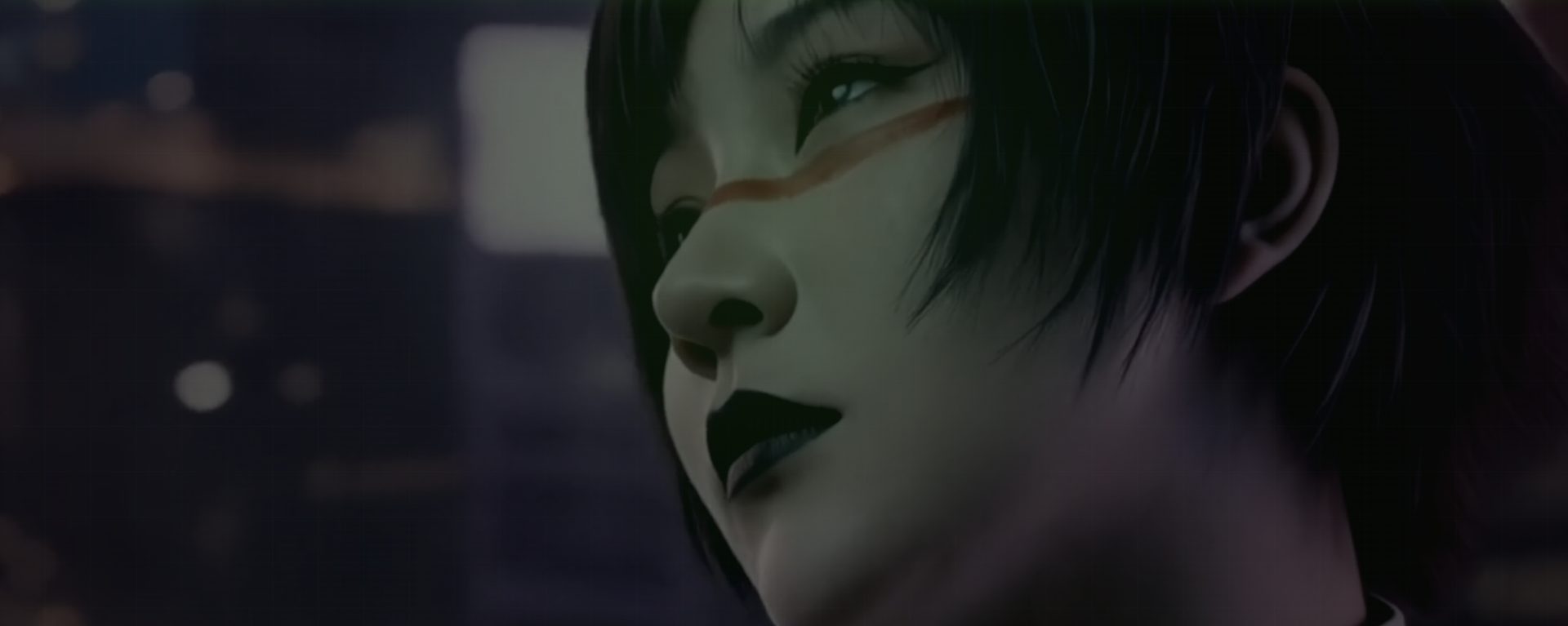
Founding Injection: One-Tenth of a Body of Work
At ZRDAO's launch, the artist injects into the treasury 10% of all asset-form works she has issued on public chains since 2017, constituting the founding collection:
| Work | Injected share | Note |
|---|---|---|
| Red and Blue | 10 / 100 | Same series as the Ulsan Art Museum's holding |
| 1000EYE | 100 / 1000 | The NFT project holding an Asian price record |
| Sound Money Series | 10 / 100 | A sound-money-themed NFT series |
| The Consensus | 1 / 10 | 4th edition · Ethereum-exclusive version |
Founding Injection: One-Tenth of a Body of Work (cont.)
This is not a one-off donation, but the starting point of an injection curve lasting 200 months. The artist has already completed, with real money, the buyback of 100 1000EYE NFTs from early collectors, and will inject them into the treasury at the project's launch.
Note that the choice of these four founding pieces is not random: Red and Blue represents participatory creation accepted by the museum system, 1000EYE represents a market record and the largest collector community, Sound Money represents the thread of monetary concepts, and The Consensus represents the latest institutional-grade collection. The four works are precisely the flagships of each of the artist's four creative threads, so the founding treasury is a holographic miniature of the entire body of work.
The Continuous-Injection Formula: A Long-Term Covenant Between Artist and Community
Every time a period of ZRT issuance completes, the ratio at which the artist's new works are injected into the treasury rises by 0.2 percentage points:
Injection ratio = 10% (genesis base) + 0.2% × number of completed sale periods, capped at 50%
| Time point | Completed periods | New-work injection ratio |
|---|---|---|
| 2026 (end of genesis period) | 0 | 10% |
| ~2030 | 50 | 20% |
| ~2034 | 100 | 30% |
| ~2038 | 150 | 40% |
| ~2043 (issuance complete) | 200 | 50% (locked long-term) |
The Continuous-Injection Formula: A Long-Term Covenant Between Artist and Community (cont.)
The scope of injection covers every on-chain, traceable asset issued in CryptoZR's name, including NFTs, ERC20 tokens and BTC inscriptions; the community can vote to decide whether these works are used for public exhibition, collateral, auction or long-term collection. With every period of ZRT issuance that advances, the community's stake in the artist's future creation deepens by one notch. This is a long-term covenant binding the artist's career to the community's interest by formula.
The credibility of this covenant comes from three levels. First, historical behavior: the founding injection is completed at issuance launch — payment first, crowdsale after — the artist opening with action rather than promise. Second, public verifiability: the ratio that should be injected after each period is a formula the whole network can compute, and the on-chain record of any new-work sale can be checked against it by the community, so a breach has nowhere to hide. Third, reputational collateral: for an artist whose works are collected by museums and top collectors and who has a nine-year public on-chain record, the reputational cost of an on-chain breach far exceeds any short-term gain. This covenant is collateralized by the artist's entire artistic career.
What the Treasury Can Do: A Modular On-Chain Vault
The ZRDAO treasury is a modular contract system designed specifically for art assets:
What the Treasury Can Do: A Modular On-Chain Vault (cont.)
- Full asset custody: native support for receiving, holding and transferring ETH, ERC20, ERC721 and ERC1155, covering every form from the governance token to NFT collectibles.
- A general execution outlet: once approved by governance, the treasury can initiate any call to any contract, preserving maximum freedom to connect to new protocols in the future.
- Modular upgrades: functions are hot-swapped via a "module registry" — a governance vote registers a new module to add a capability to the treasury (auction, funding, new DeFi protocols, and so on), so the treasury body never needs to be redeployed and the assets never need to be migrated.
- DeFi module: an asset-management module already developed and verified by testing, including interfaces for Aave V3 deposit/withdrawal and Uniswap V2 liquidity management. This module was not enabled with the mainnet deployment; whether to register it, when to enable it, and its scale boundaries are entirely for the community's governance to decide. The treasury's default posture is custody, not asset management.
What the Treasury Can Do: A Modular On-Chain Vault (cont.)
Placing the ZRDAO treasury within the industry lineage of DAO asset management: the minimalist vaults of the Moloch line protect minorities via "ragequit," at the cost of severely limited functionality; the auction vaults of the Nouns line are inherently bound to a single issuance mechanism; the Zodiac/Safe module ecosystem is flexible and powerful, but the coupling of governance and assets must be built separately. ZRDAO's design takes the strengths of all three — strong governance coupling with the timelock as the sole entry (like Nouns), functional extensibility via a module registry (like Zodiac), and auditability preserved by minimal in-house code (like Moloch) — and adds for art assets the capability all three lack: native custody of ERC721/1155 and convenient disposition interfaces.
DAO Collecting: Why This Is a Structural Upgrade to Art Collection
Combining the treasury, the token and governance yields an entirely new form of collecting organization. Its forerunners have already proven the path works:
PleasrDAO: collecting for meaning. This collector DAO, founded in 2021, acquired Snowden's Stay Free for USD 5.7 million, the original Doge photo NFT for USD 4 million, and Wu-Tang Clan's globally unique physical album for USD 4 million. Its collecting logic is neither appreciation expectation nor pure aesthetics, but cultural stance-taking: by collectively collecting a work, the community declares "we identify with the value it represents." Individual collection reflects individual taste; DAO collection can reflect community consensus — a capacity that appears for the first time in the history of collecting.
DAO Collecting: Why This Is a Structural Upgrade to Art Collection (cont.)
FlamingoDAO: the investment discipline of collective intelligence. This NFT-focused investment DAO built positions systematically at the earliest stage of CryptoPunks and Art Blocks, becoming one of the best-returning institutions in NFT investing. It proved a proposition: in an emerging art market with highly dispersed information, collective decisions made jointly by developers, artists, collectors and DeFi experts can surpass the judgment of the single best expert — and do so entirely publicly and transparently on-chain, rebutting the traditional-finance assumption that "transparency necessarily harms competitive advantage."
DAO Collecting: Why This Is a Structural Upgrade to Art Collection (cont.)
ConstitutionDAO: a stress test of collective mobilization. In November 2021, to bid at Sotheby's for a first printing of the U.S. Constitution, a temporarily assembled DAO gathered more than 17,000 contributors and about USD 47 million in seven days. Though it ultimately lost at auction, it demonstrated to the whole world the mobilization speed of on-chain collective action: seven days, no company, no contract, no bank account — only a shared goal. The full refund after the failed bid was equally a lesson: an on-chain organization can execute even its "dissolution" transparently. The two sides of this experiment — astonishing mobilization and the fragility of a temporary organization — together argue for ZRDAO's choice: to put collective mobilization into a container with a long-term institution, continuous asset injection and a clear governance framework.
DAO Collecting: Why This Is a Structural Upgrade to Art Collection (cont.)
ZRDAO's difference from these forerunners lies in its starting point: it is not a capital union starting from zero to find a collecting direction, but one that unfolds around the body of work of an artist with a complete creative lineage and ample institutional collection endorsement, while possessing complete infrastructure for issuance, trading and curation. Compared with the traditional collecting structure, the DAO model's upgrade is comprehensive:
DAO Collecting: Why This Is a Structural Upgrade to Art Collection (cont.)
| Dimension | Traditional individual collection | ZRDAO collective collection |
|---|---|---|
| Barrier to entry | Extremely high (hundreds of thousands of dollars up) | From 0.001 ETH per crowdsale period |
| Decision method | Individual judgment or advisor delegation | On-chain voting by token holders |
| Transparency | Private, unknowable to outsiders | Treasury balance, every transaction, every vote checkable in real time |
| Liquidity | Realization cycle in months and years | The governance token can circulate at any time |
| Display of works | Private space | An on-chain museum accessible worldwide |
| Attribution of proceeds | Enjoyed by the holder alone | Attributed to the community by token share |
| Basis of trust | Trust in a person | Verification of code and on-chain records |
DAO Collecting: Why This Is a Structural Upgrade to Art Collection (cont.)
Worth emphasizing is the deeper meaning of the last row: in a traditional art fund, contributors receive a quarterly report written by the manager, whose contents the manager decides to disclose; whereas in ZRDAO, anyone at any moment can directly read every asset movement of the treasury address and every vote of the governance contract. Trust shifts from "delegated" (trust that you will do right) to "verificatory" (able to verify for oneself what you did). This is not an improvement in degree, but a replacement of the power structure.
The comparison of fee structures is equally stark. A typical private art fund charges 1–2% of assets per year as a management fee, plus 20% of profit as carried interest; over a ten-year fund the total friction cost can swallow a considerable share of returns. The ZRDAO treasury has no management fee, no carry, no GP — governance is exercised directly by holders, execution is completed automatically by contract, and the only cost is Ethereum gas. The zeroing of intermediary cost is not a small efficiency gain; it changes the cost function of the business of art-asset management.
DAO Collecting: Why This Is a Structural Upgrade to Art Collection (cont.)
The comparison of lifecycle is more fundamental still. A traditional art fund has a term, usually 7–10 years, and at maturity must liquidate and exit — even if that is precisely the worst moment to sell the holdings; the fund's collection is therefore inherently short-sighted. The ZRDAO treasury has no maturity date: a piece can be kept for an exhibition ten years hence, and an investment can be positioned for value a generation later. Only when a collecting body is no longer hostage to an exit date can it, for the first time, think like a true museum.
The Complete Lifecycle of a Collection
In ZRDAO, the whole process of collecting a work loops on-chain: proposal (a member proposes acquiring some work or disposing of some holding) → discussion (ZRDAO.org community debate, forming a ZIP document) → vote (snapshot weight, 5-day window) → timelock publicity (48 hours) → execution (the treasury automatically completes the transfer / bid / listing) → archiving (the transaction and decision record permanently on-chain). Looking back a decade later, ZRDAO's collecting history is not a compilation of annual reports written by a manager, but a public decision chain that anyone can independently verify.
The Complete Lifecycle of a Collection (cont.)
Zooming into this chain, each link has a clear point of accountability: at the proposal stage, the proposer's address is permanently bound to the full proposal text, and signature is the default state on-chain; at the discussion stage, every revision of the ZIP document is timestamped, so who proposed which amendment and when is a history that will not be forgotten; at the voting stage, the direction, weight and voter of every vote are public, and "anonymous abstention and armchair hindsight" have no room to survive here; at the execution stage, the transaction hash is the receipt; at the archiving stage, a work's label can directly cite this decision chain. Every piece in the future CHIJIN Art Museum can be clicked to see the complete original record of why the community collected it — a body of primary material the historiography of collecting has never before possessed.
The Treasury's Risk Boundaries
The stronger the treasury's capabilities, the more important risk discipline becomes. ZRDAO draws four boundaries for the treasury at the mechanism level:
- No leverage: the DeFi module currently implements only Aave deposit/withdrawal and Uniswap liquidity management; lending is deliberately excluded, and treasury assets do not serve as collateral bearing liquidation risk.
- A protocol whitelist: modules can interact only with protocol addresses fixed in code; connecting to any new protocol must register a new module through the full governance process, and there is no backdoor for ad-hoc calls.
- Full timelock coverage: including the lowest-risk asset operations, every treasury action goes through 48 hours of publicity, with no shortcut.
- Modules can be retired: governance can de-register any module at any time; if an external protocol shows signs of risk, the community can first vote to freeze the module entry, then dispose of the existing position at leisure.
Valuation and Disclosure: The Annual Report of the On-Chain Era
Art assets have no real-time quote, so how does the treasury present its value to the community? ZRDAO's disclosure philosophy is raw data first, interpretation always optional:
Valuation and Disclosure: The Annual Report of the On-Chain Era (cont.)
- Real-time asset inventory: every asset under the treasury address (ETH, ERC20, every NFT) is already public in real time, requiring no act of disclosure; the CHIJIN Art Museum and a community dashboard will visualize this on-chain inventory.
- Plural presentation of valuation: for assets with an active market, on-chain market data (floor price, recent sales) is shown; for art assets with no market quote, no official valuation is made. Community members may each build their own valuation models, but the treasury endorses no single figure, avoiding the mutation of "official valuation" into a price-manipulation tool.
- Decision trace is disclosure: the proposal document, voting record and execution hash of each asset disposition together constitute the decision archive; the most valuable part of a traditional fund's "quarterly report" (why buy, why sell) is here a natural by-product of the governance process.
Valuation and Disclosure: The Annual Report of the On-Chain Era (cont.)
The confidence behind this principle is: when all raw data is verifiable, "information disclosure" turns from an obligation into a redundancy. All that needs building are tools that make the data easier to read, not an institution to make people trust.
Chapter 7 · Issuance and Trading Infrastructure: The Bidder Suite
Five Years of Technical Accumulation: From Protocol Experiments to a Platform Matrix
If an art self-governance community is to complete the full loop of issuance — trading — collection, it must own its own infrastructure. ZRDAO's foundation is supported by the Bidder platform suite built by the development team over five years. These platforms were already running in real markets before ZRDAO's launch:
Five Years of Technical Accumulation: From Protocol Experiments to a Platform Matrix (cont.)
| Platform | Positioning | Core mechanism |
|---|---|---|
| Bidder.Top | Radical-auction platform | Self-pricing NFTs based on the TopBidder protocol: anyone can force a purchase by bidding 10% above the current price, ownership in perpetual competition |
| Minter.Top | NFT-collection issuance | Batch minting and structured issuance of NFT series |
| Bidder.Art | BTC inscription trading | Issuance and trading of inscription art based on the Ordinals protocol |
| Bidder.Fun | Art tokenization | ERC20 tokenized issuance of works (not yet formally launched) |
| Bidder.Club | Ethereum NFT trading | Independent deployment of an industry-standard protocol, carrying regular listing/settlement |
Five Years of Technical Accumulation: From Protocol Experiments to a Platform Matrix (cont.)
After ZRDAO's launch, the artist's already-issued works are listed directly on the official platform Bidder.Club, and new-work sales are conducted through this suite as well. The issuance and trading links are carried by the community's own infrastructure.
This matrix is not a diagram on a whitepaper but an online system already running for years: Bidder.Top has carried radical auctions continuously since 2021, with cumulative volume exceeding USD 5 million; Bidder.Art has run in the Bitcoin Ordinals ecosystem since 2023, covering the complete chain of inscription art from carving to circulation; Bidder.Club's self-deployed Seaport protocol means that even the most basic listing matchmaking does not depend on any third-party platform's availability promise. Five years, two public chains, five platforms — ZRDAO's infrastructure confidence comes from this market-tested mileage.
The Issuance System: Making Mechanism a Language of Curation
The issuance mechanisms the Bidder suite supports go far beyond ordinary "fixed-price minting":
- Traditional non-fungible-asset issuance: ERC721 / ERC1155 standard issuance;
- Self-pricing NFTs: the Radical-Markets mechanism of the TopBidder protocol, with price dynamically discovered by continuous bidding;
- Candle auction: a random closing moment eliminates last-second sniping;
- Vickrey auction: sealed second-price bidding, encouraging truthful bids;
- LBP (Liquidity Bootstrapping Pool): liquidity-guided pricing with a descending weight curve.
For Silicon Art, the issuance mechanism is itself part of the work's expression: 1000EYE used the Nasdaq index as a random seed, and 100 Days used a reverse Dutch auction to test community credit. The richer the mechanism library, the broader the grammar of creation.
Mechanisms in Detail: Why Every Auction Is a Mode of Expression
Self-pricing NFTs (TopBidder) stem from the "partial common ownership" (COST / Harberger tax) idea proposed by the economists Glen Weyl and Eric Posner in Radical Markets: ownership is not an absolute fortress but a state continuously subject to market testing. The protocol translates it into one minimal rule: anyone can force a purchase by bidding 10% above the current price. The holder therefore faces at all times an honest question: is this work's value to you higher than the next price the market is willing to pay? When ownership must be continuously defended, collecting turns from possession into stance-taking.
The candle auction takes its name from seventeenth-century English candle auctions. The moment the wick goes out is the close, unforeseeable to anyone. The on-chain version determines the actual closing moment with a verifiable random number: the sniper loses the weapon of "the last second," and bidders are forced to express genuine will across the whole window. For an art sale, this means price discovery returns to patience and sincerity rather than scripts and hash power.
Mechanisms in Detail: Why Every Auction Is a Mode of Expression (cont.)
The Vickrey auction (sealed second-price bidding) is a jewel of mechanism-design theory: the highest bidder wins, but pays only the second-highest bid. Under this rule, reporting one's true reservation price is the mathematically optimal strategy. Used in an art sale, it lets a work collect, for the first time, a set of "game-uncontaminated" genuine valuations. That data is itself primary literature on the consensus about a work's value.
LBP (Liquidity Bootstrapping Pool) opens with a weight curve descending over time: the initial price is set high and keeps falling until real demand catches it. Front-running bots find no profit before a falling curve, and a whale's early sweep immediately raises its own cost — the fairness of issuance is guaranteed by the curve itself.
These four mechanisms, plus traditional English/Dutch auctions and fixed-price minting, constitute the Bidder.Club mechanism library. For Silicon Art, which mechanism to issue with is like a traditional artist choosing between oil on canvas and marble — it determines how a work meets its first audience.
The Trading System
Secondary-market circulation of works supports three forms: traditional BID/ASK matched trading, protocol-driven automatic-pricing trading (such as TopBidder), and English/Dutch auctions. The auction and sale of treasury holdings after governance approval are likewise executed through this system, with the whole trade verifiable on-chain.
Why Build Our Own Infrastructure
"Can't you just use an existing trading platform?" Not Found Tokens has already answered this question for ZRDAO: in 2020, this work was blocked at the front ends of two major platforms without any reason, and more than two thousand holders overnight could not see the works they owned. To depend on another's front end is to pledge a work's visibility to another's policy.
Building our own infrastructure is a threefold necessity for ZRDAO:
Why Build Our Own Infrastructure (cont.)
- Sovereignty: the rules of issuance and trading are decided by community governance, free of the single-point risk of platform-policy changes;
- Mechanism freedom: non-standard mechanisms like candle auctions, Vickrey auctions and self-pricing NFTs have nowhere to sit on generic platforms, yet they are precisely the creative grammar of Silicon Art;
- A value loop: proceeds from the trading link can in the future be directed to the treasury by governance, so that every increment of ecosystem growth sediments into a community asset rather than a third-party platform's revenue.
Self-Built but Not Self-Enclosed: The Relationship with Open Standards
Building our own infrastructure does not equal a walled garden. Every layer of the Bidder suite anchors to open standards: the asset layer fully adopts the ERC20/721/1155 and Ordinals standards, so works issued on a ZRDAO platform can circulate losslessly to any external market; the trading layer reuses the open Seaport protocol, naturally compatible with the broadest wallet and aggregator ecosystem; and everything at the data layer is recorded on public chains, so any third party can build a browser, analytics tool or alternative front end for ZRDAO holdings. Self-building guarantees sovereignty, standards guarantee openness — the combination of the two is the complete philosophy of infrastructure: if one day the community is unhappy with the official front end, anyone has ample interfaces to start over, and this pressure of "being replaceable" is the best spur for the official infrastructure to keep up its quality.
Chapter 8 · Community and Culture
Chapter 8 · Community and Culture
The Consensus
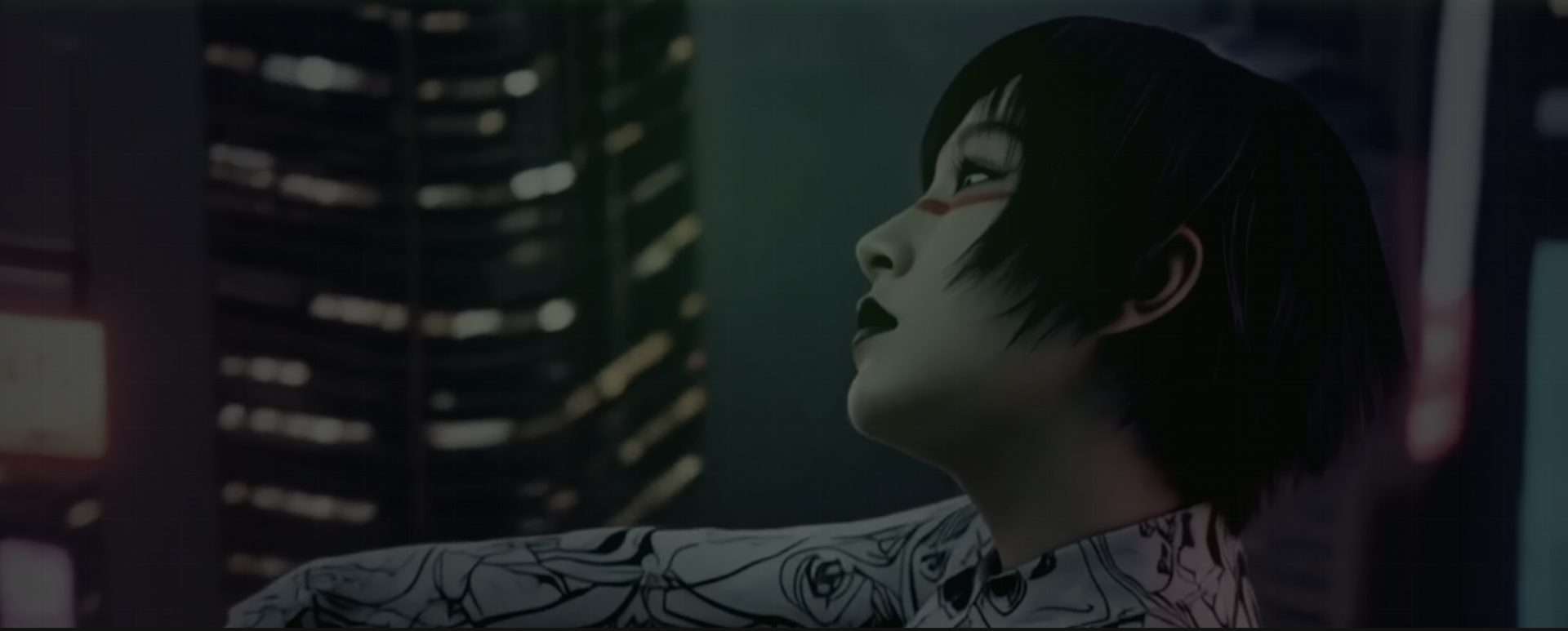
Participatory Creation: ZRDAO's Artistic DNA
Most DAOs treat the community as the subject of governance; ZRDAO also treats the community as the material and co-author of creation. This gene comes from CryptoZR's consistent creative method. In several of the artist's representative works, meaning is co-completed by community behavior:
Participatory Creation: ZRDAO's Artistic DNA (cont.)
- Red and Blue (2019): the continuous bidding on one hundred NFTs is a fully transparent referendum: collectors bet with real money on red or blue color-block NFTs, and the work's image and meaning are rewritten in real time by bidding. Bidding is not buying the work; it is participating in creation.
- 100 Days (2022): a reverse Dutch auction with community credit as its subject, where the price rises rather than falls over time, and participants must judge how many members of the community are, like themselves, willing to trust; trust itself is made the medium of the work.
- Codenamed B404 (release September 2026): ZRDAO's first participatory new work after launch, meeting the community in the first month after genesis issuance completes.
- Codenamed Utopia (expected release 2036): a long-horizon work with a ten-year creative cycle, whose conception, evolution and final form will all be closely tied to the development of the ZRDAO community.
Participatory Creation: ZRDAO's Artistic DNA (cont.)
Of B404, the only thing that can be revealed is the naming logic itself: 404 is the internet's code for "does not exist," and this work can only exist after the ZRDAO community exists. It is the first shared secret reserved for this community: in September 2026, the participants of the genesis period will be the first to know the answer.
For ZRT holders, this means an unprecedented identity: you have not merely collected the artist's work; your participation itself becomes part of a future work, written into art history's on-chain archive.
ZRDAO.org and ZIP: A Digital Agora and a Self-Governance Charter
ZRDAO.org is the community's online agora: the brewing and debating of proposals, the discussion of curatorial plans, and the onboarding of new members all happen here. On-chain voting is the endpoint of decision; this is the incubator of decision.
The ZIP lifecycle references the mature practice of Ethereum's EIP and simplifies it: a proposal begins as an Idea, and after basic feedback on the forum enters Draft, completing motivation, specification, impact analysis and execution payload per a standard template; after at least one round of open review it enters Review; for proposals involving treasury funds or parameter modification, an off-chain signal vote first tests consensus, and then an address meeting the threshold submits the On-chain vote; after passing and executing it is archived as Final. Every ZIP has a permanent number and an immutable version history. A new member ten years later can read the whole process of ZIP No. 1 from debate to finalization.
ZRDAO.org and ZIP: A Digital Agora and a Self-Governance Charter (cont.)
ZIP (ZRDAO Improvement Proposals) is the community's self-governance charter system: any important change — governance parameters, treasury strategy, event rules... — is submitted, numbered and archived as a standardized proposal document, forming a "living constitution" written by the community's own hand and traceable through every revision.
Annual Membership Events: From the Chain to the High Seas
To hold ZRT is to hold the pass to the global membership events. The event network covers major international art cities — New York, London, Paris, Berlin, Los Angeles, Hong Kong, Shanghai, Beijing, Tokyo, Seoul, Basel, Singapore and others. Exhibition openings, collector salons and creative workshops will rotate with the global art calendar.
Most in the ZRDAO spirit is the bespoke high-seas cruise event: community members board a ship that has sailed beyond every jurisdiction and create live works upon the high seas. This is both an artistic action and the most romantic geographic metaphor for "decentralization."
The organization of events likewise follows the grammar of the DAO: the city list and budget of the annual events are set by ZIP proposal, and local community members may bid to host; entry is verified by a holdings snapshot, requiring no registration review; and the results of live creation during events (such as cruise creation) enter the treasury or are distributed to participants as agreed in the proposal. An event is not a perk the team gives the community, but a ritual the community organizes for itself through governance.
CHIJIN Art Museum: Metaverse Curation
ZRDAO will build its own online museum, the CHIJIN Art Museum, realizing permanent and special exhibitions of treasury holdings through web and AR/VR technology, and supporting real-time exchange among visitors. Its predecessors have long existed: CryptoZR's metaverse works Point Zero Museum (2021), Bit Tower (2021) and Topbidder Artbyss (2021) were the earliest experiments in on-chain curation. When treasury holdings open to the world around the clock in virtual space, "the museum" will for the first time break free from the constraints of geography and opening hours.
CHIJIN Art Museum: Metaverse Curation (cont.)
The CHIJIN Art Museum's curatorial logic will unfold around three kinds of halls: the permanent hall presents treasury holdings and the catalogue-raisonné chronology, synchronized in real time with on-chain data, so that if a holding is sold through governance, its label instantly updates its whereabouts; the special-exhibition hall hosts thematic shows curated by the community through ZIP proposal, so that curatorial power itself becomes part of governance, and any member can submit a curatorial plan and compete for a slot; the live hall opens real-time viewing and exchange during new-work sales, major auctions and annual events, bringing the opening ceremony into the metaverse. A visitor's identity is defined by wallet address: ordinary visitors view freely, and ZRT holders unlock comments, curatorial voting and event booking. For the first time, a museum's membership system needs no card issued, because the on-chain address is the membership card.
The Academic Construction of Silicon Art
The establishment of a new art category ultimately depends on whether it can build its own academic narrative. ZRDAO will systematically advance: tracing the lineage of crypto / AI / data art within art history, elevating Silicon Art from a market phenomenon into an academic object; building a taxonomy of work forms — from crypto-native art and generative art to AI-collaborative creation and data-visualization art; and exploring hybrid forms through cross-experiments of crypto art with AI and big-data works. The history of the artist introducing the Chinese translation of "crypto art" is precisely the first brick of this academic project.
Chapter 9 · Technical Architecture and Security
A Four-Contract Architecture: A System Designed for Sixteen Years
ZRDAO's on-chain system consists of four contracts, each with its own role, all built on the OpenZeppelin 5.x standard library:
A Four-Contract Architecture: A System Designed for Sixteen Years
A Four-Contract Architecture: A System Designed for Sixteen Years (cont.)
ZRT crowdsale contract: a three-in-one of ERC20 + ERC20Permit + ERC20Votes. The crowdsale logic (201 periods, pro-rata distribution, burning of zero-contribution periods) and the governance voting power (timestamp snapshots) are built into the same contract; the two-year linear vesting of the team allocation is enforced by the contract; and the artist-team address can be changed by the multisig, guaranteeing key-rotation capability over an ultra-long cycle.
Governor contract: the OpenZeppelin Governor framework plus five extensions — parameter self-governance (GovernorSettings), three-way voting (for / against / abstain), snapshot voting power (GovernorVotes), timelock binding (GovernorTimelockControl), and late-quorum extension (GovernorPreventLateQuorum). The quorum uses a fixed absolute value rather than a proportional scheme, guarding against governance-attack risk when the community is not yet mature.
A Four-Contract Architecture: A System Designed for Sixteen Years (cont.)
Timelock: the sole control entry to the treasury. Whether the Phase-1 multisig or the Phase-2 Governor, all instructions must queue and be publicized here for 48 hours. The role system (proposer / executor / canceller / admin) has clear separation of powers, and the deployer's admin role has been renounced on the spot in the deployment transaction.
Treasury: asset custody + general execution + module registry. Functional modules run in the treasury's context via delegatecall, can be hot-swapped and upgraded by governance, and the treasury body and its assets are never migrated.
Contract Mechanisms in Detail
Crowdsale contract: the participation group (buy / buyInPeriod) accepts contributions no less than 0.001 ETH and counts them into the current period or a designated future period, optionally with a period-total cap parameter as price protection; the claim group (claim / claimMultiple / claimAll) distributes tokens by share after a period ends, supporting per-period, batch and one-click-all modes, and unclaimed shares never expire; the governance group (delegate and the full ERC20Votes suite) maintains timestamped voting-power checkpoints, providing the governance contract with historical weights that cannot be retroactively tampered with; the team group (claimTeamTokens) computes the claimable amount by a 730-day linear release curve; and the admin group (pause / burn / artist-address change) has clear separation of powers: the pause power belongs to the Owner (the team multisig), the empty-period burn power to the artist, and the artist-address-change power to the multisig.
Contract Mechanisms in Detail (cont.)
Governance contract: the ZRDAO Governor is assembled from the OpenZeppelin Governor framework plus five official extensions: GovernorSettings makes the three parameters — voting delay, voting period and proposal threshold — self-modifiable by governance; GovernorCountingSimple provides for/against/abstain counting; GovernorVotes connects to ZRT's timestamp snapshot; GovernorTimelockControl transfers execution power to the timelock; GovernorPreventLateQuorum implements late-quorum extension. The only point of customization is fixing the quorum at the absolute value of 84 million — making only the necessary minimal change atop the most mature standard components, the engineering restraint a sixteen-year project ought to have.
Contract Mechanisms in Detail (cont.)
Treasury contract: the treasury has only one owner, namely the timelock contract; the timelock ensures that "any treasury operation must be publicized for 48 hours." Functional extension is realized via a "selector → module address" registry: after governance registers a new module, the corresponding function call is delegatecalled into the module implementation and executed in the treasury's own storage and asset context. Three iron rules for modules are written into the development spec: they must not touch the treasury's core storage slots, must be registered through the full governance process, and can be de-registered by governance at any time.
Details designed for the long cycle: both crowdsale and governance uniformly use a timestamp clock rather than block height. In a project lasting 16.5 years, any long-term drift in block interval should not affect the semantics of governance durations; the artist-team address can be changed by the multisig, since sixteen years is long enough for any key to undergo rotation, and the mechanism must leave a channel for this; and all economic constants are fixed at compile time, leaving upgradeability to the module layer and determinism to the asset layer.
The Security-Design Checklist
| Security dimension | Implementation |
|---|---|
| Code baseline | The OpenZeppelin 5.x audited library, introducing no in-house cryptography |
| Reentrancy protection | nonReentrant + the checks-effects-interactions (CEI) pattern on all fund paths |
| Voting security | ERC20Votes historical snapshots, immune to flash loans |
| Governance buffer | 1-day voting delay + 5-day voting period + 2-day timelock, a triple window |
| Emergency mechanism | The multisig retains the timelock cancel power (can only "brake," not "accelerate") |
| Convergence of privileges | All deployer privileges handed over / renounced: crowdsale Owner → multisig; timelock admin → renounced |
The Security-Design Checklist (cont.)
| Security dimension | Implementation |
|---|---|
| Fixed parameters | Economic parameters such as issuance amount, period count and vesting cycle are fixed at compile time, unmodifiable after deployment |
| Supply discipline | Zero-contribution-period tokens can only be burned, and only by the artist |
Verifiable Entirely On-Chain: Mainnet Deployment Information
All of ZRDAO's core contracts were deployed to Ethereum Mainnet in July 2026, with source code 100% publicly verified on Etherscan, so anyone can review it line by line:
| Contract | Mainnet address |
|---|---|
| ZRT (TOKEN) | 0x0c862C4Aff0c87F3b4e93350Ecf2DD6ADA0C5400 |
| TIMELOCK | 0xb9410Acc99B77fe1f831383DC461E947853Eb88E |
| GOVERNOR | 0xc307e8B962cB839A49E085b91ed1954138cc74aB |
| TREASURY | 0xacE4cd79FbEEf3E13B4Cee1Eae3B77E55a8b2dCe |
| TEAM_GNOSIS (multisig) | 0xa7089fAd9E300d07021FEe20589b102cB0172C2b |
Why Deploy on Ethereum Mainnet
ZRDAO's deployment of all core contracts on Ethereum Mainnet is a considered, conservative choice:
Time-scale match: this is a project lasting 16.5 years. Ethereum Mainnet has the longest uninterrupted operating record, the largest validator set and the strongest social consensus; for an art organization that must survive three bull-bear cycles, the survival probability of the settlement layer matters more than the decimal point of transaction fees.
Where the assets are: blue-chip NFTs, mainstream DeFi protocols (Aave, Uniswap) and the deepest ETH liquidity are all on mainnet. Where the treasury's core assets and core operations happen is where governance should be deployed; the trust assumption of a cross-chain bridge should not become a systemic risk for an art treasury.
A reasonable cost structure: ZRDAO's on-chain interactions are low-frequency and high-value (one crowdsale per month, occasional governance execution), insensitive to gas prices; introducing a new chain's security trade-offs for low-frequency operations is not worth it.
Open Security: Audits, Bounties and Downgrade Contingencies
Code audit. The core contracts are built from the standard components of the OpenZeppelin audited library, and the in-house logic (crowdsale distribution, module routing) is kept minimal; before mainnet deployment they underwent a full testnet rehearsal and mainnet-fork testing. After community governance matures, it is necessary to add third-party professional audits and publish the full reports.
Bug bounty. The treasury will establish, through governance, a standing bug-bounty program: white hats receive rewards from the treasury by the severity of the bug, and the report and remediation process are made public after the matter is handled.
Downgrade contingency. If an external protocol (such as one the DeFi module connects to) shows risk: governance can immediately de-register the module and freeze the relevant entry; the multisig can cancel unexecuted related operations in the timelock; and the treasury's core (holding and transferring assets) depends on no external protocol — function can be downgraded, but sovereignty over assets is not to be downgraded.
Open Security: Audits, Bounties and Downgrade Contingencies (cont.)
Open-source commitment. All contract code is fully verified on Etherscan, and the front end and toolchain are progressively open-sourced. An organization that invites the whole world to audit it, and one that begs users to trust it, belong to two different levels of civilization.
Standing on the Shoulders of an Ecosystem: ZRDAO's Technical Dependencies
ZRDAO's engineering philosophy is to maximize the reuse of verified public components: the governance and token standards come from OpenZeppelin 5.x (Governor/Timelock/ERC20Votes — the same components running the most important on-chain governance of ENS, Uniswap and others); the multisig uses Gnosis Safe 1.4.1 (the de facto standard holding a considerable share of the on-chain ecosystem's assets); the trading protocol reuses the open Seaport standard; and DeFi connects to Aave V3 and Uniswap V2, the two protocols tested over the longest time and by the largest funds. In-house code is deliberately compressed to two places — the crowdsale's pro-rata distribution logic and the treasury's module routing — both kept at a minimal implementation. For a system meant to run for sixteen years, the greatest security strategy is to be boring: not inventing wheels, only assembling wheels forged a thousand times over. This is at the same time a statement of ecological niche: ZRDAO spends its entire innovation budget on art and organizational form, and outsources engineering reliability to the collective intelligence of the whole Ethereum ecosystem.
The Permanence of the Archive: What Can Still Be Seen a Hundred Years From Now
An art organization with an ambition measured in centuries must answer the question of storage. ZRDAO's layered archival strategy: the ownership layer (who owns what, who decided what) is entirely on-chain, as long-lived as Ethereum; the work layer — on-chain native works (ERC20 logic, contract art, generative art) whose body is on-chain code, with permanence equal to Ethereum itself; the metadata and content of image/video assets use decentralized storage in parallel with multi-point mirrors, and the community can, through governance, add redundant permanent storage for important holdings; the literature layer (ZIPs, criticism, exhibition documents) is archived on ZRDAO.org and periodically snapshotted to decentralized storage. There is only one principle: the closer to the core of ownership and decision, the more it must rely on the strongest public ledger; the closer to the presentation layer, the more flexibility and redundancy may coexist.
Chapter 10 · Roadmap
Completed (before July 2026)
- ✅ Development of the core contract system (crowdsale / governance / timelock / treasury / DeFi module) complete
- ✅ Full-process rehearsal on the Sepolia testnet: per-period crowdsale funding, the proposal lifecycle, the multisig's transfer of a treasury NFT via the timelock, and mainnet-fork verification of the DeFi module
- ✅ Ethereum Mainnet deployment and full source-code verification on Etherscan
- ✅ Privilege lock-down: crowdsale Owner handed to the team multisig, timelock admin role renounced
- ✅ Independent Uniswap V2 deployment plan and official-interface adaptation
Launch Phase (second half of 2026)
- 2026-07-27: mainnet block height 25,624,800, genesis-period issuance begins
- 2026-08-26: the genesis period ends, the regular periods (9 million ZRT each) follow seamlessly; the founding works complete their treasury injection
- 2026-09: the participatory new work codenamed B404 is released
- 2026-10: ZRDAO.org community goes live, the ZIP proposal standard is published
- 2026-11: the Hong Kong Arts Centre (HKAC) solo exhibition, the first offline gathering of ZRDAO members
Launch Phase (second half of 2026)
HKAC
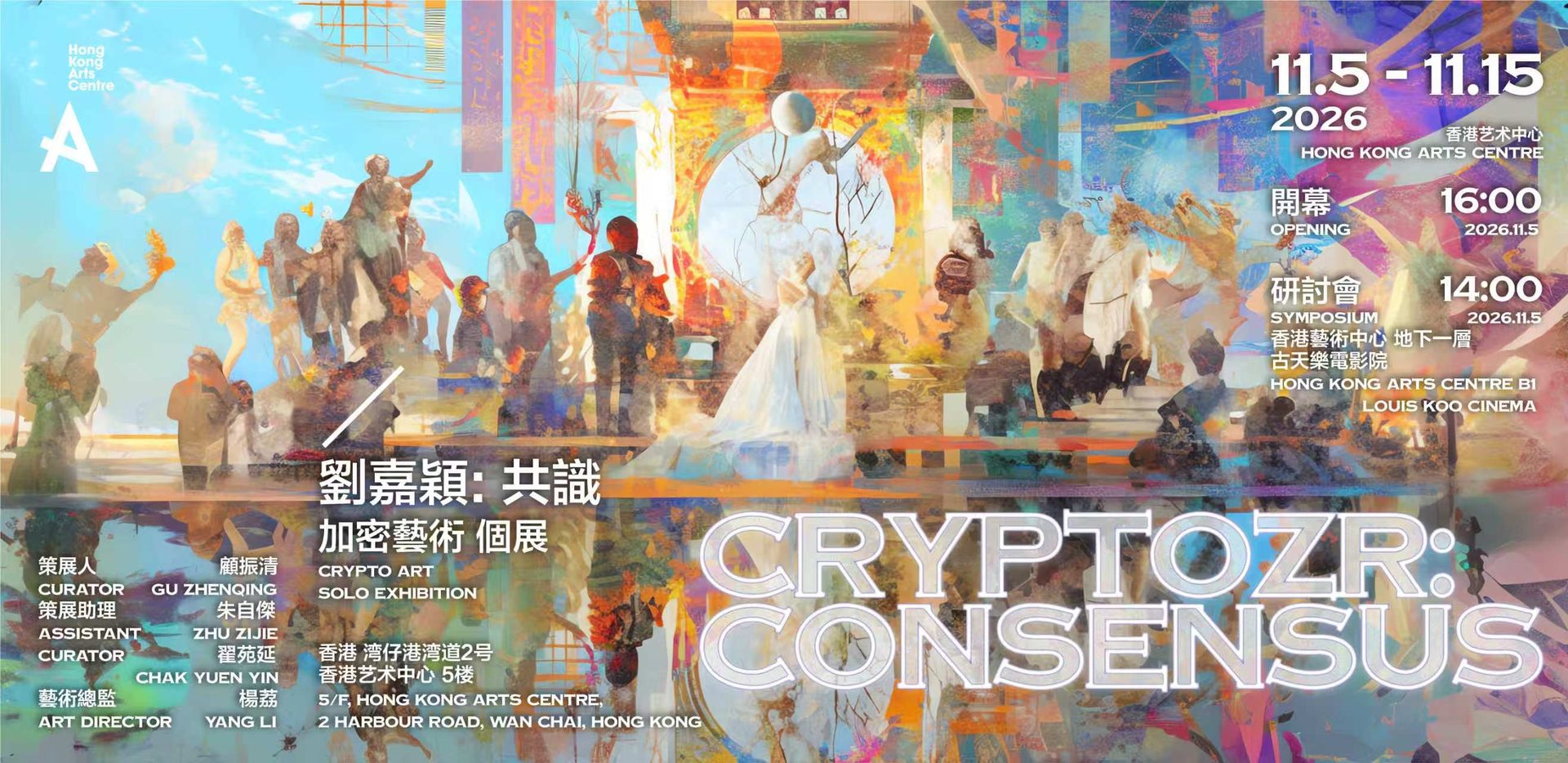
Construction Phase (2027–2028)
- Continued development of Bidder platform functions, integrating existing platform features and building new ones per creative needs (such as various issuance and auction mechanisms)
- Deep integration of the Bidder platform suite with the DAO: treasury-holding auctions and the full new-work-sale process on-chain
- Phase one of the CHIJIN metaverse museum goes live (web), with AR/VR viewing progressively connected
- The first batch of annual membership events held around the world, with offline club branches established
- Whether and how to enable the treasury asset-management module decided after governance evaluation
Autonomy Phase (from around 2028)
- Once issuance and the trading system are stable and ZRT in circulation reaches 20% of total issuance: the multisig hands treasury authority to the Governor, entering full on-chain autonomy
- The fully on-chain art fund launches: project incubation, blue-chip art collection and asset management decided by the DAO
- Construction of the silicon-based-art academic system: publications, symposia and criticism awards
- The treasury auction module and community-funding module come online one after another through governance proposals
The Long Horizon (to 2043)
- All 200 periods of issuance complete, the artist's new-work injection ratio reaching 50% and locked long-term
- Codenamed Utopia (2036): a long-horizon work completing its first decade together with community members
- ZRDAO becomes a landmark self-governing institution in the field of Silicon Art: a complete art ecosystem, owned by the community, spanning creation / collection / curation / trading / scholarship
How We Measure Success
Whether ZRDAO has succeeded, looking back sixteen years hence, requires evaluating the following ten indicators:
How We Measure Success (cont.)
- Issuance completion: how many of the 201 periods received broad participation;
- Holder breadth: the number of unique ZRT holding addresses and the evenness of distribution;
- Governance vitality: average annual proposals, average voting turnout, the diversity of the delegate ecosystem;
- Treasury-holding lineage: the number of works injected and acquired, and the breadth of artists and forms covered;
- Handover milestone: whether the governance handover completed as promised and whether the system ran smoothly after;
- The caliber of the co-created works: whether B404 and Utopia become works that ought to be recorded in art history;
- Exhibition and academic footprint: the CHIJIN Art Museum's visitor count, the number of institutional collaboration exhibitions, academic publications;
How We Measure Success (cont.)
- Infrastructure adoption: the scale of issuance and trading carried by the Bidder suite;
- The community's generational turnover: whether, five and ten years later, new faces still become core contributors;
- Archival completeness: whether this on-chain decision history is written, without interruption, up to the very latest block.
How We Measure Success
The Consensus
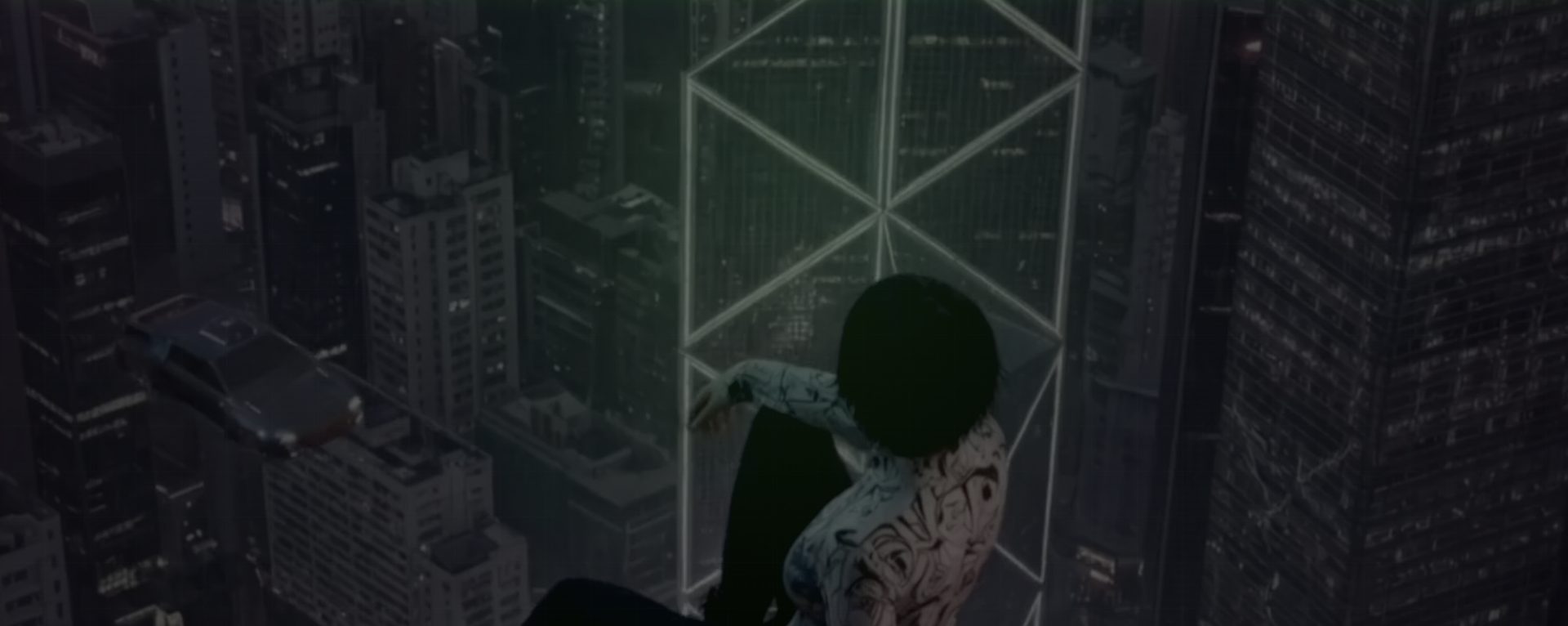
Epilogue: A Letter to the People Sixteen Years From Now
A whitepaper with an issuance cycle of 16.5 years is destined to be written not for this moment's market, but for time.
In 2043, when the 200th period of issuance ends and half of the artist's new works flow by formula into the community treasury, the mechanisms written down today — pro-rata fair pricing, the fixed 4% quorum, the 48-hour timelock — will all have become on-chain conventions that have already run a thousand times. Looking back then, the standard by which people judge ZRDAO will not be the price curve of any period, but a plainer question:
Can an artist and an open community, using code as their covenant, sustain their mutual trust for sixteen years and together build an art world that did not exist before?
We hand the answer to the blocks, to be written one at a time.
Epilogue: A Letter to the People Sixteen Years From Now (cont.)
If you are a collector, here is a collecting world that needs no letter of introduction; if you are a creator, here is an issuance infrastructure that needs no permission; if you are a researcher, here is a complete original archive of a category in its formative period; and if you are simply someone curious about the art of the Silicon Age, the gate of the genesis period will open at block 25,624,800.
There is no need to rush to understand all of this whitepaper. The rules are already on-chain, and there is plenty of time — this is precisely the most extravagant gift of a 16.5-year project.
This whitepaper is version 1.0. As governance evolves, subsequent revisions will be proposed in ZIP form and confirmed by the community, with all historical versions publicly archived — including every error we may correct in the future.
Acknowledgements
This whitepaper stands on many shoulders: thanks to the public infrastructure the Ethereum community has built over more than a decade — from the ERC standards to the OpenZeppelin contract library, from Gnosis Safe to Seaport, every line of reliable code in this project benefits from the collective intelligence of this open ecosystem; thanks to forerunner organizations such as PleasrDAO, FlamingoDAO, ENS and Uniswap, which, through real successes and failures, blazed a referenceable trail for on-chain governance and collective collection; thanks to every institution, collector and writer who over nine years has collected, exhibited or commented on CryptoZR's works — your serious attention is the foundation on which crypto art has reached today; and thanks to you, reading this document — if the new continent of Silicon Art is at last to be settled, your address should be among the first names.
Frequently Asked Questions (FAQ)
Q1: How is ZRDAO different from a typical NFT project? The typical model of an NFT project is "issue once, promise a roadmap, team executes." ZRDAO's model is "issue two hundred times, promise by formula, code executes": issuance is spread over 16.5 years across two hundred periods, the injection of the artist's works is backed by an on-chain formula, and the disposition of the treasury is decided by holder votes rather than by the team. You need not believe any roadmap; the rules are already written into an unmodifiable contract.
Q2: How do I take part in the genesis-period issuance? Within 30 days from 27 July 2026 (mainnet block 25,624,800), via the Bidder.Club platform or by sending ETH directly to the crowdsale contract (minimum 0.001 ETH per contribution). After the period ends, claim ZRT in the proportion of your contribution to the period's total. No whitelist, no rush; contribution share is distribution share.
Q3: What if I miss the genesis period? There are 200 more periods afterward, 30 days each, with exactly the same mechanism. This is precisely the point of long-cycle issuance: join at any time, and you can obtain ZRT from the primary market under the same rules as everyone else.
Frequently Asked Questions (FAQ) (cont.)
Q4: Who decides the price of ZRT? It is decided jointly by the genuine contributions of each period's participants: price of the period = total ETH contributed in the period ÷ tokens issued in the period. No pre-sale discount, no institutional-round pricing; the founding team and any latecomer face the same formula.
Q5: How do I obtain voting power? After claiming ZRT, call delegate once (you may delegate to yourself or a trusted address) to activate voting power. ZRDAO.org will provide a graphical interface for the full governance functions. Voting weight is computed by the snapshot at the moment of proposal creation, so buying votes at the last minute is ineffective.
Frequently Asked Questions (FAQ) (cont.)
Q6: Might the team multisig misappropriate the treasury in the first two years? The multisig cannot operate the treasury directly. Every one of its instructions must first be submitted to the timelock contract and can only execute after 48 hours of publicity, visible to the community throughout; the multisig itself is a 4/5-threshold Gnosis Safe, and no single person can act. The ETH from the crowdsale belongs to the issuing entity, used for ecosystem operations and to pay the artist's work-license consideration as agreed; what the treasury holds is the works injected by the artist and the assets brought in by subsequent governance decisions. The two fund paths are entirely separate at the contract level, and issuance proceeds do not enter the artist's personal wallet.
Q7: What can treasury assets be used for? After a governance vote (in Phase 1, via the multisig + timelock), they may be used for: community grants, work auctions and exhibitions, charitable donations, blue-chip art NFT collection, and on-chain asset management prudently enabled through governance, among others.
Frequently Asked Questions (FAQ) (cont.)
Q8: What happens if no one participates in a period? No one can claim that period's tokens, and the artist will call the burn function to permanently remove them from circulation. The total supply only decreases; it is not redistributed.
Q9: Can governance parameters (such as voting period, threshold) be changed later? Yes, but by only one path: initiated and passed by ZRT holders through a governance proposal. Neither the team, the multisig, nor the artist has authority to modify them; the power to modify the rules itself also belongs to the community.
Q10: What happens after the injection ratio caps at 50%? After the 200th period of issuance ends, the 50% injection ratio for the artist's new works is maintained long-term. The artist retains the other 50%, a necessary guarantee of creative sustainability. ZRDAO's design philosophy is long-term symbiosis, not draining the pond to catch the fish.
Frequently Asked Questions (FAQ) (cont.)
Q11: How do I confirm the contract I interact with is genuine? Take the addresses in Appendix A of this whitepaper as the sole benchmark and check on Etherscan: the address page should show the green "Contract Source Code Verified" mark, and the token name should be CryptoZR DAO Token (ZRT). Any act — in the name of an airdrop, customer service or a "contract upgrade" — that leads you to interact with another address is fraud.
Q12: Does holding ZRT mean owning the treasury works? No. Ownership of the treasury works belongs to the treasury contract itself; what ZRT grants you is the governance right over how these assets are disposed, plus community benefits. This is precisely the essential difference between DAO collection and "NFT fractionalization": the former governs a living collecting body, the latter merely divides a single still object.
Frequently Asked Questions (FAQ) (cont.)
Q13: Why price in ETH rather than a stablecoin? Three reasons: ETH is Ethereum's native asset, with the shortest participation path and no extra approval needed; ZRDAO's participants are, by nature, a crypto-native group that keeps books in ETH; and over a 16.5-year time scale, any centralized stablecoin's survival assumption is more fragile than ETH itself.
Q14: Who are the members of the team multisig? The multisig is a 5-member, 4-signature-threshold Gnosis Safe (address in Appendix A), with member composition publicized through community channels. What matters is not the list but the structure: no single person can do evil, no two in collusion can do evil, and every treasury operation of the multisig goes through 48 hours of publicity.
Q15: Will ZRT be listed on exchanges? ZRT is a standard ERC20 from birth and can circulate freely on any decentralized exchange. A listing on a centralized exchange is not promised by the team; it is decided by the market itself.
Frequently Asked Questions (FAQ) (cont.)
Q16: I am an artist / curator / developer — how do I participate deeply? Besides holding and voting: curators can submit CHIJIN Art Museum special-exhibition plans via ZIP; developers can take part in module and tool building and be rewarded through treasury bounties; artists can watch the community co-creation projects and future incubation directions. Among ZRDAO's six functions, every profession has its own place.
Q17: Voting is public — will that bring interpersonal pressure? On-chain voting is public by nature, the price of accountability. There are two ways to mitigate it: the delegation mechanism lets a holder unwilling to make their stance public hand their vote to a delegate whose stance is public; and a major contested issue can first be fully brewed through an off-chain signal vote, so that consensus is already clear by the formal on-chain vote. In a transparent organization, the cost of persuading one another is borne by the forum, not by the vote.
Frequently Asked Questions (FAQ) (cont.)
Q18: What if the artist cannot continue to create for health reasons? The works already injected into the treasury are unaffected; their ownership is on-chain and depends on no one's continued action. The future injection formula applies to "new works actually sold," and if there are no new works there is no new injection — but neither does any debt relationship arise. The treasury's existing holdings, funds and governance system run as usual. ZRDAO ensures by mechanism: the artist is the community's most important partner, but not a single point of failure.
Q19: Can treasury holdings be lent to museums for exhibition? Yes, and this is precisely one of the treasury's important uses. Once a loan proposal passes governance, the "loan" of an NFT work can be realized through label authorization, a dedicated display address or a time-limited agreement: lending an on-chain work needs no insurance and no freight, only a vote. The Ulsan Art Museum and the Sigg collection have already proven institutions' acceptance of such works.
Frequently Asked Questions (FAQ) (cont.)
Q20: Will the whitepaper itself be updated? Where do I see the latest version? Yes. The OpenSlide version of the whitepaper will be deployed on a server and accessed via a web link, updated from the same source as the Markdown document; any substantive revision is proposed through the ZIP process, with all historical versions archived. To emphasize the priority again: on-chain contract > whitepaper > any oral or community retelling.
Appendix A · Contract Addresses and Parameter Master Table
Ethereum Mainnet Contracts (source code all verified on Etherscan)
| Name | Address | Role |
|---|---|---|
| TOKEN (ZRT crowdsale contract) | 0x0c862C4Aff0c87F3b4e93350Ecf2DD6ADA0C5400 | ERC20 governance token + 201-period crowdsale + team vesting |
| TIMELOCK | 0xb9410Acc99B77fe1f831383DC461E947853Eb88E | The treasury's sole control entry, 48-hour execution delay |
| GOVERNOR | 0xc307e8B962cB839A49E085b91ed1954138cc74aB | Proposal, voting, queuing, execution |
| TREASURY | 0xacE4cd79FbEEf3E13B4Cee1Eae3B77E55a8b2dCe | Full asset custody + module registry |
| TEAM_GNOSIS (team multisig) | 0xa7089fAd9E300d07021FEe20589b102cB0172C2b | Gnosis Safe 1.4.1, 5 members, 4/5 threshold |
Issuance Parameters (fixed in the contract, unmodifiable)
| Parameter | Value |
|---|---|
| Token name / symbol | CryptoZR DAO Token / ZRT |
| Total issuance | 2,100,000,000 ZRT |
| Genesis-period sale | 200,000,000 ZRT (Period 0) |
| Regular-period sale | 9,000,000 ZRT × 200 periods |
| Team allocation | 100,000,000 ZRT (730-day linear vesting, claimed by the multisig) |
| Period length | 216,000 blocks (about 30 days) |
| Issuance start block | 25,624,800 (around 2026-07-27) |
Issuance Parameters (fixed in the contract, unmodifiable) (cont.)
| Parameter | Value |
|---|---|
| Total issuance duration | 201 periods ≈ 16.5 years |
| Minimum contribution | 0.001 ETH |
| Distribution method | Claimed pro rata to contribution after a period ends |
| Zero-contribution period | That period's tokens can be burned only by the artist |
Governance Parameters (self-modifiable only through a governance proposal)
| Parameter | Value |
|---|---|
| Proposal threshold | 21,000,000 ZRT (1% of total) |
| Voting delay | 1 day |
| Voting period | 5 days |
| Quorum | 84,000,000 ZRT (4% of total, a fixed absolute value) |
| Counting method | For / against / abstain, snapshot weight |
| Late-quorum extension | First reaching quorum within the last 2 days → auto-extend ≥ 2 days |
| Timelock delay | 172,800 seconds (2 days) |
Governance Parameters (self-modifiable only through a governance proposal) (cont.)
| Parameter | Value |
|---|---|
| Clock mode | timestamp |
Treasury and Economic Formulas
| Item | Formula / value |
|---|---|
| Price per period | Total ETH contributed in the period ÷ tokens issued in the period |
| New-work injection ratio | 10% + 0.2% × completed periods (capped at 50%) |
| Founding injection | Red and Blue 10/100 · 1000EYE 100/1000 · Sound Money 10/100 · Consensus 1/10 |
| Governance-handover condition | Issuance and trading system stable AND ZRT issuance ≥ 20% of total |
| DeFi module | Not enabled by default; includes Aave V3 deposit/withdrawal and Uniswap V2 liquidity interfaces, registration and enabling require governance (the Router can be switched through governance) |
Appendix B · Glossary
Silicon Art: the collective term for art that takes cryptographic technology, artificial intelligence and data flows as its medium and mode of existence, encompassing crypto art, AI art and data art.
Crypto Art: an art form that takes cryptographic technology as its creative language and whose asset ownership depends entirely on public chains. The Chinese translated term was introduced and promoted by CryptoZR in 2019.
DAO (Decentralized Autonomous Organization): an on-chain organizational form with governance-token voting as its decision mechanism and smart contracts as its executive body; decisions and fund flows are publicly verifiable throughout.
ZRT: ZRDAO's governance token, total supply 2.1 billion, serving as both governance voting power and a community-benefit certificate.
Genesis Period: Period 0 of ZRT issuance (the first month), selling 200 million.
Appendix B · Glossary (cont.)
Pro-rata Distribution: each period's tokens are distributed by the proportion of a participant's ETH contribution to the period's total, and the price is discovered jointly by all participants.
Treasury: the on-chain contract in which ZRDAO holds art works and financial assets, controlled exclusively by the timelock.
Timelock: a contract that enforces delayed execution. Any operation on the treasury must first queue and be publicized for 48 hours, leaving the community a window for review and reaction.
Governor: the on-chain governance contract that manages the creation, voting, queuing and execution of proposals; based on the OpenZeppelin Governor standard framework.
Quorum: the minimum total votes required for a proposal to be valid. ZRDAO uses a fixed 84 million ZRT (4% of total), unchanging with circulation.
Appendix B · Glossary (cont.)
Snapshot Voting: voting weight is taken from the historical holdings record at the moment of proposal creation, making "last-minute vote-buying" and flash-loan attacks ineffective.
Delegate: the act of a ZRT holder assigning voting power to some address (including one's own); undelegated tokens are not counted in voting.
Multisig / Gnosis Safe: a contract wallet that requires the joint signatures of several members to execute a transaction. ZRDAO's team multisig is 5 members with a 4-signature threshold.
Handover: the one-off governance event of transferring treasury control from the team multisig to the Governor, conditioned on a stable system and ZRT issuance reaching 20% of total.
Module: a functional-extension contract that governance can register to the treasury (such as the DeFi module), executed in the treasury's context via delegatecall.
Appendix B · Glossary (cont.)
NFT (Non-Fungible Token): an on-chain asset standard with a unique identifier (ERC721/ERC1155), one of the main forms of ownership certification for crypto artworks.
ERC20: Ethereum's fungible-token standard; several of CryptoZR's conceptual works (Out of Nothing, Private Currency, etc.) take ERC20 directly as creative material.
Inscription / Ordinals: a protocol that permanently carves data into Bitcoin satoshi ordinals, giving the Bitcoin network the capacity to carry native artworks.
Radical Markets: a mechanism-design idea proposed by economists including Glen Weyl; the TopBidder protocol implements its "partial common ownership" idea as self-pricing NFTs anyone can force-purchase by bidding 10% higher.
Dutch auction / reverse Dutch auction: an auction form in which the price decreases (or increases) over time; 100 Days uses a reverse Dutch auction with community credit as its subject.
Appendix B · Glossary (cont.)
Vickrey Auction: a sealed second-price auction in which the highest bidder settles at the second-highest price, incentivizing truthful bids.
Candle Auction: an auction whose closing moment is randomly determined, eliminating last-second sniping.
LBP (Liquidity Bootstrapping Pool): a liquidity-guided issuance mechanism with weight descending over time.
Aave: a leading Ethereum lending protocol; the ZRDAO treasury's DeFi module reserves an interface to connect to it, and whether to enable it is decided by governance.
Uniswap V2: a decentralized trading protocol with constant-product market making.
LP (liquidity certificate): the share certificate obtained after injecting liquidity into a trading pair.
Appendix B · Glossary (cont.)
ZIP (ZRDAO Improvement Proposals): ZRDAO's standardized proposal-document system, the carrier of the community's self-governance charter.
Provenance: a work's ownership and circulation history. The provenance of an on-chain work is inherently complete and tamper-proof.
Metaverse Curation: the practice of organizing exhibitions in virtual three-dimensional space; the CHIJIN Art Museum is its institutionalized form.
Checkpoint: the historical record point ERC20Votes writes on each balance change, the technical basis for precisely tracing "weight at the moment of a proposal."
Selector: the 4-byte hash of a function signature, by which the treasury module registry keys its routing.
Appendix B · Glossary (cont.)
delegatecall: the low-level instruction that executes a target contract's code in the caller's storage context, the technical core of the treasury's modularity.
CEI pattern: the checks-effects-interactions contract-writing paradigm, the first line of defense against reentrancy attacks.
Genesis Block: the first block of a blockchain; the newspaper headline in Bitcoin's genesis block is regarded as the starting point of crypto culture.
Gas: the computational fee paid to execute a transaction on Ethereum.
ENS: the Ethereum Name Service, mapping readable names to addresses; also one of the benchmark projects for DAO governance practice.
Appendix B · Glossary (cont.)
Harberger tax / COST: the property-rights mechanism proposed in Radical Markets — the holder self-reports a valuation, is taxed on that valuation, and anyone may force-purchase at that valuation; the TopBidder protocol is its implementation in the art field.
Dutch Auction: an auction form in which the price descends from high to low and the first responder settles.
Ulam Spiral: the pattern the primes reveal when the natural numbers are arranged in a spiral, the compositional principle of 1000EYE.
Seaport: an open-source NFT-trading protocol standard; ZRDAO's self-deployed instance carries regular listing trades.
Ragequit: the mechanism by which Moloch-line DAOs let members exit with a proportional share of assets; ZRDAO does not adopt it, trading treasury integrity for the institutional character of the collection.
Appendix B · Glossary (cont.)
Temperature Check (signal vote): an off-chain intent test before the formal on-chain vote, reducing the on-chain cost of proposals lacking consensus.
Delegate: a community member who accepts others' delegated voting power and exercises governance rights publicly.
Proof of Stake (PoS): the consensus mechanism Ethereum adopted from 2022, with energy use about 99.95% lower than proof of work.
Decentralized storage: distributed content-storage networks such as IPFS and Arweave, the persistence solution for the presentation layer of on-chain art.
Appendix C · Index of Exhibitions and Press Coverage
Solo Exhibitions
| Year | Exhibition | Institution / Place |
|---|---|---|
| 2021.5–6 | CryptoZR: COOKIE COOKIE (the world's first solo crypto-art exhibition) | Guardian Art Center, Beijing |
| 2022.4–11 | CryptoZR: COOKIE COOKIE 2.0 (inaugural unit of the First Venice Metaverse Biennale) | Spazio Thetis / the Arsenale, Venice |
| 2023.5 | CRYPTOZR: ARRIVAL | Saatchi Gallery, Gallery 3, London |
| 2026.11 (upcoming) | CONSENSUS | Hong Kong Arts Centre (HKAC), Hong Kong |
Group Exhibitions
| Year | Exhibition | Institution / Place |
|---|---|---|
| 2020.5–8 | CAFA Graduate Exhibition | CAFA Art Museum, Beijing |
| 2021.4 | Virtual Habitat — Have You Seen the Meme in the Mirror | UCCA Lab, Beijing |
| 2021.8–10 | Do Not Black Out | Ming Contemporary Art Museum, Shanghai |
| 2021.8–11 | Dislocation: From Digital Native to Metaverse | How Art Museum, Wenzhou |
| 2021.10 | Hyperlink | 751 Design Festival, Beijing |
| 2021.10 | Past Futurism — The Past and Future of Chinese Contemporary Art | Beijing Exhibition Center, Beijing |
| 2021.9–2022.2 | Evolution — The Future of the Public | CAFA Art Museum, Langfang |
Group Exhibitions (cont.)
| Year | Exhibition | Institution / Place |
|---|---|---|
| 2022.11–2023.3 | Nothing to Do with Money: Log in to the Metaverse | Sea World Culture and Arts Center (UNESCO pavilion), Shenzhen |
| 2022.12–2023.3 | Microcosm: Technology-Driven Emotions | Chengdu Art Museum, Chengdu |
| 2023.10–2024.1 | Infinite Reality Lab, Season 1 | CIC Innovation & Creativity Center, Shenzhen |
| 2023.11–2024.4 | Hyundai Blue Prize Art + Tech 2023 winners' exhibition, Dramatic Ecology | Hyundai Motorstudio, Beijing |
| 2024.1–3 | Amazing "Sheroes" — Forbes China Tribute to Outstanding Female Artists Invitational | Phoenix Center, Beijing |
| 2024.12–2025.4 | 3rd Jinan International Biennale, "The Age of Human Intelligence" | Shandong Art Museum, Jinan |
Group Exhibitions (cont.)
| Year | Exhibition | Institution / Place |
|---|---|---|
| 2025.4 | Osaka World Expo, TEAM EXPO Pavilion TE2 | Osaka |
| 2025.6–8 | Silicon-based: New Creator | Tang Contemporary Art, Beijing |
| 2025.8 | Bitcoin Asia 2025 | HKCEC Hall 1, Hong Kong |
Institutional Collections
| Collector / Institution | Work | Year |
|---|---|---|
| Ulsan Art Museum (South Korea) | Red and Blue | 2023 |
| Uli Sigg (Switzerland) | The Consensus | 2025 |
| Hundreds of private collectors | 1000EYE (edition of 1000) | from 2021 |
| SCA-1 art satellite (in orbit) | Solo Mining | 2024 |
Index of Press Coverage and Criticism (cont.)
International media: Venice solo-exhibition coverage (2022)
| Outlet | Content |
|---|---|
| Forbes | Coverage of CryptoZR's Venice Metaverse Biennale solo exhibition |
| Artribune | Review of COOKIE COOKIE 2.0 |
| The Cryptonomist | The Venice solo exhibition and crypto-art market observation |
| Art Agenda | Exhibition announcement and review |
| Espoarte | Italian-language exhibition review |
| Juliet Art Magazine | Exhibition review from a contemporary-art perspective |
| La Nuova di Venezia | Local Venice press coverage |
Index of Press Coverage and Criticism (cont.)
| Outlet | Content |
|---|---|
| T Magazine | Exhibition feature |
| Thats Contemporary | Coverage on a contemporary-art platform |
| Forme Uniche | Italian art-media review |
| Exibart | Exhibition coverage |
| Phuket Times | Venice coverage from an Asian perspective |
Index of Press Coverage and Criticism (cont.)
Chinese media and in-depth interviews
| Outlet / Column | Content |
|---|---|
| iFeng Art | Preview feature on the Venice Metaverse Biennale |
| Artron | Coverage of Small Goal 2 at Venice |
| 8btc | In-depth artist interviews (parts 1 and 2) |
| ArtHub | Blockchain-art series: criticism, crypto dialogues, observation column, chat interviews |
| Tencent | "From product designer to artist" interview |
| Right Click Save | An international dialogue on crypto art |
| Hyundai Master Talks | An art-and-technology masters' conversation |
Index of Press Coverage and Criticism (cont.)
| Outlet / Column | Content |
|---|---|
| Cao Yin (feature essay) | On decentralized art |
Index of Press Coverage and Criticism (cont.)
Representative features and literature
| Feature | Note |
|---|---|
| 1000EYE issuance-experiment report (CN/EN) | A complete methodological document of a record-setting Asian NFT sale |
| TopBidder and Radical Markets | A theoretical dialogue on protocol art and the Harberger tax |
| CryptoCuration | An early text on on-chain curatorial methodology |
| Red and Blue creative statement (CN/EN) | The artist's first-hand account of "bidding is creation" |
| Debate on the boundaries of blockchain art | Literature debating the definition and extension of crypto art |
| From the Crypto World to the Art World | A long observation from the perspective of industry migration |
| Retrospective on the first blockchain-art exhibition | A starting-point document in the history of China's crypto-art exhibitions |
Index of Press Coverage and Criticism (cont.)
| Feature | Note |
|---|---|
| NFT Meets Art / The Language of Crypto | A public-facing science-communication and criticism series |
The complete media archive (40+ full texts, including bilingual Chinese-English versions) is continuously archived in the ZRDAO library, and the OpenSlide version will provide per-article source links. This literature is itself primary source material of how China's crypto art was seen, discussed and written about from 2019 to 2026.
Appendix D · Catalogue Raisonné: An On-Chain Chronology of Creation (2017–2026)
This catalogue collects CryptoZR's major on-chain works by year of creation. The contract address, issuance record and circulation history of each work can be independently verified on its respective public chain — this in itself is the evidence that distinguishes Silicon Art from every prior art form: the work's archive is kept by the public ledger.
Out of Nothing (2017 · Ethereum · ERC20)
CryptoZR's first blockchain work, created in December 2017 and released on 5 January 2018. The artist modified the ERC20 token contract so that the more than 500,000 active addresses then on Ethereum would see 88,888 PRO Tokens "appear out of nothing" upon opening their wallets; yet these tokens truly activate only when the holder initiates a first transfer — whether value exists depends on whether you believe and act. Earlier than the establishment of the NFT standard, the work completed, with the smallest technical gesture, the first question about the nature of money, and is regarded as one of the origin points of Chinese crypto art. Contract address: 0x8377ee6d3545bc6ff1425ee3015dc648b149c7b2.
Out of Nothing (2017 · Ethereum · ERC20) (cont.)
Archival note: at the work's release, "airdrop" had not yet become industry jargon, and the very act of "making tokens appear in your wallet" constituted a direct interrogation of the viewer. In retrospect, Out of Nothing nearly prophesied all the later narrative motifs of the crypto world — creation from nothing, trust-activation, and the participatory ontology of "if you do not come to claim it, value does not exist."
Greed Is Good (2019 · EOS · fungible token)
The artist modified the transfer rule of a digital currency: on every transfer, the balance increases rather than decreases. A monetary system of "the more you spend, the more you have" lets greed self-replicate at the code level — a mechanized plain description of human nature in the age of speculation. The work is at once a parody of the emerging discipline of "token-economic design": when new issuance can be written into any shape, restraint is the scarcest design.
Red and Blue (2018–2020 · Ethereum · ERC721 × 100)
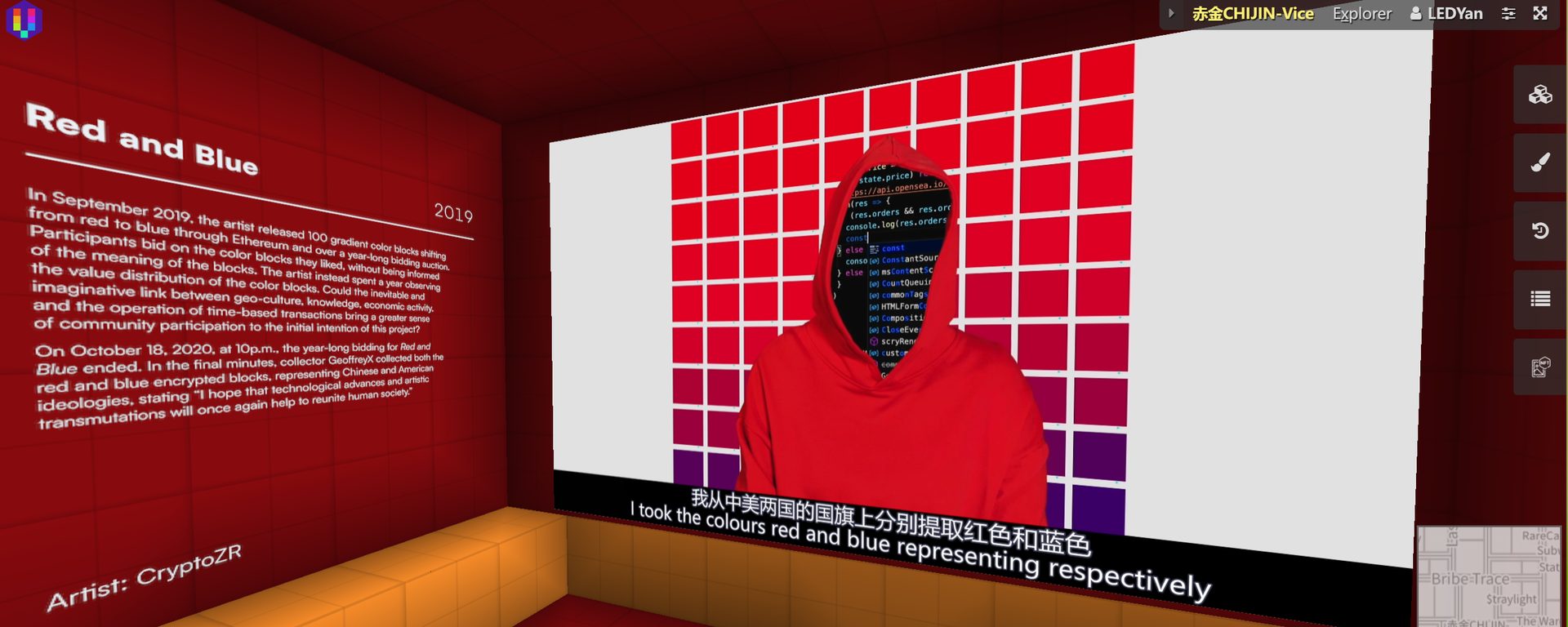
Conceived during the period of Sino-US trade conflict. The images of 100 NFTs evolve between the two colors red and blue, and every bid by a collector is a vote for one side — market behavior is creative behavior, the price curve is the work's brushstroke. After five years of continuous evolution, it was collected by the Ulsan Art Museum in South Korea in 2023, a landmark event of a public museum accepting the proposition "bidding is creation." ZRDAO's founding injection includes 10/100 of this work. Contract address: 0x85705c152b90a636ffa84b00736c2d27f982fdb9.
Red and Blue (2018–2020 · Ethereum · ERC721 × 100) (cont.)
Archival note: Red and Blue's five-year evolution happened to span the whole passage of crypto art from margin to mainstream, and the work's bidding record thus unexpectedly became a chronological monument of market sentiment. The Ulsan Art Museum's collecting decision gave the radical proposition "a work's meaning is written by buying-and-selling behavior" the formal endorsement of the museum system.
1000EYE (2019 · Ethereum · ERC721 × 1000)
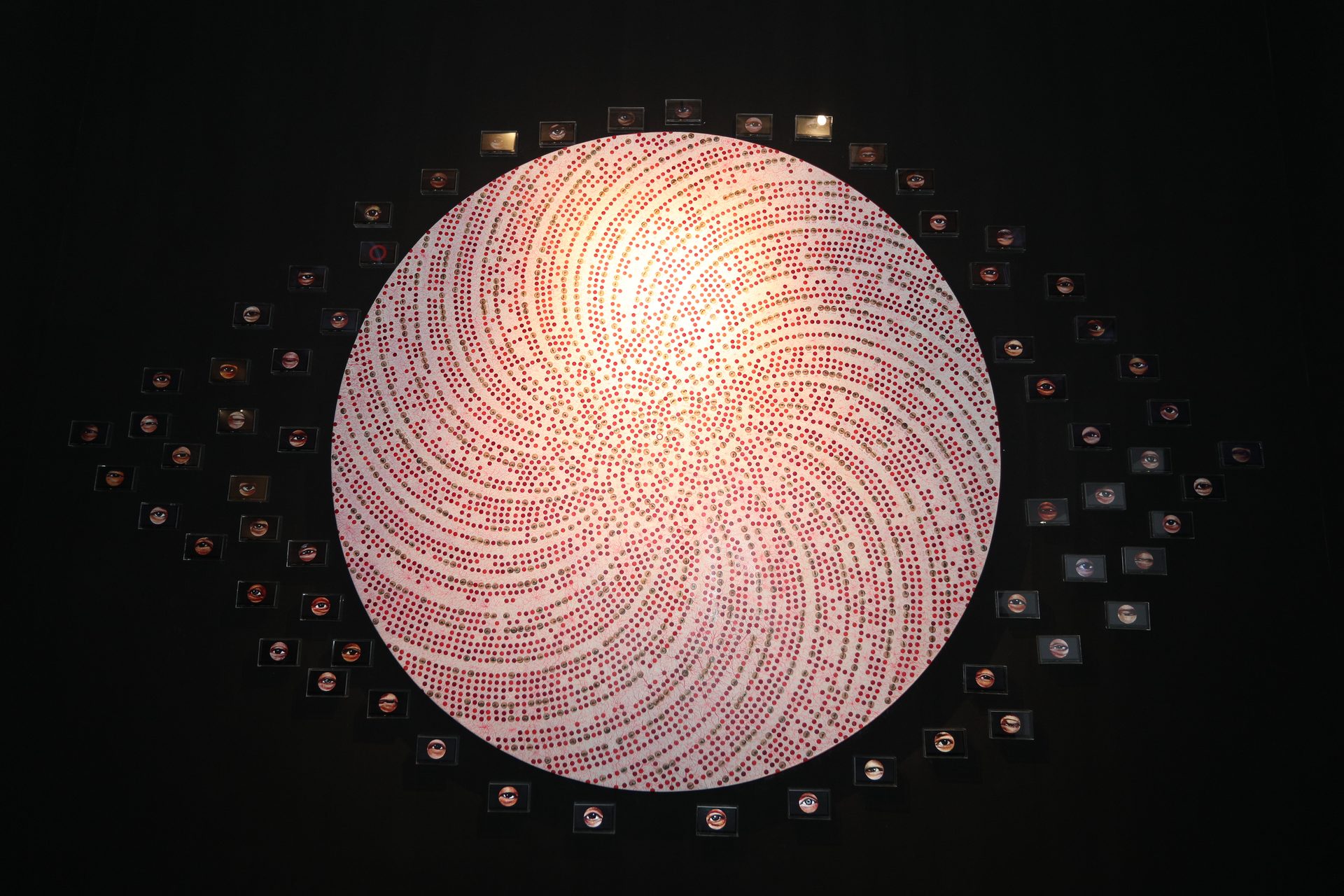
Centered on Satoshi Nakamoto's "eye," it arranges the eyes of 1,000 anonymous figures along an Ulam prime spiral, issuing a corresponding 1,000 NFTs. The issuance mechanism is itself part of the work: the closing index of the first Nasdaq trading day after the sale was used as a random seed to shuffle the image numbering, so that even the artist herself could not foresee which image any given NFT would correspond to, guaranteeing absolute fairness of distribution through the outside world's unpredictability. Sold in September 2021, it sold out in three hours for more than USD 3 million (about RMB 26 million), setting an Asian art-NFT price record, with holders spread across hundreds of collectors. ZRDAO's founding injection includes 100/1000 of this work.
1000EYE (2019 · Ethereum · ERC721 × 1000) (cont.)
Archival note: 1000EYE's issuance design triggered a lengthy discussion about "fair distribution" in the Chinese-speaking world (see the bilingual issuance-experiment report recorded in Appendix C). The technique of using the Nasdaq index as a random seed was later borrowed by many projects — a single work contributed to the industry a reusable primitive of fairness.
2020: Dense Responses in the Year of Helicopter Money
In 2020, amid the pandemic's shock, the Federal Reserve launched unprecedented quantitative easing. That year, CryptoZR's creation was like a burst of continuous shutter clicks, recording the turning moments of monetary history.
The Sound Money Series (2020 · Ethereum · NFT)
As the U.S. government "helicoptered money" by handing cash to the public, the artist analyzed on-chain Ethereum data, selected the thousand most active players in the crypto-art field, and airdropped them a crypto currency of "1000 dollars" denomination — a helicopter-money drop for the crypto-art world. If the central bank can print money out of nothing, why can't an artist create "money" out of nothing? The series was shown at the CAFA 2020 graduation exhibition. ZRDAO's founding injection includes 10/100 of this series.
The Sound Money Series (2020 · Ethereum · NFT) (cont.)
Archival note: the title Sound Money inverts the Austrian School's term — using an art airdrop to parody a state airdrop. The thousand airdropped addresses were "crypto-art activists" selected by on-chain behavior, and this list itself constitutes a demographic snapshot of the 2020 crypto-art community, now primary material for studying early community structure.
The Sound Money Series (2020 · Ethereum · NFT)
1weidollar
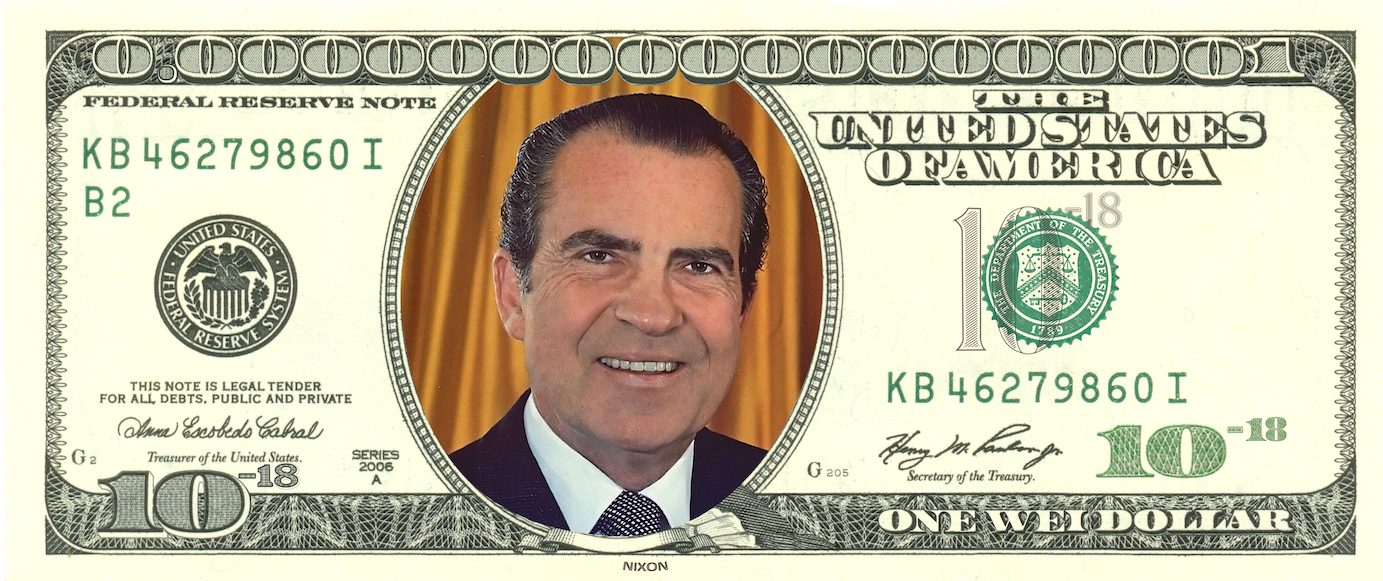
Smiley FED (2020 · Ethereum · NFT)
A moving-image work: the face of the Federal Reserve chair breaks into a smile to the rhythm of the printing press. The most concise visual footnote to "unlimited quantitative easing."
Private Currency ZR (2020 · Ethereum + copper coins + silk)
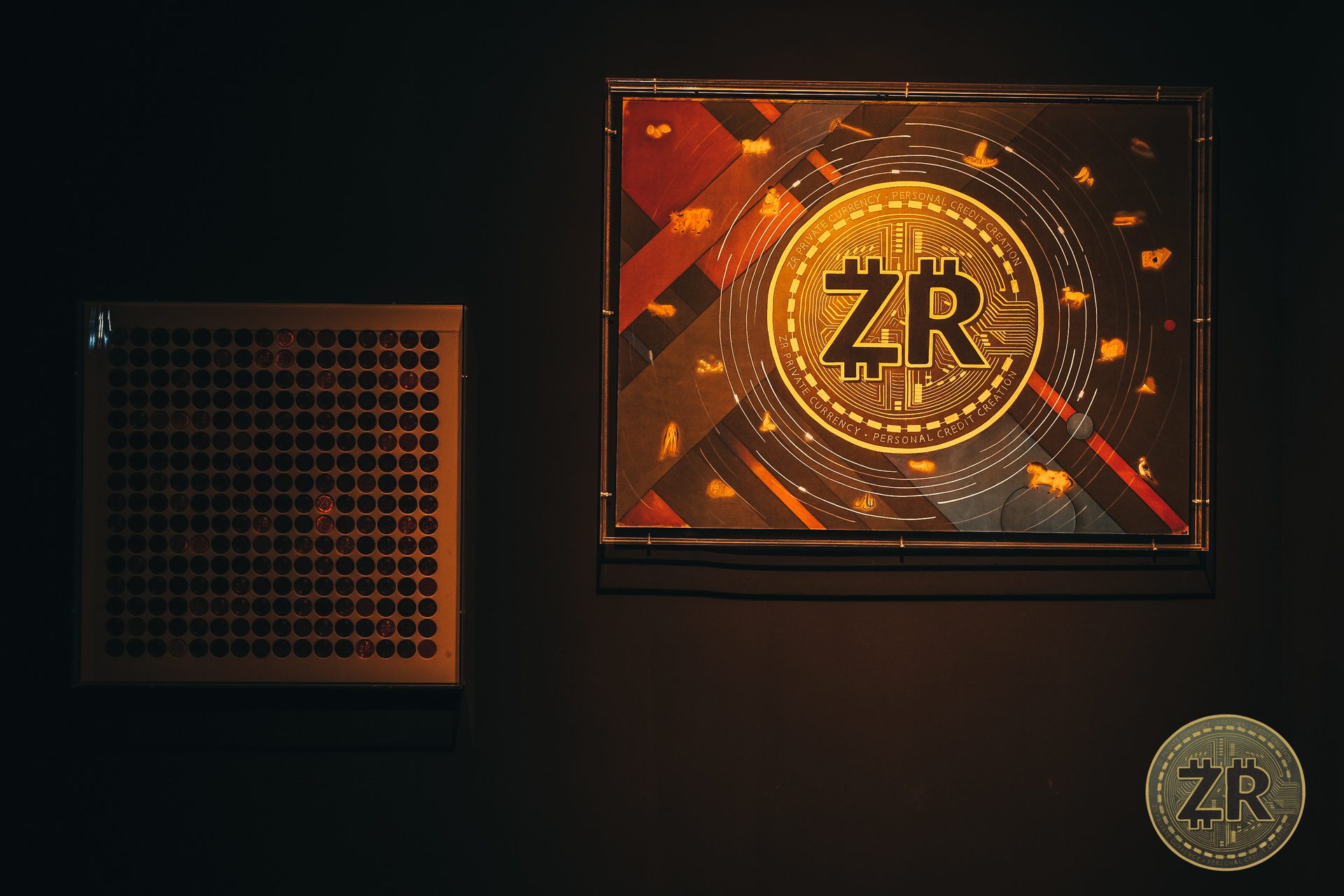
The artist issued a crypto currency under her personal online codename "ZR," promising to buy it back at par a year later: a public issuance of personal credit. Participants scanned a code to pay RMB 1 and received an Ethereum private key carrying 1 ZR. When the power to create credit devolves from the state to the individual, where is the boundary of money? The work exists as a combination of ERC20, minted copper coins and silk painting, the on-chain and the off-chain mirroring each other.
Private Currency ZR (2020 · Ethereum + copper coins + silk) (cont.)
As for the copper-coin component of the work, the artist tossed 256 copper coins whose random heads and tails composed the private key, becoming an Easter egg in the work's design. The first viewer to crack the private key withdrew the 10,000 ZR coins already deposited in the address.
Small Goal (2020 · Ethereum · DeFi art)
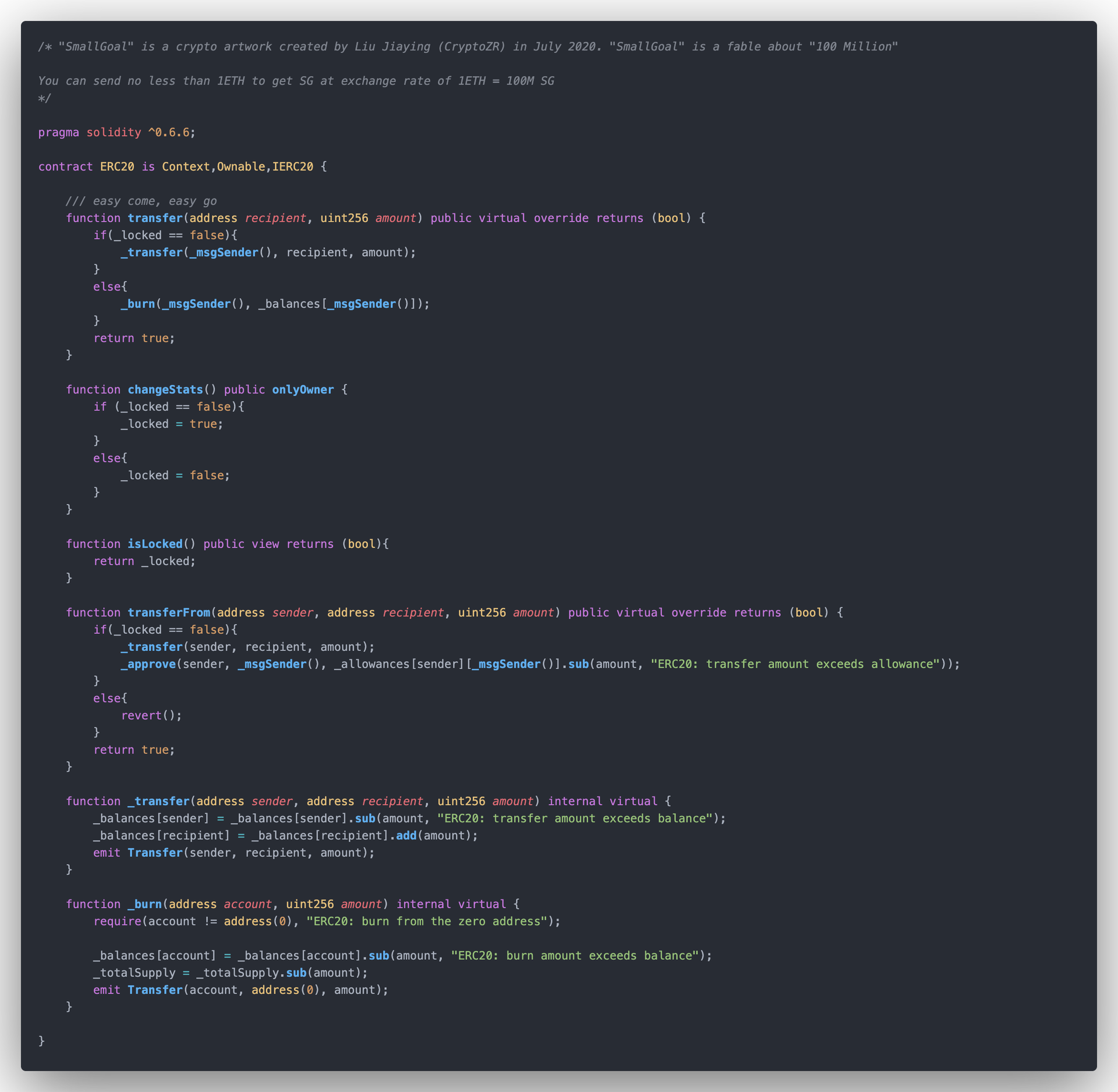
"A small goal" — the most famous wealth meme of the Chinese internet — was made by the artist into a composable on-chain position using DeFi. Worldly desire was written into financial Lego, and a modified ERC20 transfer mechanism made 100 million tokens in the wallet vanish to zero in an instant. The work was later invited to the Venice exhibition, one of the earliest practices of the DeFi-art sub-form.
Archival note: Small Goal was born on the eve of DeFi Summer, when the artist was living through the frenzy of liquidity mining as a core member of YFII. The work is therefore not a bystander's commentary on DeFi, but a postcard sent from the eye of the storm. The category "DeFi art" appeared almost together with this work.
United We Stand (2020 · Ethereum · NFT)
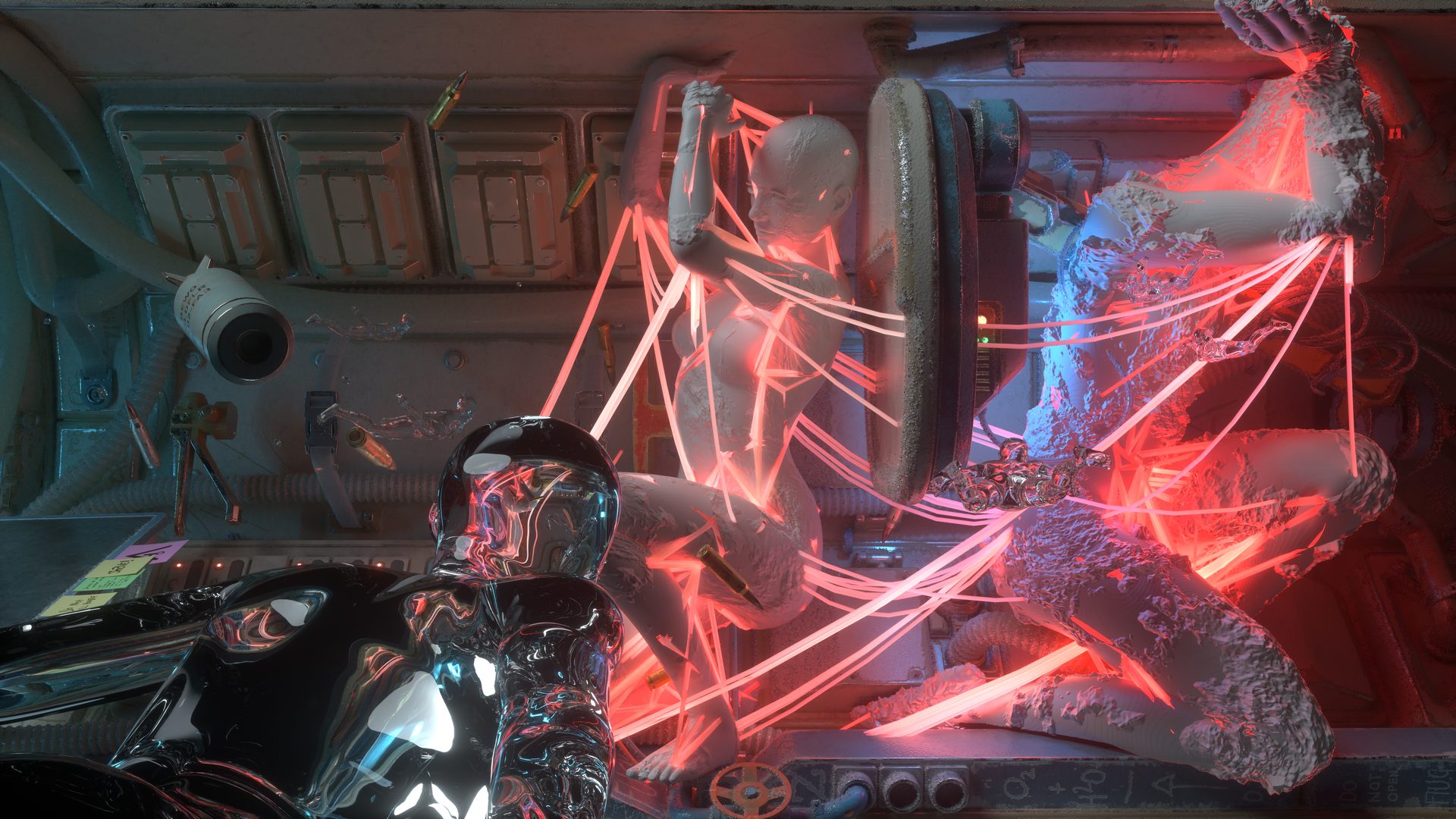
Commemorating the YFII community's "rebirth from the flames" after the Balancer and MetaMask blocking of August 2020: the Chinese blockchain community held the USD 120 price line for fourteen days and ultimately won market recognition. The artist minted this mass financial event into an NFT, claimable by sending 0 ETH to nft.dfi.eth, held by 2,768 users. A monument to community history, held jointly by the community.
Not Found Tokens (2020 · Ethereum · NFT)
The artist airdropped content-mutable NFTs to a hundred thousand addresses, hoping a hundred thousand people would "own the work for a while rather than forever." By the 2,050th airdrop, OpenSea and Rarible blacklisted the contract without reason, and the work collectively "404-ed" on the mainstream front ends. The blocking itself became the work's final form: in an industry that flaunts decentralization, the paradox of front-end censorship was captured by the work as-is and permanently exhibited — especially once the artist had a front of her own.
Not Found Tokens (2020 · Ethereum · NFT) (cont.)
Archival note: this blocking unexpectedly elevated the work from "an experiment about the temporality of ownership" to "a testimony about platform power." It also directly shaped ZRDAO's infrastructure philosophy. The entire argument of Chapter 7, "Why Build Our Own Infrastructure," can be read as a footnote to this work.
0DAY (2020 · Ethereum · NFT moving image)
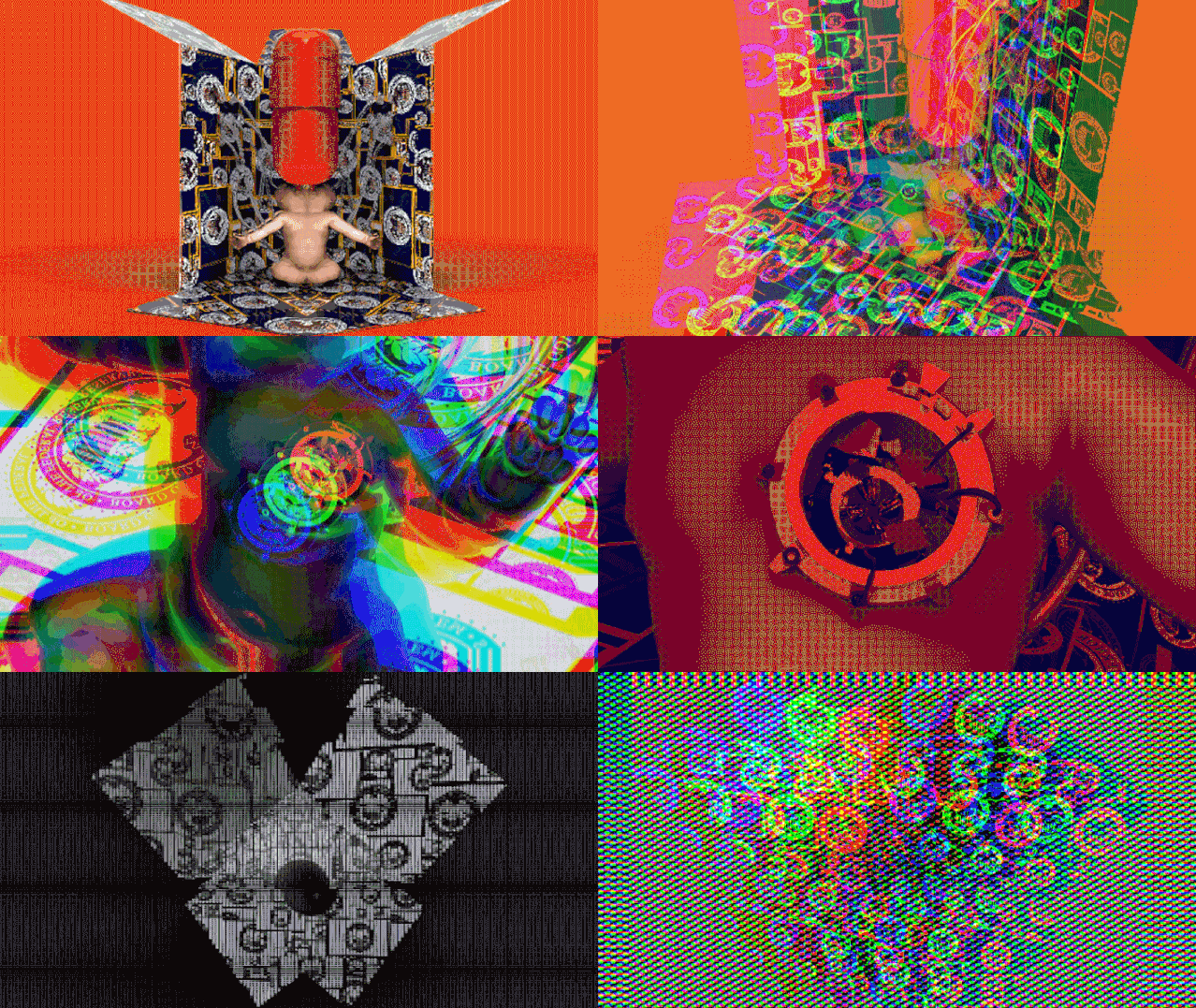
Using the vocabulary of cyberpunk and the metaphor of the red pill from The Matrix, it treats the relationship between people and money in postmodern society. Shown at the CAFA 2020 graduation exhibition.
CHIJIN (2020 · CryptoVoxels · metaverse)
The first virtual museum in CryptoVoxels based on traditional Chinese architectural elements, referencing the forms of Tibetan Buddhist temples and the corner towers of the Forbidden City. CHIJIN gathered an early metaverse-curation community around an open organizational ethos, and its sequel CHIJIN-Vice (2020) continued the spatial vocabulary of a three-story pavilion and courtyard — the first translation of the Chinese architectural tradition into silicon-based space.
CHIJIN (2020 · CryptoVoxels · metaverse) (cont.)
Archival note: the CHIJIN series later became the metaverse satellite venue of several group exhibitions, and the relevant units of shows such as "Virtual Habitat" and "Dislocation" all relate to this spatial thread. It proved a judgment later verified again and again: the value of a metaverse venue lies not in replicating the physical, but in creating a spatial grammar the physical cannot support.
CHIJIN (2020 · CryptoVoxels · metaverse)
CHIJIN-Vice
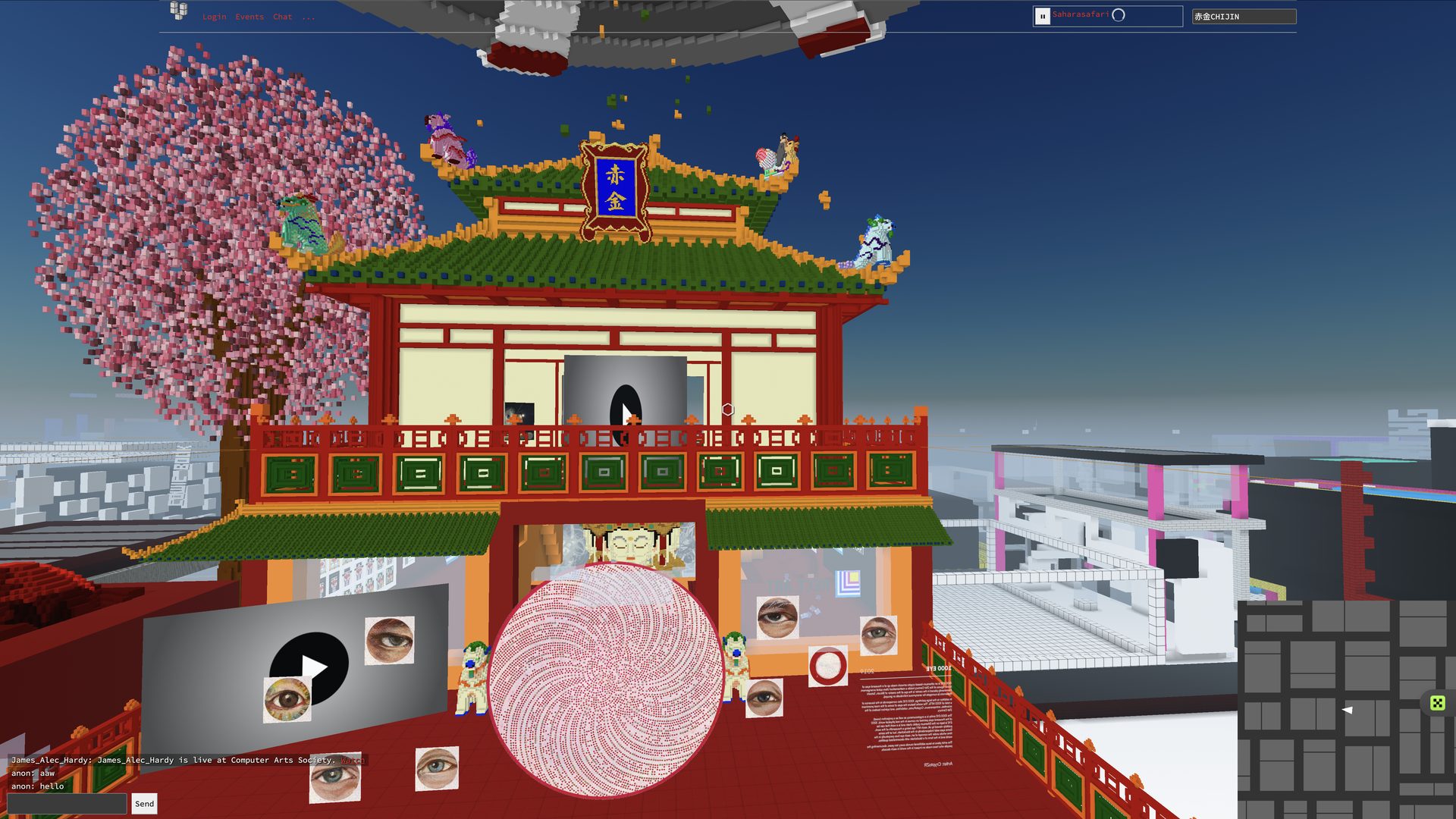
The TopBidder Protocol (2021 · Ethereum · protocol art)
A self-pricing NFT protocol based on the economist Glen Weyl's Radical Markets: for any work, anyone may at any time force a purchase by bidding 10% above the current price — ownership is forever in open competition, and "holding" becomes a state that must be continuously defended with real money. The protocol raised USD 2 million in total led by NGC Capital, running at the same time as the real trading platform Bidder.Top. Work and market, art and infrastructure, are here fused into one — this is precisely the origin of ZRDAO's "platform as art" line.
The TopBidder Protocol (2021 · Ethereum · protocol art) (cont.)
Archival note: the dispute over "whether ownership should be perpetually open" that TopBidder's launch triggered became one of the highest-quality theoretical discussions in the Chinese crypto community (see the Radical Markets feature in Appendix C). The work as protocol and the protocol as work here become, for the first time, hard to tell apart.
Confession House (2021 · Nervos · installation + smart contract)
Issuing a digital currency named after each participant who enters the installation. In the traditional system, currency is named after states and institutions, representing the endorsement of collective authority; Confession House returns the power of issuance to the individual — your name, your credit, your currency. The installation and the on-chain token are the two sides of a confessional.
Point Zero Museum (2021 · CryptoVoxels · metaverse)
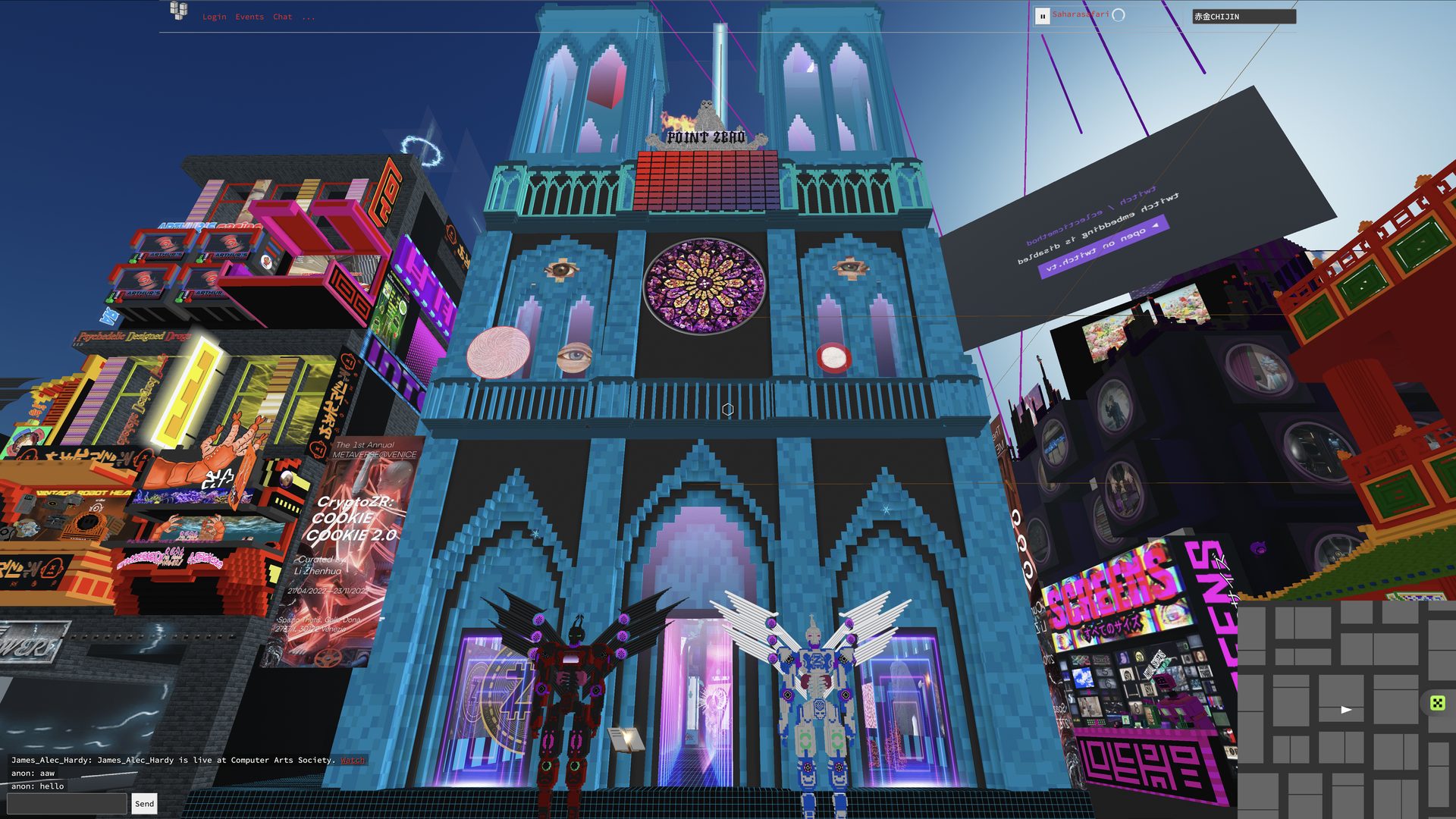
Inspired by the "Point Zéro" in the square before Notre-Dame de Paris — France's starting point for measuring national distances. The artist, together with architects Li Haiyang and Li Sirui and artists Yang Qilei and Shou Shengnan, built this museum where Gothic meets cyber in the busiest district of CryptoVoxels; during the Venice solo exhibition, 13 exhibited works were shown here in sync, completing the first mirroring of a physical biennale and a metaverse venue.
Point Zero Museum (2021 · CryptoVoxels · metaverse) (cont.)
Archival note: the significance of the Point Zero Museum lies at the level of exhibition history: it proved that a metaverse venue is not the electronic manual of a physical exhibition, but a space with its own independent curatorial grammar — visitors roam as avatars, and holdings and contracts interact in real time. The three-hall structure of the CHIJIN Art Museum (see § 8.4) directly inherits from this experiment.
Bit Tower (2021 · metaverse)
A vertically growing on-chain Tower of Babel, a monumental attempt of the metaverse era. Together with CHIJIN, Point Zero Museum and Topbidder Artbyss, it forms the spatial prehistory of the CHIJIN Art Museum.
Topbidder Artbyss (2021 · metaverse)
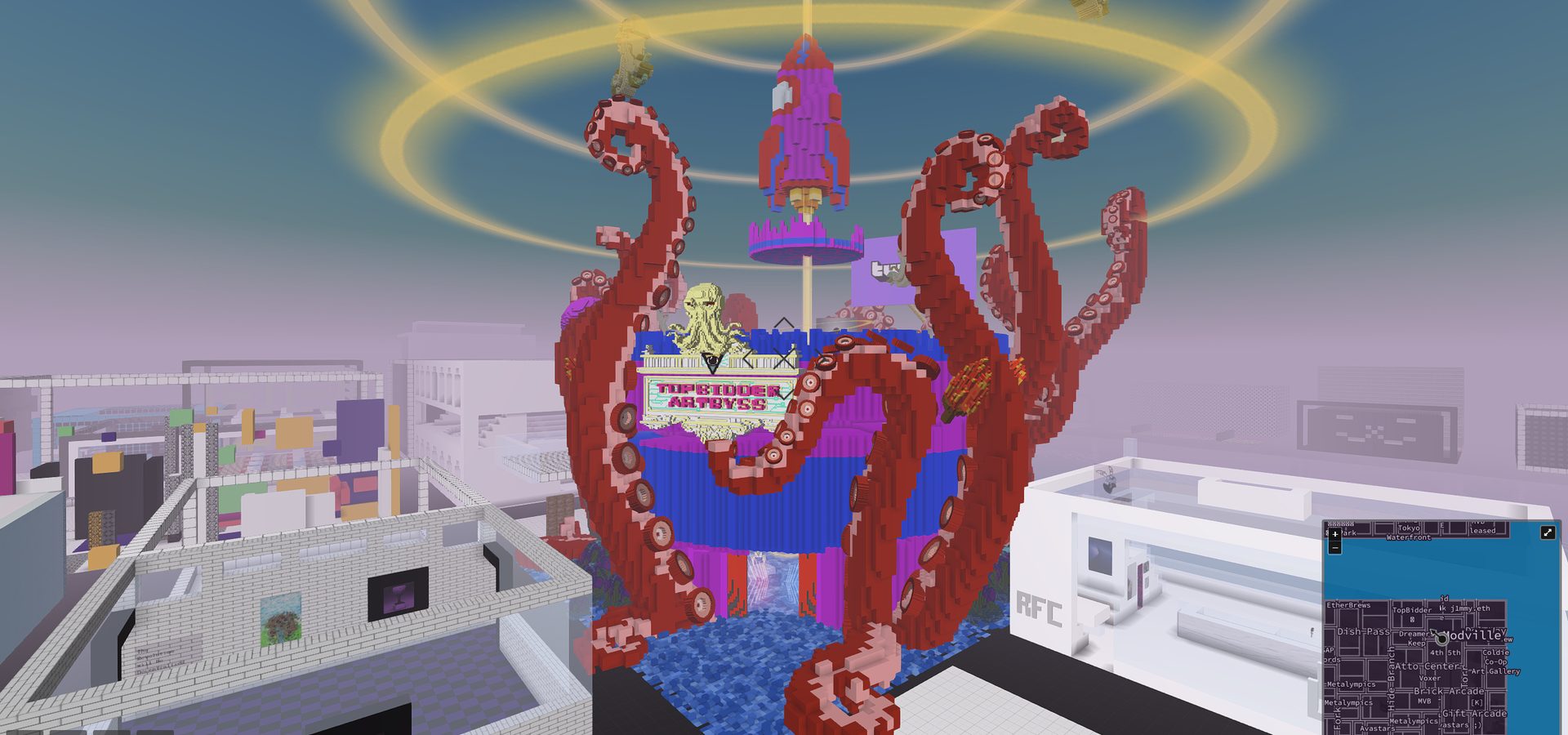
The metaverse display space of the TopBidder protocol — the name "Artbyss" (art abyss) hints at its spatial form: holdings are arranged along an abyss-like vertical structure, and visitors browse in a downward fall, the perpetual flow of ownership in radical markets translated into the perpetual descent of space. A complete demonstration of the trinity of protocol, platform and venue.
RECT.ART (2021 · Ethereum · platform art)
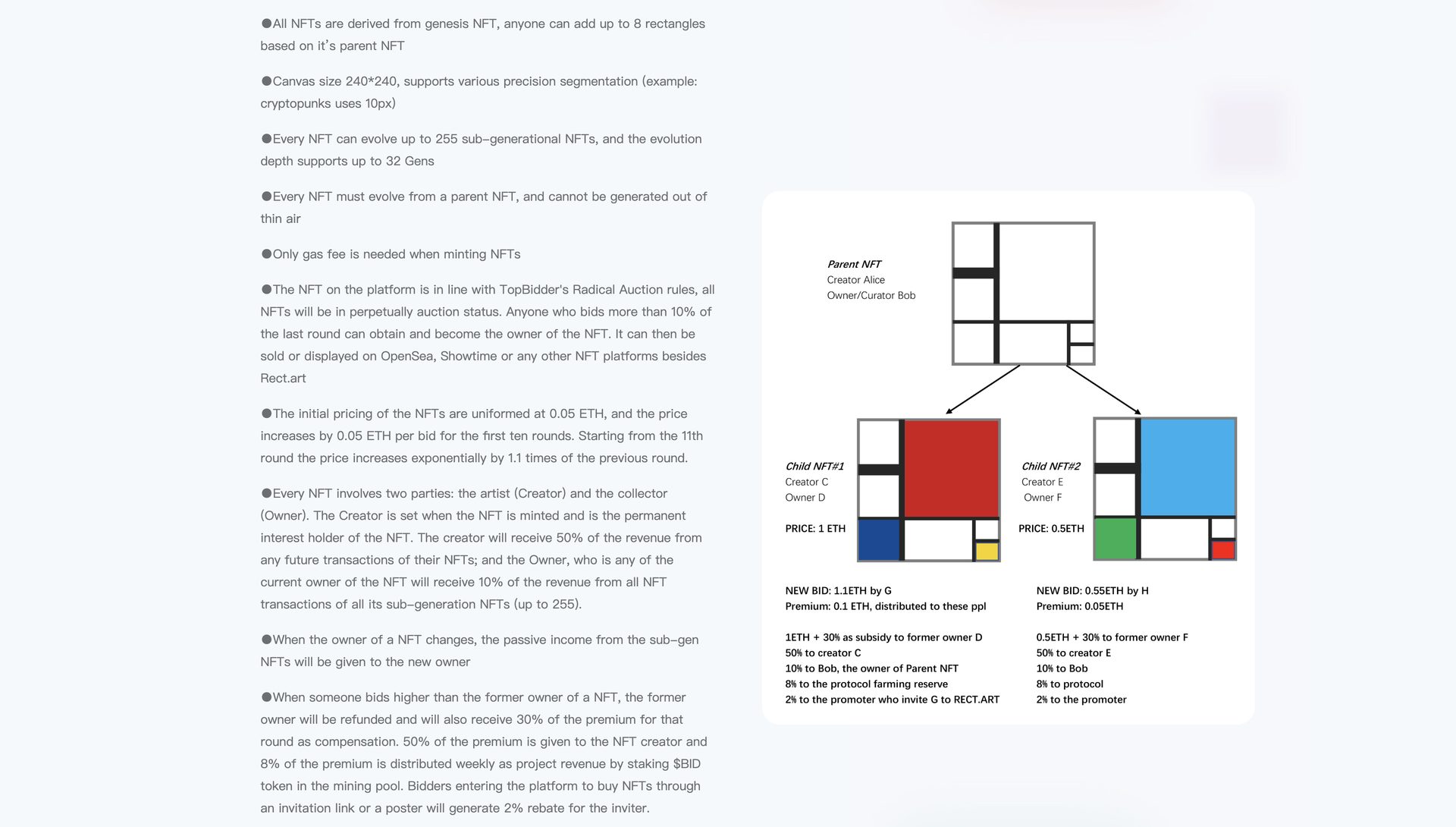
A multi-person collaborative, permissionless on-chain native NFT-creation platform, responding to the free-copyright movement and creative equality: creators paint with rectangular pixel blocks, any minted NFT can be freely called by others as material for secondary creation, and images multiply and evolve continuously on-chain. Here copyright is not a wall but soil.
100 Days (2022 · Ethereum · standalone contract)
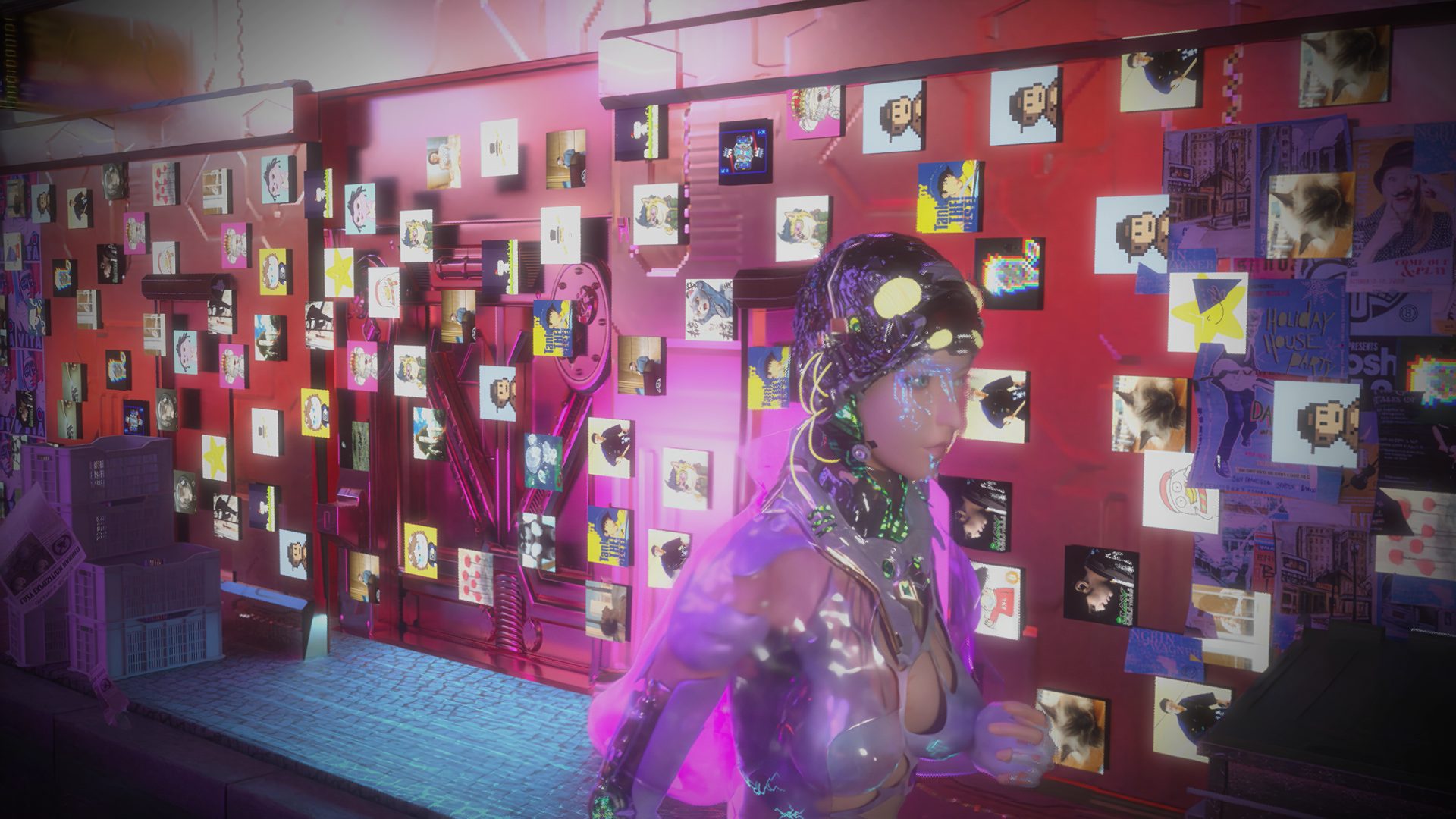
A hundred-day reverse Dutch auction with community credit as its subject: the price rises over time, and participants must judge "how many others, like me, still believe in this community." Trust is priced, traded and publicly tested. The work is the most complete rehearsal of ZRDAO's "collective participatory creation" methodology.
Archival note: every step of the price's counter-trend rise over a hundred days was an on-chain confirmation by participants that "the community is still here." What the work left at its close was not an image, but a hundred-day-long collective psychological curve — precisely the kind of work ZRDAO wants to keep producing: time art with community as its medium.
The Shub-Niggurath Series (2022 · AI art · oil painting/print)
The artist injected Bitcoin on-chain vocabulary into the prompt system of AI image generation, letting the Cthulhu-mythos "Black Goat of the Woods with a Thousand Young" be reborn in the algorithm — the decentralized network's centerless, self-replicating form of life is unexpectedly isomorphic with the image of an Old One. An early experiment fusing AI art with crypto vocabulary, and also a harbinger of the concept of "Silicon Art."
The Yog-Sothoth Series (2023 · AI art)
A sister series to Shub-Niggurath, continuing to treat the blockchain's temporality through the Cthulhu-mythos image of "the key to the gate" — Yog-Sothoth's premise of "existing in all times and spaces at once" is precisely the mythological mirror of a distributed ledger's "whole history present at once." The two series together form the twin stars of the artist's AI creative thread.
Soft Spoon (2026 · EVM public chain)
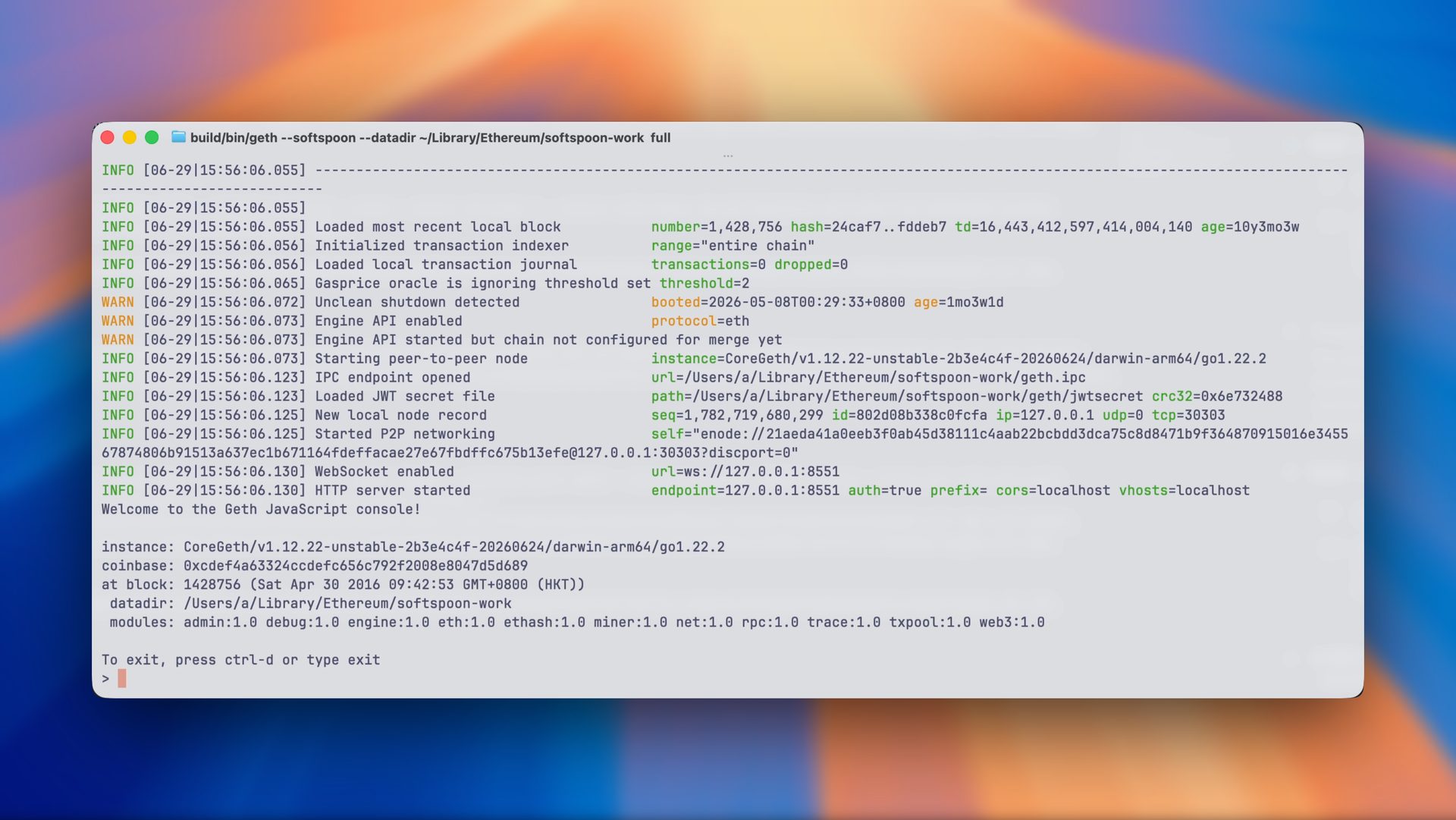
The latest experiment taking a public chain itself as creative material — when what an artist deploys is no longer a contract but a chain, the granularity of creation reaches the infrastructure layer. Together with Silicon Time, it forms a harbinger of creation in the ZRDAO era.
Solo Mining (2023 · Bitcoin · installation / satellite in orbit)
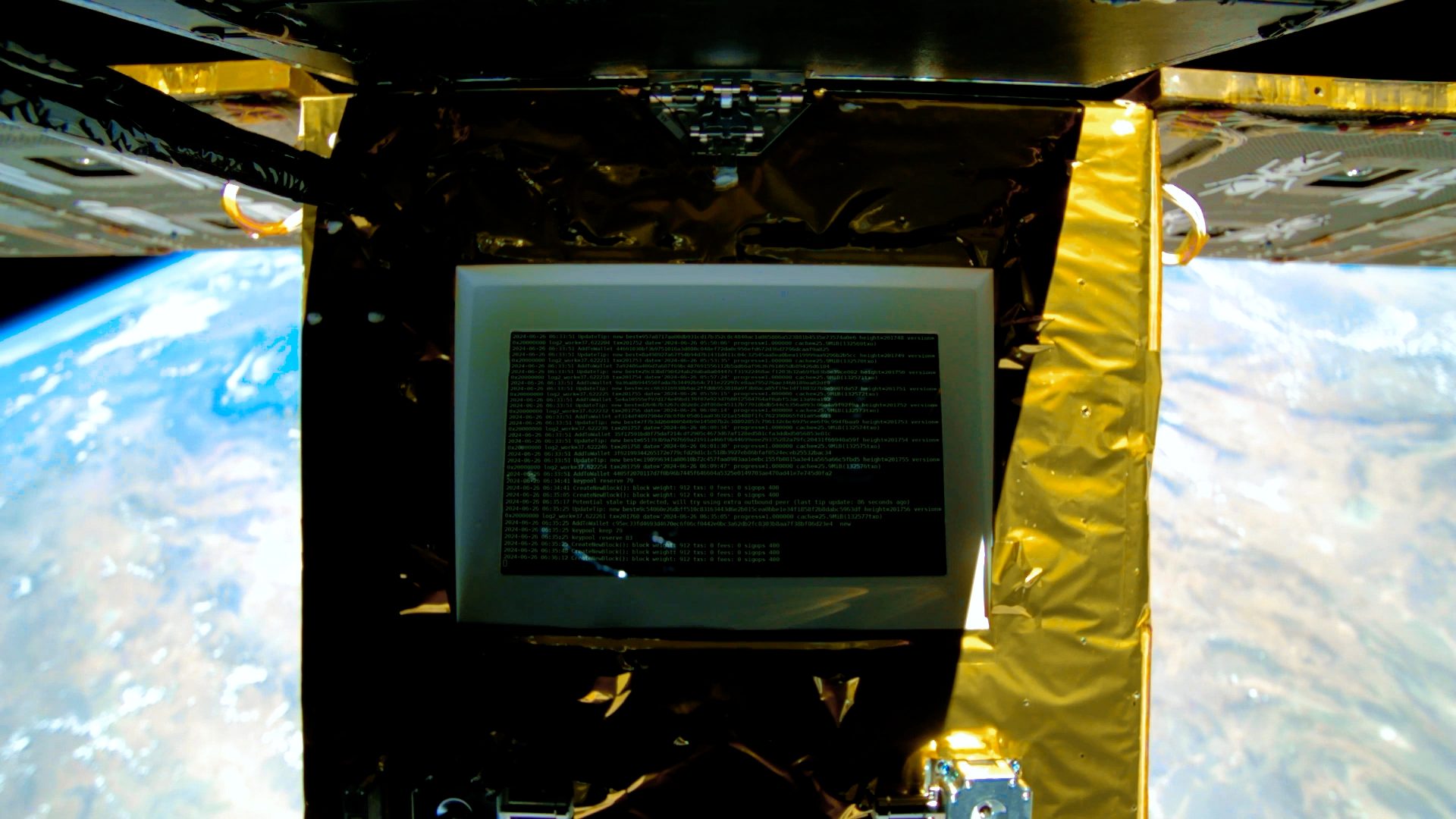
A lone miner participates alone in the Bitcoin network at a negligible hash rate — the probability of producing a block approaches zero, but participation itself is proof of faith. In 2024, the work was uploaded to China's first art satellite SCA-1 as part of the Xu Bing Art Satellite Creation Residency Program, becoming humanity's first crypto artwork running in space: in low Earth orbit, a piece of code continues its labor, almost impossible to succeed and therefore almost pure.
Solo Mining (2023 · Bitcoin · installation / satellite in orbit) (cont.)
Archival note: Solo Mining completed an extreme expansion of crypto art's display space: from wallet, gallery and metaverse to low Earth orbit. When the satellite passes overhead, the work runs more than three hundred kilometers above you — "decentralization" gains, for the first time, a literal sky dimension.
Early Image Inscriptions (2023 · Bitcoin · Ordinals)
At the dawn of the Ordinals protocol, the artist carved image inscriptions on Bitcoin satoshi ordinals, exploring the possibility of the oldest ledger carrying native art, and subsequently founded the inscription-trading platform Bidder.Art — creation and infrastructure advancing in step once again.
The Consensus (2024 · Bitcoin-themed · data art)
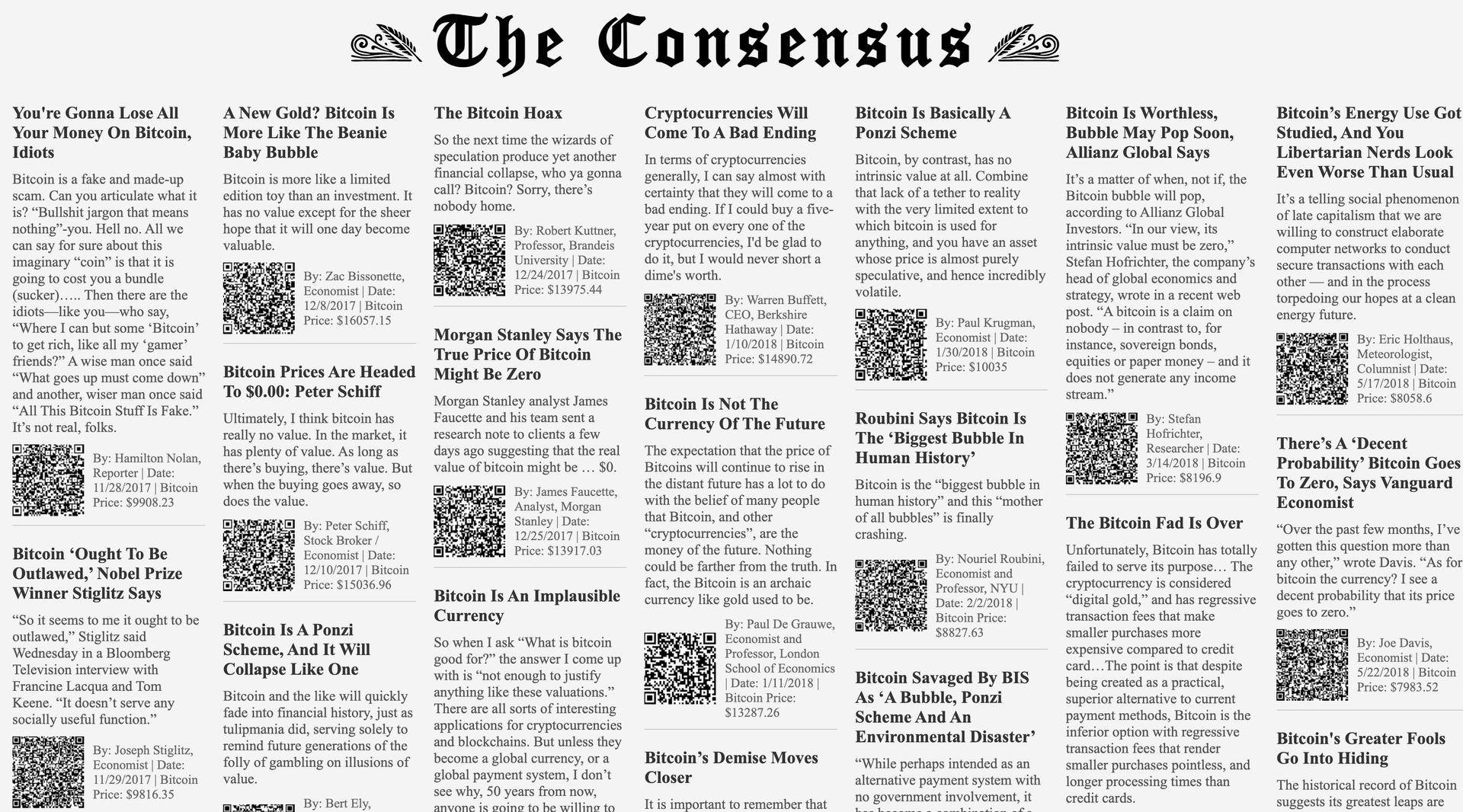
410 media commentaries, a 15-year span, a chronicle in the layout of The Times: each entry records the author, position, date and the Bitcoin price at the time. The artist poses a simple arithmetic problem — had one bought USD 100 of Bitcoin at each report's publication, one would today hold 1,043 coins worth more than USD 100 million. True consensus comes not from the keyboards of opinion leaders, but from everyone willing to take action. Collected by Uli Sigg in August 2025, exhibited the same month at Bitcoin Asia in Hong Kong; 4/10 of the fourth edition (Ethereum-exclusive) will be injected into the ZRDAO treasury.
The Consensus (2024 · Bitcoin-themed · data art) (cont.)
Archival note: Sigg's collection made The Consensus one of the crypto works to enter the ranks of top private collections; and the work's own method of "testing consensus with data" is precisely the artistic prototype of ZRDAO's governance philosophy — opinions go out of date, the ledger does not lie.
Add, Subtract, Multiply, Divide (ASMD, 2025 · Ethereum + live theatre)
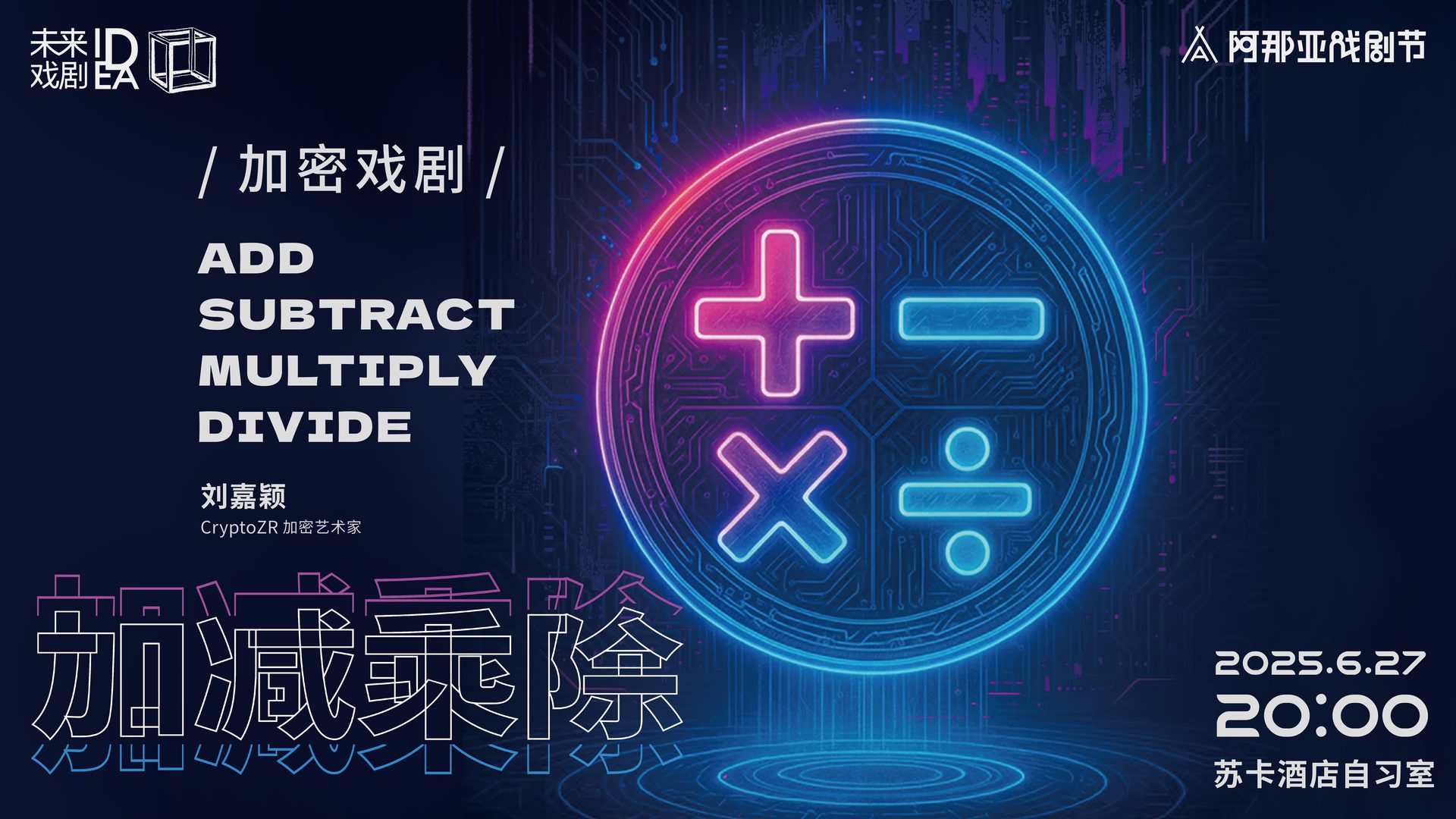
A commissioned work of the aranya Theatre Festival: the four operations — addition, subtraction, multiplication, division — were minted into four on-chain tokens, and the audience's live interaction changed token supply and the stage narrative in real time — every night's performance in the theatre is an irreproducible on-chain state transition. The first successful crossover of theatre and crypto art in art history.
Add, Subtract, Multiply, Divide (ASMD, 2025 · Ethereum + live theatre) (cont.)
Archival note: ASMD solved the problem of "liveness" for participatory crypto art — past on-chain participation was asynchronous and dispersed, but the theatre compressed hundreds of people's interaction into the same time and space. That night's on-chain data became the "full score" of the performance, and anyone can reread that night's collective rhythm on-chain.
The Painting and Image Series (2025 · oil painting + AI image)
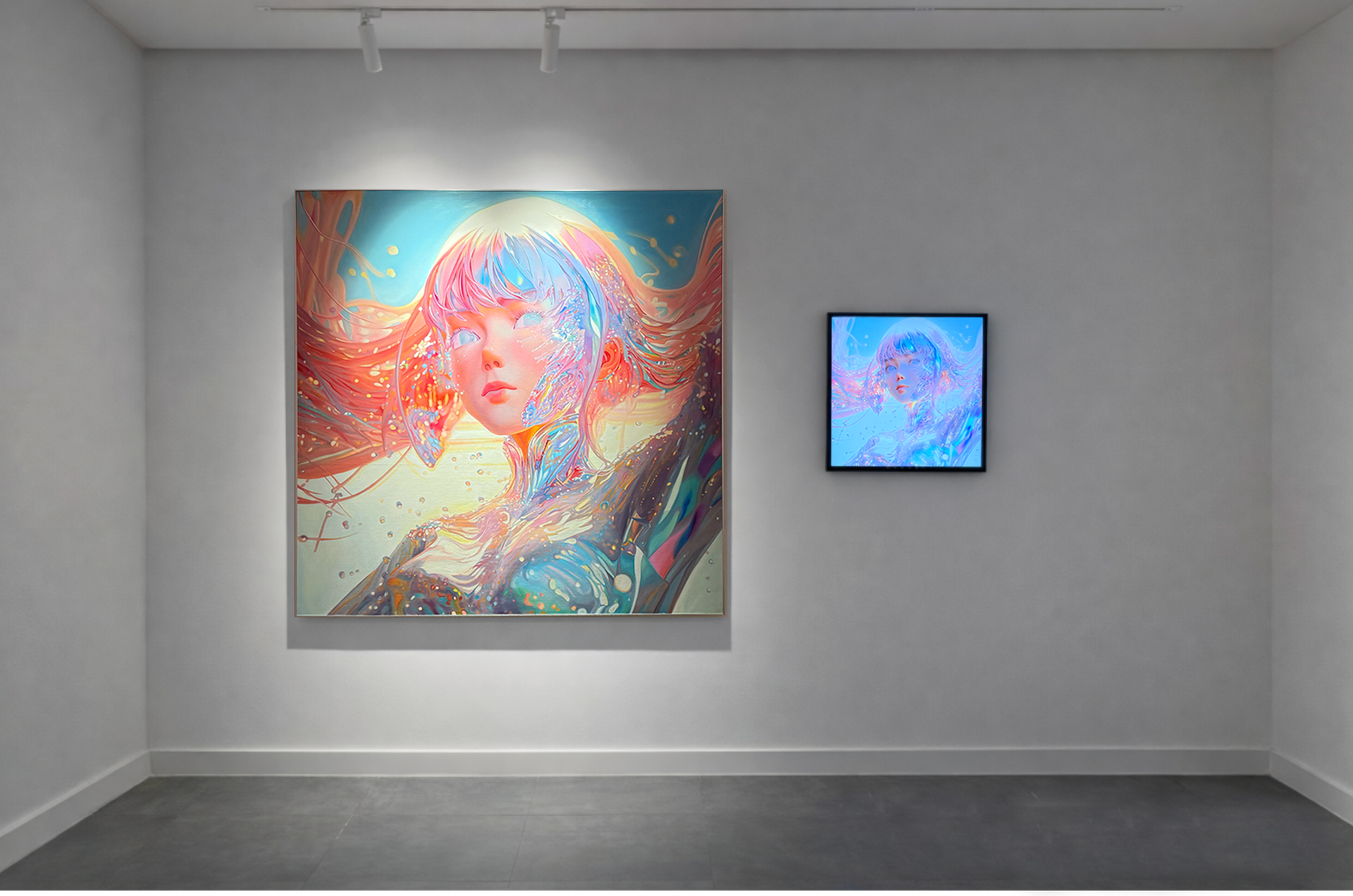
Oil painting juxtaposed with AI-generated images: when the breath of oil painting meets the precision of the algorithm, when the handmade trace collides with computational aesthetics, does the origin of art lie in the spiritual projection of the creative process, or in the pure presentation of the visual result? The series keeps a quiet room for the dialogue between "Silicon Art" and the carbon-based tradition.
Silicon Time (2026 · Bitcoin)
The latest creation taking the Bitcoin block height as its unit of time — in the silicon-based world, time is defined not by the Earth's rotation, but by a heartbeat of global consensus every ten minutes. The work will continue to unfold in the ZRDAO era.
Codenamed B404 (2026.9) and Codenamed Utopia (2036)
Two participatory works yet to be unveiled: the former will debut after ZRDAO's genesis issuance completes, the latter with a ten-year creative cycle, intertwined with the community's first decade. Their direction of meaning will be written by the ZRDAO community's own hand.
Catalogue Epilogue
From making tokens "appear out of nothing" in half a million wallets in 2017, to sending a miner into low Earth orbit in 2024; from modifying one line of a transfer rule, to letting the audience of a theatre rewrite on-chain state in real time — CryptoZR's nine years of creation constitute a miniature evolutionary history of crypto-art forms: ERC20 → NFT → DeFi → protocol → metaverse → inscription → AI → space.
This still-growing body of work, together with its extension over the coming sixteen years, is the underlying asset of the ZRDAO treasury and the earliest cultural gene of this self-governing community.
Catalogue Epilogue (cont.)
How to verify this catalogue with your own hands: every on-chain work recorded here can be independently verified — open the contract address on Etherscan to view its deployment time and transaction history (for example, the January 2018 deployment record of Out of Nothing 0x8377...c7b2); cross-check the work's literature and exhibition archive at cryptozr.net; and for inscription works, search the carving record with any Ordinals browser. Do not believe it because this document says so — go look on-chain. This sentence applies to every page of this whitepaper, and is Silicon Art's methodological gift to art-historical scholarship.
Appendix G · Data Room: Deriving the Key Numbers
Issuance and Injection Progress Master Table (one entry every 20 periods)
| Node | Approx. year | Cumulative public issuance (ZRT) | Share of total | New-work injection ratio |
|---|---|---|---|---|
| End of Period 0 | ~2026 | 200,000,000 | 9.5% | 10% |
| End of Period 20 | ~2027 | 380,000,000 | 18.1% | 14% |
| End of Period 40 | ~2029 | 560,000,000 | 26.7% | 18% |
| End of Period 60 | ~2031 | 740,000,000 | 35.2% | 22% |
| End of Period 80 | ~2032 | 920,000,000 | 43.8% | 26% |
| End of Period 100 | ~2034 | 1,100,000,000 | 52.4% | 30% |
| End of Period 120 | ~2035 | 1,280,000,000 | 61.0% | 34% |
Issuance and Injection Progress Master Table (one entry every 20 periods) (cont.)
| Node | Approx. year | Cumulative public issuance (ZRT) | Share of total | New-work injection ratio |
|---|---|---|---|---|
| End of Period 140 | ~2037 | 1,460,000,000 | 69.5% | 38% |
| End of Period 160 | ~2039 | 1,640,000,000 | 78.1% | 42% |
| End of Period 180 | ~2040 | 1,820,000,000 | 86.7% | 46% |
| End of Period 200 | ~2042 | 2,000,000,000 | 95.2% | 50% |
Note: cumulative issuance excludes the team allocation (100 million, fully vested over the first two years); approximate years are estimated at 30 days per period, with the actual figure governed by block height. The 20% governance-handover threshold (420 million) is reached around Period 25 — corroborating the "two years of multisig stewardship" time design.
Three Useful Mental-Arithmetic Formulas
My share of the period = my contribution ÷ total contribution of the period × tokens issued in the period. Unit price of the period = total ETH contributed in the period ÷ tokens issued in the period (denominator is 200 million for the genesis period, 9 million for regular periods). Current injection ratio = 10% + 0.2% × completed periods (capped at 50%).
Intuition for the Governance Numbers
- Submitting a proposal requires 21 million ZRT of voting power, roughly equal to the entire issuance of 2.3 regular periods; reaching the threshold alone is not easy, and coalition and delegation are the paths the system encourages.
- Making a proposal effective requires 84 million ZRT to vote — in the early days (say at Period 10) this is about 29% of issuance to date, meaning any vote before the governance handover requires broad mobilization; as issuance advances, the same absolute value's share gradually falls to 4%, so the difficulty curve of governance participation is naturally in sync with the maturity curve of the community.
- From proposal submission to the fastest possible execution takes 8 days (1+5+2) — for an organization managing art assets, this is an institutional cooling-off period "against impulse."
Three Scenario Calculations for the Genesis Period
Deriving the outcomes of the genesis period (200 million ZRT) under different scales of participation, to help participants build quantitative intuition:
| Scenario | Assumed genesis-period total | Genesis unit price | ZRT for 1 ETH | Note on genesis participation share |
|---|---|---|---|---|
| Cold start | 100 ETH | 0.0000005 ETH/ZRT | 2 million ZRT | Early members gain very deep governance weight |
| Steady | 1,000 ETH | 0.000005 ETH/ZRT | 200,000 ZRT | A single proposal threshold is worth about 10.5 ETH of period-equivalent contribution |
| Hot | 10,000 ETH | 0.00005 ETH/ZRT | 20,000 ZRT | A whale's concentrated contribution significantly raises its own cost |
Three Scenario Calculations for the Genesis Period (cont.)
Under all three scenarios the mechanism behaves identically: the quieter the participation, the thicker the early believers' share; the hotter the participation, the fuller the price discovery — neither outcome is bad for the organization, and this is precisely the self-adaptiveness of pro-rata distribution at both the cold and the hot ends. (The figures in the table are calculations to aid understanding and do not constitute a prediction of any scenario.)
Appendix E · Participation Guide: Five Steps from Zero
Step 1 · Prepare a wallet and ETH. Install any Ethereum wallet (MetaMask, OKX Wallet, Rabby, etc.), make sure the network is Ethereum Mainnet, and hold ETH for participation (minimum 0.001 ETH per contribution, plus a little for gas).
Step 2 · Take part in the current crowdsale. Via the Bidder.Club page, or by sending ETH directly to the crowdsale contract 0x0c862C4Aff0c87F3b4e93350Ecf2DD6ADA0C5400. The contract supports participation by direct transfer (automatically counted into the current period) as well as an advanced mode specifying the period and a price cap. Before participating, be sure to verify the contract address via Etherscan.
Step 3 · Claim after the period ends. After the current period ends (about 30 days each), call claim to receive the ZRT allotted by your contribution share; batch claiming of multiple periods at once is supported, and unclaimed shares are permanently valid and claimable at any time.
Appendix E · Participation Guide: Five Steps from Zero (cont.)
Step 4 · Activate voting power. Call delegate to delegate voting power to yourself (or a community member you trust). This step need only be done once, and thereafter balance changes update the voting weight automatically. Undelegated ZRT is not counted in the vote.
Step 5 · Take part in the community. Follow and start discussions on ZRDAO.org; reaching 21 million ZRT of voting power (including delegated) lets you submit on-chain proposals directly; any holding amount can vote on active proposals. Governance has no spectator seat — every vote is permanently recorded.
Security tip: the ZRDAO team and community members will never ask for your private key or seed phrase; all official contract addresses are governed by Appendix A of this whitepaper and Etherscan verification information; beware of imitation tokens and phishing sites.
Appendix E · Participation Guide: Five Steps from Zero (cont.)
Advanced: interact directly through Etherscan. All operations can be completed without depending on any front end — open the crowdsale contract's Etherscan page → Contract → Write Contract → connect your wallet: participate in the current period with buy() (enter the ETH amount in payableAmount); specify a period and price protection with buyInPeriod(period, period-total cap); claim after a period with claim(period) or claimAll(); activate voting power by entering your own address in the delegate field of Read/Write Contract. In Read Contract you can query at any time: currentPeriod() (current period), periodTotalETH(period) (total contributed this period), calculateReward(period, address) (your claimable amount), getVotes(address) (your current voting power). The front end will iterate, but the contract interface is unchanged for sixteen years — learn to read the contract directly, and you have the ability to participate without depending on anyone.
Common-mistake self-check: a transfer below 0.001 ETH will be rejected; a period's tokens cannot be claimed before the period ends; if you do not delegate after claiming, voting power is zero; transferring to the contract with too low a gas limit may fail (the wallet's default estimate is fine).
Appendix E · Participation Guide: Five Steps from Zero (cont.)
Seven rules of wallet security: (1) keep the seed phrase offline; any web page that asks you to enter a seed phrase is phishing; (2) use a hardware wallet for large holdings, and a small hot wallet with delegation for governance; (3) read the true contents of the wallet pop-up before signing, wary of an approval signature disguised as a "login"; (4) periodically check and revoke idle approvals with an approval-management tool; (5) bookmark official addresses and do not click search-engine ad slots; (6) keep a reflexive suspicion of the three words "customer service," "airdrop compensation" and "contract upgrade"; (7) test the whole process with a small amount before a large operation. In a world of self-custody, you are your own bank — and your own security guard.
Appendix F · Risk Disclosure
Any honest whitepaper should contain this chapter. Before participating in ZRDAO, please confirm that you understand and accept the following risks:
Market risk. The price of ZRT is formed by the genuine contributions of each period's participants and may fluctuate sharply; the cyclicality of the crypto-asset market as a whole far exceeds that of traditional assets. Invest only funds whose complete loss you can bear.
Smart-contract risk. Although all contracts are built on the audited OpenZeppelin standard library, rehearsed through the full process on a testnet and open-source verified on mainnet, the risk of a smart-contract bug can never be reduced to zero. Once on-chain assets are lost to a bug, it is usually irreversible.
Governance risk. On-chain governance has inherent challenges such as insufficient turnout, whale influence and uneven proposal quality. ZRDAO's mechanism design (snapshot voting, fixed quorum, timelock, late-quorum extension) mitigates but cannot eradicate these issues.
Appendix F · Risk Disclosure (cont.)
Long-cycle execution risk. Over a 16.5-year project cycle, team changes, technical evolution and regulatory change may all affect the pace of roadmap execution. The contract-level commitments (issuance rules, injection formula, vesting mechanism) are guaranteed by code, but off-chain commitments such as community building and event organization depend on continued operational investment.
Art-market risk. The value of art assets depends heavily on the formation and continuation of cultural consensus, and as a young category crypto art's value system is still being established. The valuation of treasury holdings may fluctuate over the long term.
Regulatory risk. Different jurisdictions' regulatory frameworks for crypto assets, DAOs and token issuance are still evolving. Participants are responsible for understanding and complying with the laws of their location; ZRDAO's mechanism design constitutes no promise of compliance in any jurisdiction.
Appendix F · Risk Disclosure (cont.)
What ZRT is not: ZRT does not represent any company's equity, debt or claim to profit distribution; it promises no return of any kind; it is the governance certificate and benefit certificate of an art self-governance community. Please participate on the basis of identification with the art and the community, not out of expectation about price.
Appendix H · From Whitepaper to OpenSlide: A Structural Mapping
In its writing structure, this whitepaper reserves a mapping for slide production: the Executive Summary → the opening three pages; the bold argument of each chapter's first paragraph → the lead line of a chapter title page; all tables → converted directly into data pages; mermaid flowcharts (the governance flow, the state machine, the architecture diagram, the asset flow) → full-screen diagram pages; the catalogue raisonné (Appendix D) → a sequence of image-and-text pages with the work images in whitepaper_images/ as the main visuals; the FAQ and Appendix E → the interactive Q&A and call-to-action pages at the end of the presentation. Once the OpenSlide version is deployed, it will be updated from the same source as this Markdown document — the document is the single source of truth for the slides.
Appendix I · Official Information Channels
| Channel | Address | Note |
|---|---|---|
| On-chain contracts | See Appendix A | The only binding source of information |
| Artist's official site | cryptozr.net | Archive of works, exhibitions and press |
| Issuance platform | Bidder.Club | Crowdsale participation and work sales |
| Community agora | ZRDAO.org (in preparation) | Proposal discussion and ZIP archive |
| Online museum | CHIJIN Art Museum (under construction) | Display of treasury holdings |
Anti-counterfeit principle: if information published on any channel conflicts with the on-chain contract behavior, the on-chain behavior prevails; any "official" channel that leads you to disclose a private key or transfer to an unverified address is a counterfeit.
Appendix I · Official Information Channels (cont.)
ZRDAO Whitepaper v1.0 | July 2026 This whitepaper is a document explaining the project's mechanisms and does not constitute investment advice or an offer of securities in any jurisdiction. On-chain data prevails over all written statements — always take the actual behavior of the verified contracts as authoritative.